Washington Report on Middle East Affairs, December 1997, Pages 76-77
Human Rights
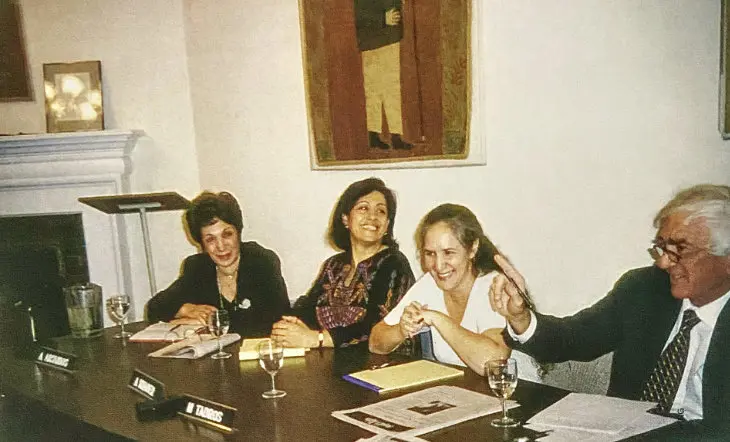
THE MIDDLE EAST Institute and Sisterhood is Global Institute co-sponsored a panel discussion on Arab women’s human rights in Washington, DC, on Sept. 30. Women from three Arab countries who presented their perspectives were: Asma Khader, coordinator of Sisterhood is Global Institute’s human rights education program in Amman, Jordan; Marlyn Tadros, managing editor of People’s Rights and Women’s Issues, and deputy director of Legal Research and Resource Center for Human Rights in Egypt; and Afifa Dirani Arsanios, public information officer in the U.N. Development Program in Beirut, Lebanon.
The Middle East has faced suffering from many wars and occupations and has had little time for dealing with human rights issues, Asma Khader began. “Because human rights issues are often considered Western values, many women reject them,” she said. “But freedom, justice and human dignity have always been valued in our religious history. Human rights belong to us all, not just to Westerners.”
Khader stressed the importance of women exercising their citizenship duties to vote and participate in political activities. Sisterhood is Global teaches women at the grassroots level about their human rights, such as the right not to be beaten.
“Their daily problems are human rights and they have the right to change [their lives],” Khader said. “We’ve spent decades working with the elite. Educated women already know their rights and prefer to find their own solutions for themselves—usually through their jobs.” But they don’t necessarily help their poor sisters attain their rights.
Marlyn Tadros described the four obstacles women’s groups face in Egypt. The first is the government, which withholds licenses to work if it doesn’t agree with the group. There are 17 human rights groups in Egypt now, all working illegally.
The second obstacle is that the groups have difficulty getting along among themselves, Tadros said. She agreed with Khader that the greatest obstacle is that human rights are often called a Western issue.
“We always try to convince women it’s a universal concept,” Tadros said. “We always say we’re not pro- or anti-American because every time the U.S. works for Israel—vetoing important issues, approving settlements—this ends up discrediting our group.”
The last obstacle, fundamentalism, is the least of the problems, Tadros said, because “we can deal with fundamentalist concepts through debate.”
Women’s rights in Lebanon are a little complicated, Afifa Dirani Arsanios explained. Political power varies according to religious persuasion, and the laws are different for each religious sect. “After 17 years of war we are reconstructing the physical stones and we’re less worried about human rights and social problems.”
Arsanios reminded her audience that Lebanon is still an occupied country—the war continues in southern Lebanon—and thousands of refugees go back and forth. The human rights of a displaced southern Lebanese woman denied education, housing, health care and safety are quite different from the human rights problems encountered by “settled” upper- and middle-class Lebanese women. Arsanios declared that it is the responsibility of the settled woman to look after the victim.
From the perspective of a Muslim married to a Christian, Arsanios remarked that “fundamentalism, Christian and Muslim, flourished during the war. Even now our youths are not exposed to each other. Our educational system plays into this—each religion teaches a different history.”
Arsanios believes that human rights for women are not contradictory to local culture and religion. “Islam gave fantastic rights to women 1,400 years ago,” Arsanios said.
Middle Eastern women attending Sisterhood is Global workshops [based on Claiming Our Rights: A Women’s Human Rights Education Manual—see the October issue of WRMEA, p. 65] are very happy to learn that religion backs them,” Arsanios said. “We just attack cultural attitudes toward women [for example, that women belong to their fathers and then their husbands] and create awareness. We don’t attack religions.”
Each speaker ended with the message that women must establish themselves as citizens and be active—not just in social concerns, charity work, family life, and the kitchen, but in politics. They also urged that women’s groups show worldwide solidarity. Each Arab country is worried about its external image abroad, the speakers agreed. Therefore, if an international spotlight is focused on human rights, the rights of women will improve in all such countries.
—Delinda Hanley