Washington Report on Middle East Affairs, November/December 2026, pp. 68-69
Talking Türkiye
By Jonathan Gorvett
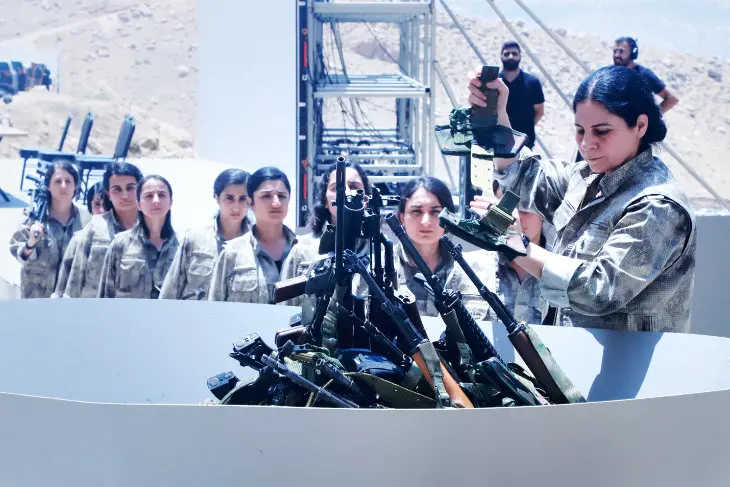
A YEAR AND A HALF after the leader of Türkiye’s separatist Kurdish Workers’ Party (PKK), Abdullah Ocalan, called on his outlawed organization to lay down its arms, a final end to the four-decade-long conflict may now be in sight.
In August, the Turkish parliament passed a new law outlining a path for most PKK fighters to rejoin civilian life, while the organization’s leaders head into exile. A series of committees has also been set up to examine the practical details, including weapons decommissioning, social integration, legal issues and on-the-ground monitoring.
Yet a wide range of obstacles still lie in the path of a genuine resolution to the conflict, which began in 1984 and has cost the lives of more than 40,000 people.
The very label of the process itself is a matter of debate.
“Nobody can agree on what to call it,” Arzu Yilmaz, an independent expert on Middle Eastern and Kurdish politics and Turkish foreign policy, told the Washington Report.
While the Turkish government calls it the “Terror-Free Türkiye” process, the main Turkish Kurdish party, the Peoples’ Equality and Democracy Party (DEM), calls it the “Peace and Democratic Society Process.”
However, with sweeping recent crackdowns on everyone from the main opposition party to the country’s LGBTI+ community, a “democratic society” seems far from where Türkiye now stands.
Since March 2025, some 35 mayors of opposition-controlled municipalities have been detained, including the mayors of the three largest cities: Istanbul, Ankara and Izmir.
Among them is Istanbul mayor Ekrem Imamoğlu, who was widely seen as likely to defeat the incumbent president, Recep Tayyip Erdoğan, in any future election.
At the same time, key Kurdish political leaders, such as Selahattin Demirtaş, the former DEM co-leader, remain in prison—as does Ocalan himself.
In recent times, artists, singers, journalists, writers and even a popular comedian have been detained. The revelation of a massive Ponzi scheme on the Istanbul stock exchange in late September was followed by a ban on its reporting, even by economists.
Yet the largest recent crackdown came on Sept. 12, with the wave of detentions widening to include organizers of civil society groups advocating for LGBTI+ rights. “At least 117 people were detained, 44 of whom were directly connected to LGBTI+ associations or were LGBTI+ activists,” Burcu Bingöllü, program director at human rights group Hafiza Merkezi, told the Washington Report. They were arrested in an operation entitled “My Family Is Safe” and publicly linked to investigations into alleged crimes such as obscenity, prostitution and child exploitation.
While Erdogan’s conservative government has always been hostile to LGBTI+ rights, “We are now seeing how the discourse around family, gender and ‘public morality’—built over a long period of time—is turning into concrete administrative and criminal measures,” says Bingöllü.
In such circumstances, some may wonder where the project of either “peace” or a “democratic society” is currently heading.
“The government is taking extremely serious steps that are undermining democracy during the process,” DEM Co-Chair Tülay Hatimoğulları told her party’s Erzurum provincial congress on Sept. 27.
FEW CHOICES
Yet current developments also come at a time of major shifts in the wider region.
“The Middle East is preparing for a post-U.S. era,” says Yilmaz. In this era, a major recalibration by Kurdish organizations in Türkiye, Syria and Iraq has been underway.
The PKK has largely been defeated militarily, while the mostly Kurdish Syrian Democratic Forces (SDF) in Syria has been obliged to try and integrate with the new Syrian state. The final U.S. withdrawal from Iraq on Sept. 30 also meant the withdrawal of some long-standing security arrangements for Kurds there. Meanwhile, the Iranian Kurds have been battered by Tehran since the recent U.S.–Israeli war with Iran began.
“For the Kurds, this is a time for survival, not development,” adds Yilmaz. “The reality on the ground is extremely uncertain and risky.”
Under such circumstances, while the process being offered by Ankara may be far from ideal, Türkiye’s Kurdish organizations may feel they have little choice but to accept it.
“Struggling for democracy doesn’t really resonate anywhere right now,” says Yilmaz.
It may, however, still resonate in Türkiye’s urban centers, which continue to be the main target of the crackdowns.
“Erdogan’s Justice and Development Party (AKP) has been unable to regain popular support in the cities,” says Dr. Mehmet Sinan Birdal from the Department of Political and Social Sciences at Free University Berlin. “So the only tool left to them is repression, right down to the local, district municipality. But this is not sustainable.”
Whether the Kurdish peace process is sustainable also remains to be seen. The committees set up to carry the process forward have been given no timetable, and no PKK fighters are so far known to have returned home.
“I don’t expect the process to collapse,” says Yilmaz, “but given all these factors, it’s under a greater threat now than ever.”
Jonathan Gorvett is a free-lance writer specializing on European and Middle Eastern affairs.