






Washington Report on Middle East Affairs, November/December 2026, p. 78
Muslim American Activism
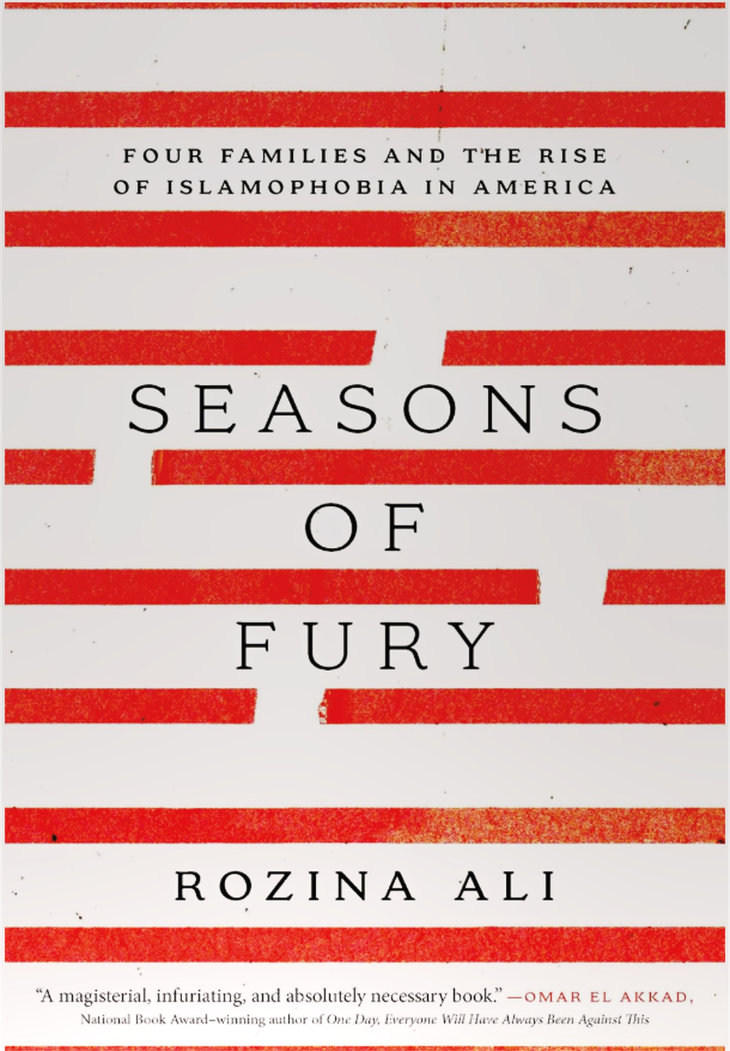
JOURNALIST ROZINA ALI discussed her must-read book, Seasons of Fury, during an October 13 webinar with Annelle Sheline, a research fellow at the Quincy Institute for Responsible Statecraft. After introducing Ali, a New York Times Magazine writer who focuses on conflict, U.S. foreign policy and immigration, Sheline said just what this reader thought as my highlighter flew across page after page of Ali’s compelling book: “I’ve been waiting for a book like this.” (I’ll admit I also found myself obsessively flipping to her index to see if she used the Washington Report on Middle East Affairs as a source. I was not disappointed.)
For nearly 45 years, this magazine documented the context, victims and instigators of Islamophobia in the United States as well as the leaders and organizations that fought back. Ali deftly weaves together these stories and more in Seasons of Fury as she chronicles the explosion of anti-Muslim bigotry that started decades before the attacks on 9/11. Ali details the environment and players as the U.S. government launched anti-Muslim policies and the public’s lack of resistance to these authoritarian decrees. She points out it wasn’t just rhetoric by national politicians but local communities in both red and blue states that pushed through anti-mosque activities and astounding anti-Shari’a legislation.
Ali told webinar listeners that she wrote the book because she was confounded by the level of anti-Muslim bigotry she saw a decade and a half after 9/11, while immediately after the attacks there had been such an effort to understand Islam and Muslims. (President George W. Bush met with Muslim American leaders at the Islamic Center of Washington, DC, six days after the attacks to promote religious tolerance.) Ali launched her investigation to find out what happened and explain why it is still going on today—especially during election seasons.
She initially planned to start the book at Sept. 11, 2001, but she quickly discovered that government policies and the rhetoric against Muslims had already been in place for decades. Arabs were already depicted as terrorists and a national security threat in the media and movies. After the 1967 Arab-Israeli War, the U.S. government became very interested in looking at threats to both U.S. and Israeli interests. After the 1991 fall of the Soviet Union, Islamic terrorism became the primary U.S. enemy. By the end of the 1990s, a mass surveillance program ironically called “Vulgar Betrayal” targeted immigrants, Muslims (Arab, South Asian or Black) and U.S. citizens of Arab origin. The FBI was surveilling mosques, bookstores, conferences, student groups and organizations.
Sheline asked Ali to unpack the terms Islamophobia and anti-Muslim bigotry. She said a phobia is an irrational fear that is hard to change while bigotry is a deliberate targeting of a minority and that perspective can shift. In the 1970s, the U.S. government understood that terrorism could be a result of frustration caused by unresolved political grievances. Americans were beginning to support the Palestinian cause. That understanding began to change in 1979, thanks to the Jonathan Institute, a think tank founded by an ambitious young Israeli named Binyamin Netanyahu, which hosted international conferences on terrorism. They worked to globalize the Arab-Israeli conflict and frame terrorism as a threat to Western civilization. Terrorists do terrorism because they are evil, and they abhor freedom and the democratic way of life, according to Netanyahu. That shift in understanding has stuck. No one is required to address grievances if terrorists are just merely interested in irrational violence.
In 2002, the Bush administration required 80,000 noncitizen men and boys from Muslim-majority countries to register with the government—10,000 were deported. While that program—never having produced a terrorism-related conviction—ended, trampling on the civil liberties of Muslims is the price this country continues to pay as hundreds of people are deported, jailed, punished or silenced.
Ali uses the powerful true stories of four families across eight decades to capture the uncertainty and fear of the pre- and post-9/11 American Muslim experience. Attorney Abdeen Jabara exposed the Nixon administration’s mid-1970s “Operation Boulder” surveillance program against him and other Arab Americans and forced the FBI to destroy their records on him because his actions were protected by the First Amendment. Mohammad Ali Chaudry fought tirelessly with a local township to build a New Jersey mosque. For decades a mother, Shahina Siraj, called for justice for her intellectually challenged son, who was entrapped by the FBI and convicted for a terror plot he never agreed to carry out. Then there is the Omar family, who is terrorized and forever scarred by a racist neighbor they call “Mr. Happy” to try to tamp down their constant fear. Ali’s focus on these individuals’ experiences makes her book a page turner.
The notion of Muslims being a threat to national security and our way of life continues because the war on terror never ended, Ali told listeners. We’re never at peace and the war keeps expanding against radicals and immigrants. Even today, candidates and leaders still make political hay by promoting bigotry against minorities and their political adversaries. Reading Seasons of Fury will help us understand Islamophobia and figure out ways to end the growing bigotry that is dividing our country.
—Delinda C. Hanley