Washington Report on Middle East Affairs, June/July 2026, pp. 85-86
Muslim American Activism
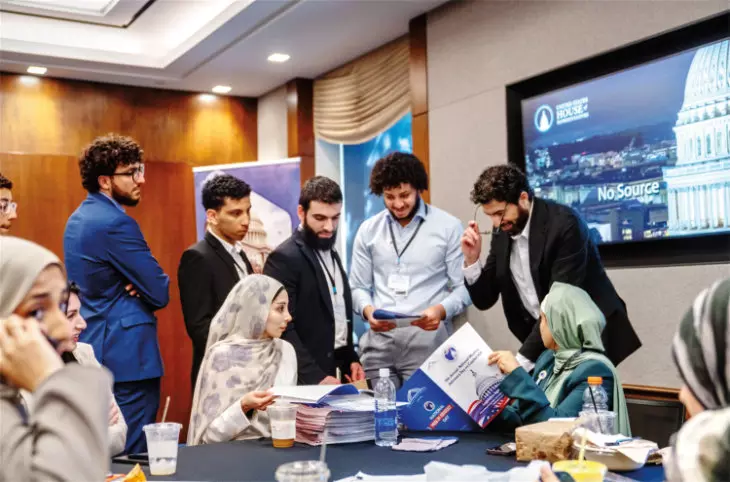
ON APRIL 20-21, more than 200 members of Young Muslims (YM), ranging from high school students to young adults up to age 25, attended the U.S. Council of Muslim Organizations’ 11th Annual National Muslim Advocacy Day (MAD) on Capitol Hill. Overall, more than 1,000 Muslim delegates from 33 states gathered in Washington, DC for two days of coordinated lobbying. The YM delegation was the largest contingent at the event, which has grown into the premier gathering for Muslim civic engagement at the federal level.
Young Muslims, founded in the early 1990s, has never approached volunteer work or advocacy as a one-day photo opportunity. The organization has built its identity around a continuous tradition of civic engagement: mobilizing after 9/11 to combat rising Islamophobia, organizing against the Iraq war and supporting Gaza encampments at universities, as just some examples. This year’s delegation was not a departure from that tradition, but another chapter in its ongoing work.
In an era when global crises compete for attention and political exhaustion runs high, youth apathy remains a real and persistent obstacle. Young Muslims has responded with a grassroots model it calls NeighborNet, a national structure of 200 local chapters, each functioning as a hyperlocal network of close-knit friend groups that develop real relationships with Muslims from all walks of life. The chapters meet, eat and organize week to week. When it is time for MAD, those personal relationships convert into mobilization capacity. YM brings people to Capitol Hill who otherwise might never be exposed to lobbying, simply because someone from their own friend group asked them to come.
Before the advocacy days, many state delegations had already scheduled meetings with members of Congress or senior staff. Others conducted drop-ins. Their asks included opposing discriminatory legislation and rhetoric, resisting any return of problematic policies such as a Muslim ban, defending free speech and immigrant due process, supporting protections for immigrant communities, ending endless wars and reasserting congressional war powers.
What stood out to several organizers was not only the number of meetings, but the preparation behind them. In past cycles, Muslim advocacy groups often arrived on the Hill with the same pitch for every office, regardless of a member’s committee assignments, constituent profile or known political leanings. This time, YM tried a different approach. Members prepared briefings in advance, studied the offices they were visiting and adjusted their framing depending on who was across the table. In some meetings, they spoke directly about Islamophobia and how foreign policy rhetoric can translate into domestic hostility toward Muslim communities. In others, they emphasized civil liberties, constitutional rights, government overreach and a more restrained foreign policy.
“Even in meetings with some of the most pro-MAGA offices in Georgia, there was room for a serious conversation,” said Sameer Mahmood of Georgia. “When we raised concerns about foreign policy accountability and the conduct of the Iran war, the legislative director acknowledged that President Donald Trump and many Republicans had campaigned on ending wars, not starting new ones. That kind of openness was not what many of us expected.”
For YM, the presence of more than 200 youth mattered beyond the headcount. It represented a generation learning that American Muslim civic power cannot be improvised every election year or summoned only in moments of crisis. It has to be organized locally, trained intentionally and brought into public institutions with discipline.
The work did not end when the flights and buses left Washington. Organizers say follow-ups will continue through district office meetings, town halls, voter education, issue awareness campaigns and local accountability efforts. Alumni of YM’s organizing networks are also increasingly entering public life themselves, including as candidates in races in New York City, New Jersey and Chicago. It begins in neighborhoods, weekly circles and local relationships that can be converted into civic power.
“We are not waiting until the next MAD in April to stay engaged,” said Ammar Siddiqui of Illinois, speaking on behalf of YM leadership. “Over the coming months, our teams will continue district office follow-ups, local accountability work and participation in AJP’s Palestine Advocacy Day. This has to become a year-round civic discipline.”
—Young Muslims Leadership