















Washington Report on Middle East Affairs, November/December 2026, pp. 74-76
Waging Peace
THE CROWD AT the Palestine House of Freedom on Aug. 29 grew quiet as a video about Palestinian cartoonist Naji al-Ali began to play, showing scenes from his life and the political drawings that made him one of the most influential artists in the Arab world. Many in the room said they came because al-Ali’s work still feels urgent in a time marked by violence, displacement and political unrest across Palestinian communities.
The center, located on Capitol Hill, played the video as part of a broader event marking 39 years since al-Ali’s 1987 assassination in London, which remains unsolved. Organizers said the anniversary comes at a time when Palestinians are again searching for ways to express loss, anger and resistance.
The video featured interviews and reflections from artists, and described how al-Ali’s cartoons challenged Arab governments, Palestinian leaders and Israeli occupation forces alike. His drawings, often sharp and direct, made him a target. “He criticized all of these Arab regimes at that time...even the Palestinian leaders,” said Khaled Faqeeh, a Palestinian justice advocate. “He became very important and very influential.”
“He was talking about the Palestinian prisoners...corruption...the silence of the Arab regimes,” Faqeeh said in the video. “That’s why most of [his] cartoons are still relevant now.” The footage argued that al-Ali focused on themes rather than single events, making his work adaptable to new crises. “You can use it right now,” Faqeeh said, “when you are talking about Gaza...about the settlers...about the Palestinian Authority.”
The video also featured Palestinian cartoonist Mohammad Sabaaneh, who spoke about growing up in Kuwait and learning about Palestine through al-Ali’s drawings. “My mother used his cartoons to tell us about Palestine,” he said. He said al-Ali’s work helped shape political awareness for an entire generation of Palestinians living outside their homeland.
Sabaaneh also described his own imprisonment and how he tried to draw inside Israeli detention. “The only thing that I did...was [al-Ali’s famous] Handala inside the prison,” he said. “And I was punished by the jailer because...you cannot draw.” He said he later created illustrations for imprisoned Palestinian writer Walid Daqqa after Israeli authorities confiscated Daqqa’s original drawings.
The video showed how Palestinian prisoners use art to communicate with families and maintain a sense of identity. “You could find many, many Palestinian prisoners who...use the visual language just to spend their time and to convey their messages,” Sabaaneh said. The audience remained silent during these scenes, with several people wiping their eyes.
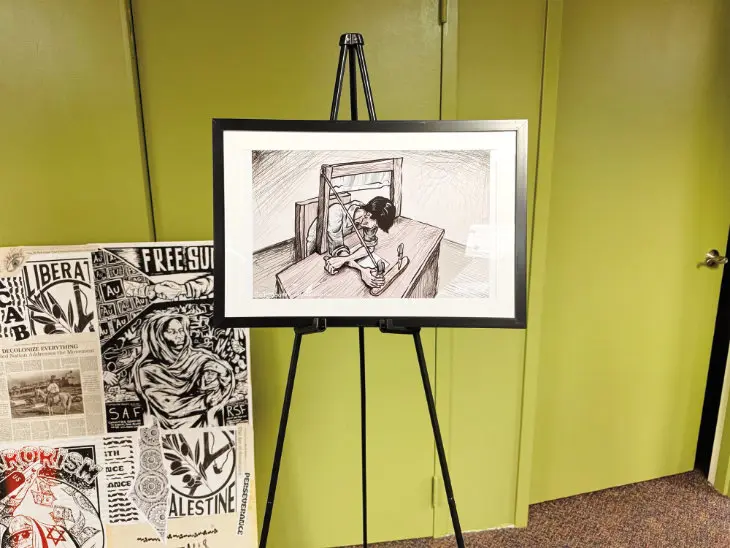
The event drew many attendees, including activists, artists and community members. The Palestine House of Freedom displayed prints, hosted vendors and invited people to explore political cartoons by al-Ali and Sabaaneh.
Several attendees who did not want to be identified said they came because they wanted to understand why al-Ali’s work still resonates decades after his death. One speaker in the video said Handala, the barefoot child al-Ali created, “became an icon...and represents all the Palestinian people.” The character has appeared in protests, murals and social media posts for decades.
The video also addressed how al-Ali’s work differed from other cartoonists of his generation. Faqeeh said his political clarity set him apart. “His political statements, his opinions, his criticism...that was very important,” he said. Sabaaneh said al-Ali focused on topics rather than isolated events, making his cartoons durable. “He wasn’t talking about just a specific topic during his journey,” he said.
For many in the room, the video offered a reminder of how one artist’s work continues to shape political expression nearly four decades after his death. The gathering, they said, felt less like a memorial and more like a call to pay attention to the present moment.
—Brittany McAlister















