















Washington Report on Middle East Affairs, November/December 2026, p. 79
Book Talks
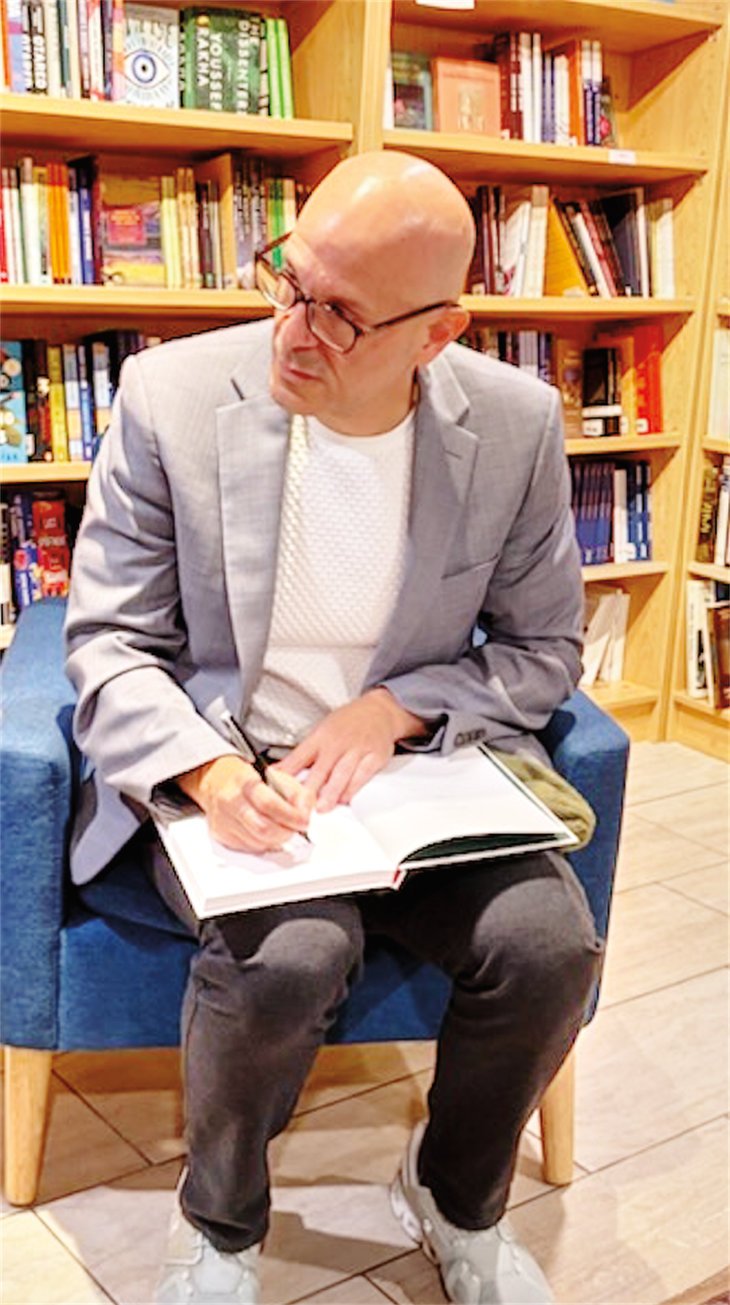
ON OCTOBER 6, poet and National Book Award finalist Fady Joudah spoke about his newest book Exhibit G: Poems, Essays and Photographs of Gaza at Middle East Books and More in Washington, DC.
Exhibit G is a collection of poetry, prose and photos taken in Gaza during the current genocide. Many of the images come from photographers with the organization Gaza Soup Kitchen, while others come from an art exhibit called “Gaza Habibti,” which means “Gaza My Love.” While the photographs do not match the poems, the blend of image and text “allow[s] feelings and thought to merge,” Joudah explained.
A key component of the book is the “full color” of the photographs he chose to include. “I am responding to color,” Joudah said. Famous Palestinian artists before him, such as the painters Nabil Anani and Sliman Mansour, similarly infused their work with vivid color. “The emphasis on color [in their paintings] is just intense,” he noted.
In his prose in Exhibit G, Joudah “ends up conversing with time,” he explained. “We live in a...civilizational moment where we are told that you belong to a culture that can actually dominate time,” he opined. “I think it is fundamentally related to the fact that we are each indoctrinated to believe in a linear time that we own,” he continued. “Because when you believe in a circular time, you might have a different relationship to other people in the world than the one we have.”
Joudah also drew attention to how much of the Western world’s response to the genocide is self-centered. Even those standing with Palestinians tend to center their own perspectives when engaging the issue, he said. Many showing solidarity in the West want “Palestinians to listen to [them] because they are just in shock and they want to tell us about their new learning,” he explained. But, “We’re like, ‘We’ve been there!’” he said, encouraging allies to focus more on listening.
In fact, the world knows about the genocide because Palestinian journalists have documented and reported it, he noted. “It’s the Palestinians that forced the world to respond,” he reminded the audience.
Joudah also drew attention to the absurdity of how Palestinians’ reporting on the genocide is what it took for many people to merely begin to notice the long-standing reality on the ground that predates Oct. 7, 2023. “The Western world required...a genocide to start believing [Palestinians], not even to [fully] believe,” Joudah commented.
This inclination to always question Palestinians shows the overwhelming mainstream disposition toward giving Israel the benefit of the doubt, Joudah said. “Do not think that this [Western] culture is not about denying the genocide,” he warned. “Do not think that this culture is not about rehabilitating Zionism—rehabilitating the genocider, not the genocided.”
—Ivana Gabriele-Smith














