















Washington Report on Middle East Affairs, November/December 2026, pp. 18-19
Special Report
By Dale Sprusansky
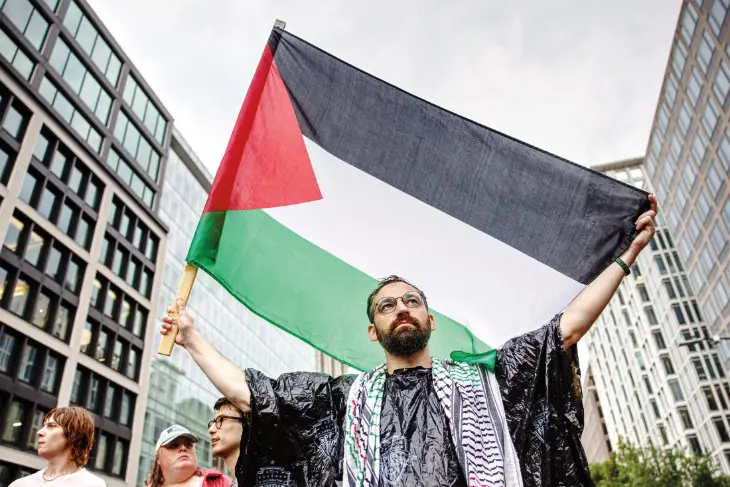
PRO-PALESTINIAN activists in the U.S. are facing a gut-wrenching dual reality: tremendous strides have been made in recent years to advance popular support for Palestine, and yet the Israeli genocide of Gaza funded by our tax dollars continues unabated. The Arab Center Washington DC’s third annual conference on Palestine, held at the National Press Club in Washington, DC, on Sept. 23, attempted to parse out what to make of this paradoxical present moment and assess how the movement for Palestine ought to think about its future.
Shibley Telhami, the Anwar Sadat Chair for Peace and Development at the University of Maryland, noted the fundamental societal breakthrough that has happened over the past three years. Until recently, many Americans sympathetic toward Palestine felt hesitant to speak out, fearing marginalization—or worse. Now, even with the Israel lobby’s attacks as ferocious as ever, many are no longer afraid to voice their opinions, as they now see being pro-Palestine as a mainstream opinion. “There’s a permission structure for you to speak out,” Telhami noted.
These gains are no reason to become complacent, cautioned Assal Rad, a non-resident fellow at the Arab Center Washington DC. “It’s not just about public opinion shifting, it’s about what actions we take to make those shifts have some tangible outcome,” she said. Real change will require a sustainable and persistent movement, she added, especially since “the Israeli side is not going to cede any space.”
An incredible amount of progress has been made on Capitol Hill in recent years, noted Lara Friedman, president of the Foundation for Middle East Peace. “We are in the midst of changes that are extraordinary, and truly the ground is fertile,” she said.
Indeed, recent votes have shown an exponential growth in the number of Democrats willing to support legislation critical of Israel. While it’s easy to remain pessimistic because these bills fail to get enough votes to pass, Friedman said it’s more important to seize the momentum of the moment and use it to build power for the future. “It is about demonstrating to the next leadership in Congress [and the White House] where their caucus is,” she said.
Friedman advised advocates not to nitpick over pieces of legislation that move the needle forward but are imperfect. It is important to see the sudden panoply of bills challenging the status quo on Israel as an indication of momentum and to use such bills as an opportunity to build a collation rather than impose a purity test, she said.
The current momentum is no guarantee of success, and Friedman urged advocates to weigh short- and long-term needs as they develop strategies. Like Rad, she noted the unrelenting nature of the pro-Israel movement and pointed out that Israel’s agents on the Hill are “in a race” to stymie progress.
Cory Archibald, co-founder of Track AIPAC, a wildly popular social media tool that exposes how much money candidates have received from pro-Israel interests, reinforced the themes of progress and persistence. While the American Israel Public Affairs Committee (AIPAC) still has ample money and proximity to power, “there is no going back to the old way of doing things for AIPAC—and they know it,” she said. “The ground has fundamentally shifted. I like to say the AIPAC era is over—and I believe that.” In the face of this reality, “we have to create a new normal that nobody can roll back,” she added.
At the heart of Track AIPAC’s success is its ability to invert the politics of Israel. “We have turned their spending from a strategic advantage into a liability,” she boasted. “Gaza has become a litmus test. Voters use a candidate’s position on AIPAC and Gaza to decide whether a politician has a basic moral compass to be trusted about anything.”
Archibald co-founded Track AIPAC in April 2024 in response to the Gaza genocide and out of frustration that pro-Palestine candidates were being so aggressively targeted and smeared by AIPAC. Archibald and co-founder Casey Kennedy operated the account anonymously until they faced doxing threats and subsequently decided to become public figures. She said they did not back down upon facing intimidation “because we knew it was working, and the people that were trying to scare us off were showing us exactly how well it was working.”
Much like Archibald, Rad has also been highly engaged in using social media to reshape narratives surrounding Palestine. She has become famous on X for repeatedly exposing how mainstream news headlines often obfuscate the reality on the ground in Palestine and has recently published a book on the topic: Don’t Say Palestine: How the Media Manufactured Consent for Genocide.
Rad has reluctantly become a niche social media icon, noting that she only entered the online fray at the behest of her former employer, the National Iranian American Council (NIAC). “I’m not trying to get clicks and likes, that’s not the reason I keep doing this,” she clarified. Rather, her mission is to relentlessly apply pressure on media organizations to report the unadulterated facts. In doing so, she is also consciously countering the constant pressure that pro-Israel groups place on media organizations to skew their reporting.
At their core, Rad believes most journalists want to tell the truth and are either intimidated into altering their reporting or have subconscious biases they don’t even recognize. “I think in a lot of cases they genuinely are unaware of just how racist they are,” she said. Ultimately, she’s not looking to score points at the expense of journalists, but to hasten change in newsrooms. “This is not criticism for the sake of criticism,” she emphasized. “It’s criticism because we want it to be better…because we want them [the media] to operate the way they’re supposed to.”
As the work continues across multiple arenas to achieve justice in Palestine, Ian Lustick, a professor of political science at the University of Pennsylvania, stressed the importance of not being overly immersed in the daily news cycle. Instead, he encouraged assessing developments in “strategic time” (which he defined as two-to-five years) and “geological time” (which he defined as decades). This, he said, allows advocates to be both strategic and realistic. History shows “the problems we care about are not going to be solved in our lifetime,” he said.
The U.S. civil rights movement is just one example demonstrating that human rights struggles are not resolved in one fell swoop. “We begin by recognizing that in politics problems are not normally, or perhaps ever, solved in the sense that afterward everything is just fine and dandy,” Lustick said. Instead, he urged us to use this question—as unsatiating as it may be—to guide our efforts to achieve justice: “Can we have better problems tomorrow than we have today?”
Dale Sprusansky is managing editor of the Washington Report on Middle East Affairs magazine.















