All books featured in this new section are available from Middle East Books and More, the nation’s preeminent bookstore on the Middle East and U.S. foreign policy. www.MiddleEastBooks.com • (202) 939-6050 ext. 1
Washington Report on Middle East Affairs, November/December 2026, pp. 86-87
Middle East Books Review
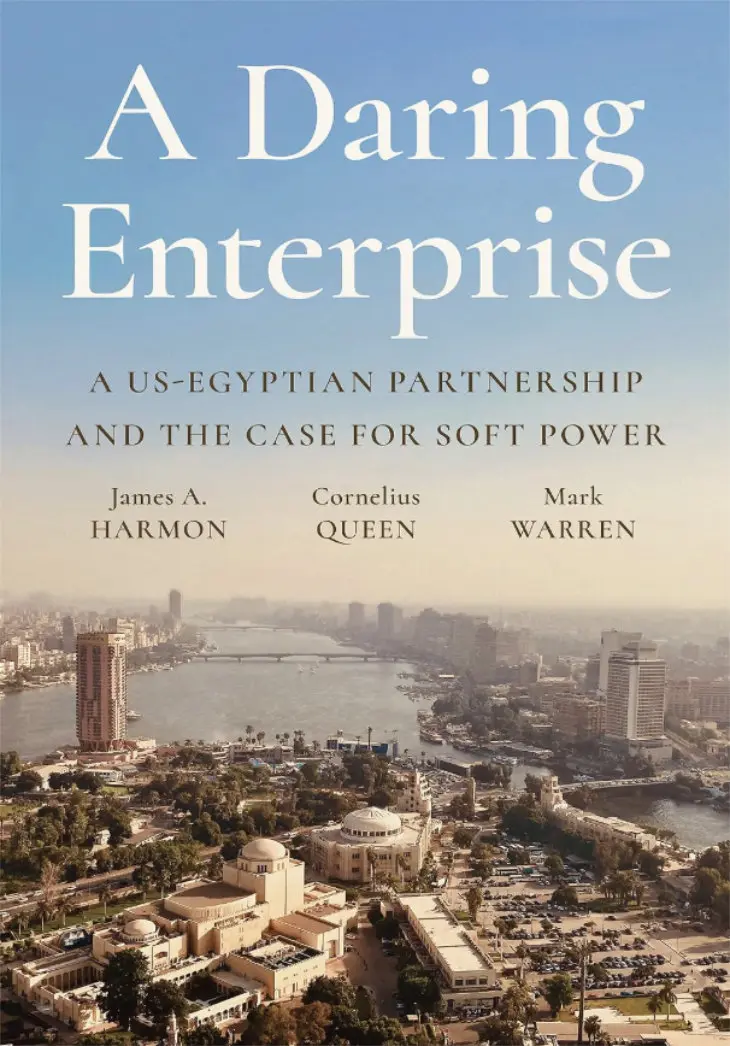
By James A. Harmon, Cornelius Queen and Mark Warren, The American University in Cairo Press, 2026, hardcover, 224 pp. MEB $35
Reviewed by Sana Abed-Kotob, Ph.D.
A Daring Enterprise, published at a time when the U.S. government is retreating from foreign aid, uses the case study of Egypt to argue that soft power is a win-win for the U.S. and its foreign partners.
Narrating in the first person, James A. Harmon writes that, during Egypt’s Arab Spring in 2011, then Secretary of State Hillary Clinton tapped him to lead the Egyptian-American Enterprise Fund (EAEF) from a nascent idea to a significant venture capital program backed by a $300 million appropriation by Congress through the now shuttered U.S. Agency for International Development (USAID). The mission was “to influence and improve the Egyptian private sector, so that a stable Egypt might be a solid ally and good trading partner for its neighbors and for the United States.”
Harmon was a private investor and former president of the Export-Import Bank of the United States. He had little experience with international politics and no experience in Egypt. He became chairman of the EAEF, seeing it through challenging discussions as it was being created on Capitol Hill—including an initial hold on its funds by then Sen. Lindsey Graham (R-SC).
When Harmon and the EAEF team came upon the scene in Cairo, they had to navigate through fast-paced revolutionary changes that followed President Hosni Mubarak’s ouster. First came the new government of President Mohamed Morsi; then came Morsi’s overthrow and replacement by Minister of Defense Abdel Fattah el-Sisi and a government in which the military had primacy in both the political and commercial landscapes. Despite operating in such challenging conditions, the EAEF demonstrated that U.S. dollars invested in smart, determined Egyptian entrepreneurs would benefit the Egyptian people and provide a significant return on investment to the U.S. taxpayer.
Working through trusted local Egyptian fund managers, venture capital firms and accelerators, EAEF provided financing for startups and showed that, despite political upheaval, Egypt could be a “surer bet for foreign direct investment.” The EAEF fund has made 148 investments since 2015 and helped attract $1.7 billion in additional foreign capital to Egypt.
Of most interest in this book are the many success stories—people with innovative ideas that would improve how Egyptians took out loans, paid their phone bills, filled their prescriptions, sought out healthcare, found a spouse and more.
Fawry, a digital financial technology firm whose name means “instantly,” was the first recipient of EAEF funds in 2015. Egyptian entrepreneur Ashraf Sabry launched Fawry in 2008 to help Egyptians pay their utility bills and top off the minutes on their mobile phones. At that time, writes Harmon, fewer than 10 percent of Egyptians had a bank account, only 3 percent had a credit card and there was no electronic bill payment infrastructure. Fawry solved the problem by rolling out thousands of point-of-sale terminals in kiosks, supermarkets, post offices and banks across the country. Customers no longer had to stand in long lines to pay their bills.
Recognizing Fawry’s ubiquitous reach, EAEF organized a consortium to acquire a majority stake in the company for $100 million, “making the deal one of the largest acquisitions of a technology company in Egyptian history.” Today, notes Harmon, 55 million Egyptians are customers of Fawry, out of a population of 120 million.
Another company that addressed a need was founded by Doaa Aref, an MBA student who was diagnosed with thyroid cancer in 2017 and discovered that she could not order medication online while she was in medical isolation. She and her friend Rasha Rady, a medical doctor, “soon recognized the immense potential for a digital platform to streamline medication access, reduce order errors and elevate healthcare outcomes in a country grappling with a high prevalence of chronic diseases and an incoherent hodgepodge of healthcare institutions.” In 2017, they founded Chefaa (Arabic for healing), allowing patients to upload their prescriptions and get connected to a nearby pharmacy that would deliver the medication. They attended an EAEF-funded accelerator in 2018, earned modest new funding and garnered attention from investors.
The COVID pandemic validated the need for digital pharmacies and helped Chefaa open an additional market in Saudi Arabia and create other business features, such as giving lower-income pharmacies access to discounted medicines. The company has grown from four employees to 110.
These examples and more reflect the growth of companies that address weighty needs of the Egyptian people. What they do not demonstrate is any impact on poverty alleviation or income generation for the underprivileged. In fact, poverty rates in Egypt have been rising in recent years, with the latest official figures showing that the poverty rate increased from 25.2 percent in 2010-2011 to approximately 30 percent in 2020. In addition to EAEF, Egypt received “some $200 billion in loans, grants, in-kind assistance and politically motivated investments from the Gulf and international financial institutions and development agencies in 2013-2024,” according to a recent Carnegie Endowment report. Despite all the incoming capital, poverty continues to increase and the middle class is shrinking.
Investing in Egypt’s private sector is a noble effort that must continue, as Harmon stresses; but the government of Egypt must also focus more on improving the lives of its citizens.
Sana Abed-Kotob, Ph.D. is former deputy director at the U.S. Department of State’s Bureau of Educational and Cultural Affairs. Prior to joining the State Department, she served as director of publications and book review editor at the Middle East Institute. She is co-author, with Denis Sullivan, of Islam in Contemporary Egypt: Civil Society vs. the State.