All books featured in this new section are available from Middle East Books and More, the nation’s preeminent bookstore on the Middle East and U.S. foreign policy. www.MiddleEastBooks.com • (202) 939-6050 ext. 1
Washington Report on Middle East Affairs, January/February 2027, pp. xx-xx
Middle East Books Review
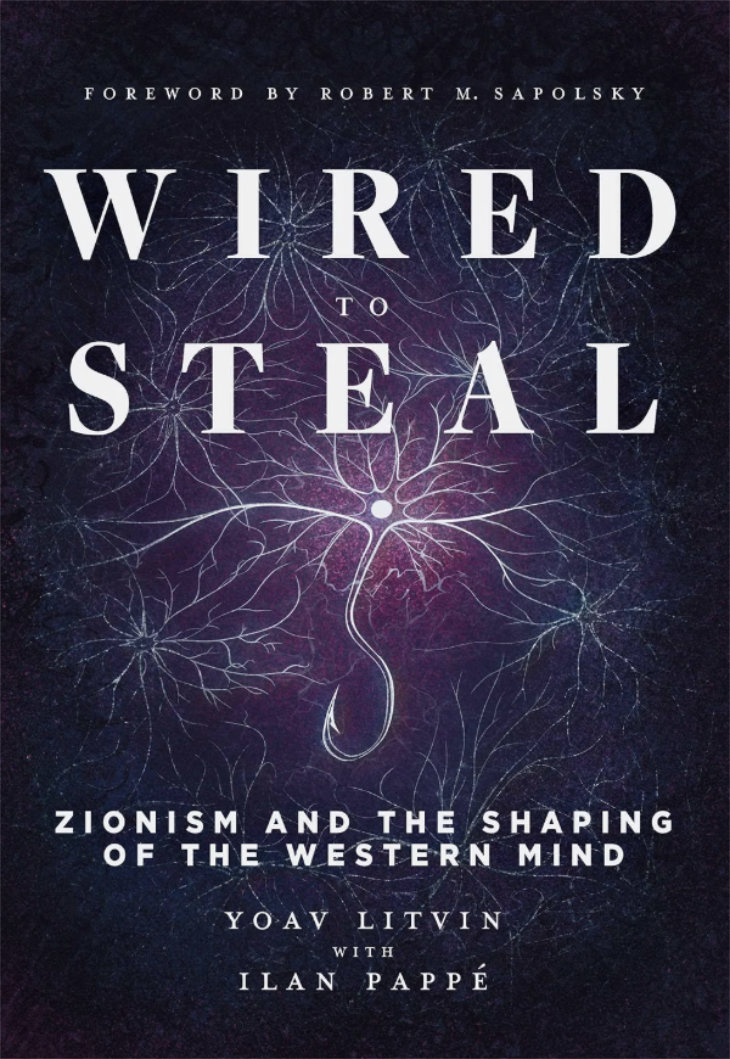
By Yoav Litvin and Ilan Pappé, Olive Branch Press, 2026, paperback, 248 pp. MEB $25
Reviewed by Steve France
PERHAPS NOTHING can truly account for why modern, prosperous and educated people came to wage a war of extermination on the Palestinians. After more than three years of unimaginable cruelty in Gaza, the mystery grows ever darker and more pressing. In Wired to Steal, two anti-Zionist Israeli expatriates offer a new way to probe the question: they apply brain science to open a unique window on the causes of Israel’s relentless aggression.
Yoav Litvin, a behavioral neuroscientist, and Ilan Pappé, a leading historian of the Nakba, describe a pattern of “compulsive aggression”—“akin to addiction”—that sustains and accelerates a settler-colonial system of domination and expansion. They analyze the specific hormonal mechanisms—or circuits—in the brain that drive such “addictive cycles of violence.” In the case of Israel, “The result is a hardened belief that expansion, lethal aggression and dispossession are not simply justified, but the only conceivable responses to a conflict constructed as eternal and unsolvable.”
Drawing on Pappé’s encyclopedic knowledge of the origins of the Zionist ideology and its bloody rollout in Palestine, the authors frame the collective Israeli psychosis within modern history: the story of a group of radical intellectuals and militants united behind the goal of founding a “Jewish state” in Palestine. To transform the Zionist project from a visionary proposition into a reality, a Jewish vanguard was formed to recruit and lead a movement.
“The unequal, hierarchical nature of power structures makes it crucial to distinguish between the psychology of the ruling class and that of the general [Jewish] population,” who were made to fully embrace Zionist ideology and obey its imperatives, the authors write. This ruling class—which Litvin and Pappé say was primarily driven, not by trauma, but by “greed for power”—set about changing a people who for centuries had lived as marginalized minorities into aggressive “New Jews” primed to “redeem” their nation by becoming a Western-style, settler-colonial state. Zionism was sold to European Jews as the best way to protect themselves against anti-Semitism.
Trauma and grief, which Zionists portrayed as the sum of Jewish history during 1,800 years of “exile” from their Levantine homeland, would be replaced by a glorious new age of Jewish power, prosperity and prestige. All it would take was support from the imperial powers of Europe to subjugate the Arabs of Palestine, which came with the 1917 Balfour Declaration. In the 1940s, the Zionists drove out their benefactors—and then most Palestinians—with a terror campaign portrayed as Jewish liberation.
Beneath the conscious process of adopting the tenets of Zionism and the settler lifestyle, a dramatic rewiring of unconscious brain functions was taking place within the Israeli people. Wired to Steal breaks new ground in its detailed demonstration of how this hidden transformation operates. The authors, at times using scientific terminology, show how Zionist indoctrination systematically taps “well-studied neural and endocrine systems, including fear circuitry associated with the amygdala, reward pathways mediated by dopamine and social bonding mechanisms involving oxytocin.”
Put more plainly: natural human empathy has been suppressed through “mutually reinforcing mechanisms” that dehumanize Palestinians: “threat inversion,” which recasts Palestinian resistance as unprovoked aggression and Israeli attacks as self-defense; a “divine mandate” or secular manifest destiny, which sanitizes immoral behaviors; the “erasure” of Palestinian history and culture; and “fear conditioning,” which bypasses reason and triggers defensive circuitry. The chronic stress and emotional trauma induced by tormenting Palestinians in endless ways causes irrational PTSD-like behaviors in Israelis.
A brief review of this groundbreaking text can barely convey the richness of its neuroscientific analysis of genocide and its demonstration of how Israel became a genocidal society. It details how “incremental genocide”—punctuated by horrific bombings of Gaza—exploded instantly on October 7 into an “overt, unapologetic mass murder of Palestinians with total imperial impunity.”
What are we to do with the analysis offered by Litvin and Pappé? “Reforming Zionism is simply not possible,” the authors say. Its political structures and toxic psychology must be “dismantled” via heavy international sanctions. The inescapable fact is, however, that the first victims of Zionism were the people who, in pursuit of a Jewish utopia, drank its cocktail of fear and power. Their descendants find themselves mentally trapped in a genocidal dystopia. Thus, to free Palestine will require deep healing. The book concludes with a detailed description of “collective un- and re-learning, a rewiring of the brain, and a reclamation of humanity, empathy, truth and accountability through dialogue, solidarity, creativity, collaboration and worldmaking.”
In the meantime, additional neuroscientific awareness is called for, including work on the history of Palestinian coping and resistance; Western complicity; and the Christian Zionist and diasporic Jewish embrace of Israel’s propaganda and policies. In the end, this process should spur other societies, including Americans, to mend their own ideological ills.
Steve France is a Washington, DC-based journalist and lawyer. He is affiliated with the Episcopal Peace Fellowship Palestine Justice Network and other Palestinian solidarity groups.