Web Exclusives
UAE-Israel “Abraham Accord” troubles reveal why
By Grant F. Smith
DECEMBER HAS ALREADY been a terrible month for the Israel-UAE “Abraham Accords.” These accords, negotiated by the Trump administration and continued under President Joe Biden, are a part of a policy initiative for Israel and its U.S. lobby to deliver American military hardware and recognition by Washington of dubious land grabs in exchange for diplomatic recognition of Israel and large commercial opportunities. Beginning with the failed attempt to further disenfranchise Palestinians, the Abraham Accords have vastly undermined America’s reputation. The Israel-Morocco accord, which depends on official U.S. recognition of annexed land in the Western Sahara, is facing international backlash. Sudan’s accord, unpopular with the majority of Sudanese, has been stymied by that country’s military coup.
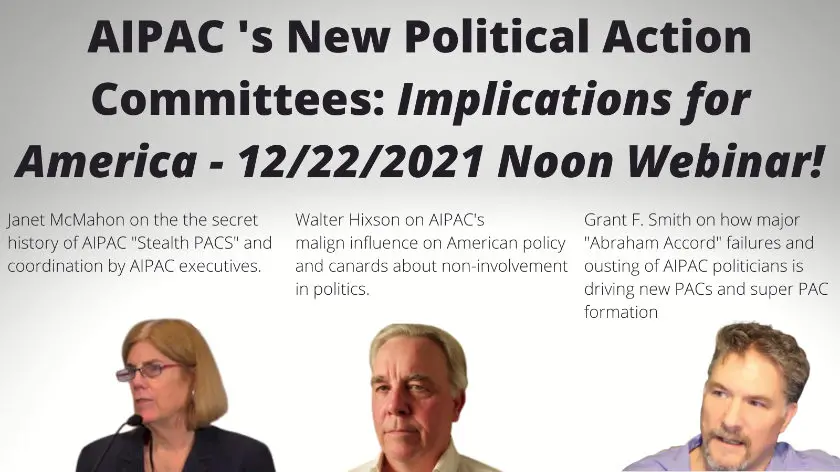
Register to participate in a discussion via Zoom or view on YouTube.
In the UAE—the most important Abraham Accord country—things are also not going as planned.
The sale of American F-35 jet fighters to the UAE was the supposed linchpin that broke. Tiring of its continued lack of access to the advanced version of the plane (which Israel obtained for itself) along with mounting U.S. diplomatic conditions placed on the sale, the UAE just announced it would instead purchase an $18 billion package of Rafael fighter jets and other aircraft from France.
The UAE’s suspension of F-35 talks with Washington was a knockout punch to Lockheed Martin’s $23 billion sales effort announced at the end of the Trump administration.
The UAE will also apparently no longer be financing a $200 million Israeli salmon farming project in southwest Virginia codenamed “Project Jonah.” After reports of the Israeli company AquaMaof’s incompetence and secret efforts by its owners to sell the recirculating aquaculture system (RAS) operator for $1 billion, Pure Salmon of Abu Dhabi switched to a former Veolia RAS vendor and broke off relations with AquaMaof. This severs AquaMaof’s access to UAE funding through the investment bank 8f as a part of Pure Salmon. The move leaves the AIPAC-sponsored deal, which was angling for $25 million in county, state and U.S. government subsidies, in limbo.
In seeming retaliation, Israel’s Environmental Protection Ministry just announced it would block movement of UAE oil from Eilat to the Mediterranean through an existing pipeline.
Lobbying on behalf of the Abraham Accords, but in reality for foreign countries (in addition to Israel), was the key item on the American Israel Public Affairs Committee’s (AIPAC) 2021 legislative agenda. AIPAC’s inability to smoothly deliver advanced U.S. fighter jets to the UAE may be why the lobby for Israel just announced it will be directly incorporating and operating political action committees (PACs) and super PACs to financially support key candidate races.
Rep. Jamaal Bowman’s (D-NY) 2020 defeat of longtime Israel lobby stalwart Eliot Engel, along with other electoral losses, were wakeup calls to AIPAC. In the 1980s AIPAC tutored groups of donors on how to set up PACs, then issued secret directives based on sophisticated election analysis on how those PACs’ funds should be distributed. As revealed in the book Stealth PACs, How Israel’s American Lobby Seeks to Control U.S. Middle East Policy, by Richard H. Curtiss, among 30 PACs only 4 had names revealing their true agenda, such as World Alliance for Israel. The rest bore innocuous names like National Action Committee and Heartland PAC to conceal their foreign agenda and cloud their obviously tight coordination. AIPAC operatives have also directly engaged in political campaigns, through such tactics as fielding “spoiler” candidates like Ed Vallens to ensure that AIPAC-favored politicians such as Alan Cranston won key races.
Since those long-ago AIPAC forays into political campaigns, Americans have not only grown much more aware of Israel’s true nature as a settler colonial apartheid state, but also of the Israel lobby’s malign campaign influence that begins as soon as politicians decide to run. The crumbling of the Israel-UAE “Abraham Accord”—which advanced no identifiable U.S. interest—may be only the first in a chain reaction against schemes devised and implemented by America’s most powerful foreign agent.