






Web Exclusives:
Daily Life and Shattered Dreams in Gaza—Writers Share Their Stories
By Khaled al-Qershali
SINCE THE BEGINNING of this genocide, Hosam Shallah has been displaced and living in a tent in Deir al-Balah with his family of five. Last March 2024, Hosam’s daughter, Lara, was born.
“While I was displaced in the south, finding food supplies was difficult as I had to walk for hours to buy them,” Hosam said.
Afraid of living through a famine, as the people in the north are, Hosam stored some food when the Israeli occupation closed the borders on March 2.
“I stored what I could, one bag of flour, 10 kilograms of sugar, 10 kilograms of rice, and diapers and milk for my daughter,” Hosam said.
“But after a month and a half nothing remained.”
With the food he stored, rats and cockroaches became a problem. “Although my wife, Um Bader, is so tidy and clean that she even cleaned the tent every day, insects and rats remained,” Hosam explained. He could not find insecticides in the market.
Now, Hosam tells me that since May 2025, he and his family eat one meal a day to afford diapers and milk for the baby. Costing less than $3 before the genocide, one can of milk costs $80.
“I had to choose between buying milk for Lara or one kilogram of flour for the whole family,” Hosam says while carrying her.
At the end of May, the Israeli and U.S.-backed Gaza Humanitarian Foundation (GHF) declared that it would distribute aid for people in Gaza weekly. “My brother went to the GHF site in Rafah, but he returned with fear instead of food for his children,” Hosam said.
“My son, Bader, begged to go to eastern Deir al-Balah to get whatever he might find on the trucks entering there, but I prevented him,” Hosam added.
Hosam’s neighbor, Fouad Abu Jabal, was killed while he was trying to get aid for his family. “Before he was killed, Fouad promised that if he found any canned milk, he would sell it to me,” Hosam said.
Bader went twice to the airdrops in the Al-Zawayda area, but he returned empty-handed. “On August 5, the second time he went to Al-Zawayda seeking aid, Odai Al-Quraan, who was working at Al-Aqsa Hospital as a nurse, was killed when an airdrop fell on his head,” Hosam recalled.
“I have never allowed Bader to go anywhere. We need aid but we also want to live,” Hosam continued.
THE MARKET BOYCOTT
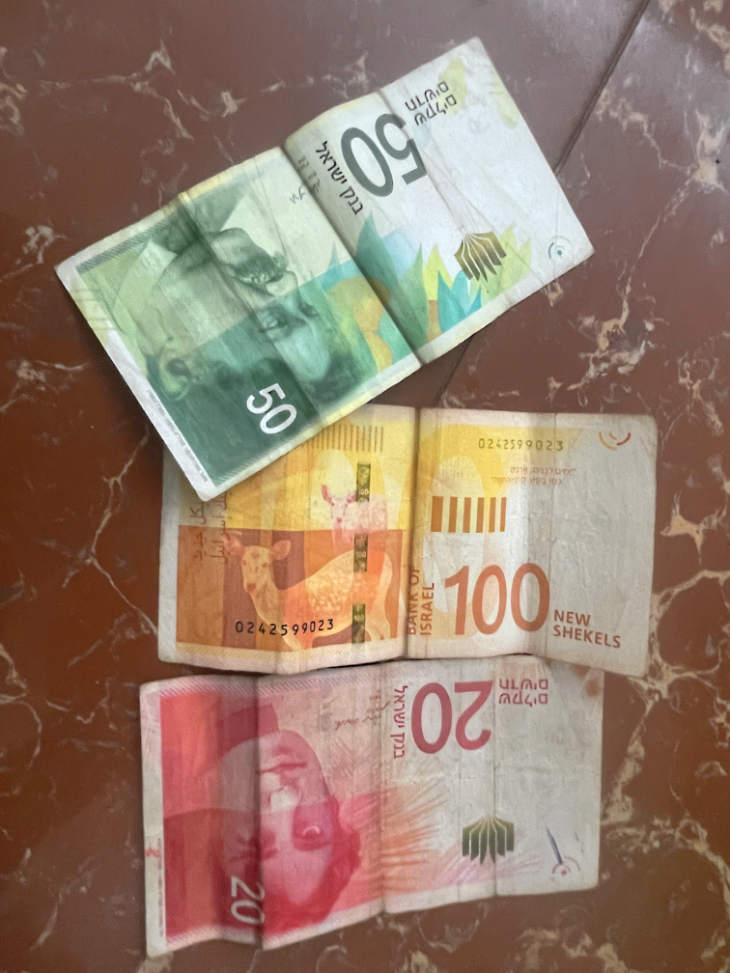
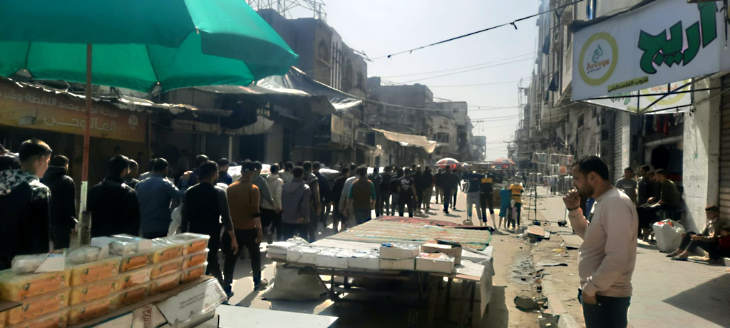
During July, one kilogram of expired canned milk powder cost more than $100. Large families in Deir al-Balah such as the Abu Amra and Abu Samra families decided to close the market as an attempt to decrease the prices of food supplies.
It was a complete failure. The purpose of the boycott was to force the thieves to drop the prices for lack of buyers, but famine had already spread in the whole Strip and all stored food had gone. People were forced to buy from these sellers.
The market was closed for three days. On the first day, Hosam went to a trader he knew and bought one kilogram of macaroni for $20. On the second day he bought one kilogram of rice for $35.
“My wife cooked half a kilogram of rice on the second day and cooked the other half on the third. Flour was totally nonexistent during the boycott,” Hosam says.
“I had to feed my infant rice and macaroni for lack of milk,” he added.
NOT RISKING HIS LIFE FOR AID
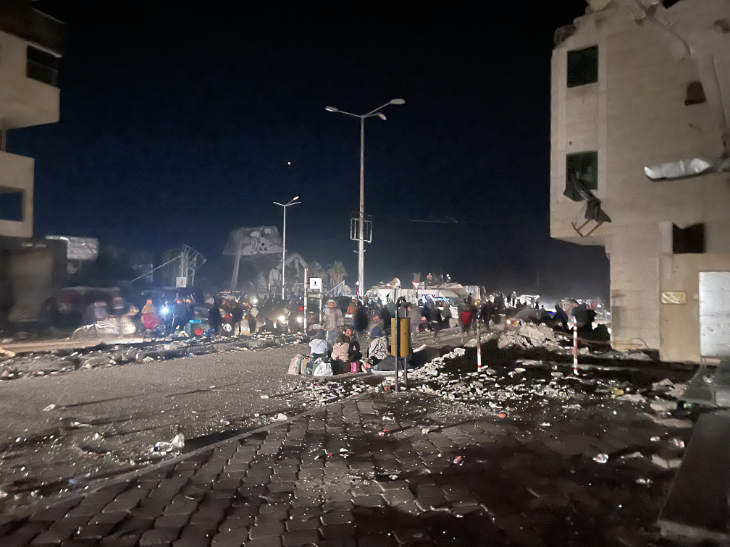
Kareem Al-Tana, 23, was planning to work in the market on the first day so he could afford the price of one kilogram of flour for his family.
Since the beginning of this genocide, Kareem was displaced in a tent in Al-Zawayda, a town near Deir al-Balah, until he returned home on Jan. 19, 2025.
Kareem’s father, Hassan, has been jobless since the beginning of the genocide so Kareem and his brother work to support their family of six.
“I had been working in a clothes shop since 2021, but the genocide destroyed my workplace,” Kareem said.
When he returned to Gaza, Kareem built his own stall with the wood he used to build his tent while being displaced.
“My family and I had been living in famine for the past four months,” Kareem said. “I can barely afford buying one kilogram of flour every two or three days for the whole family.”
Kareem was selling clothes and accessories at his stall in the Al-Nasser neighborhood. “I had to stand for more than eight hours a day under the burning sun to afford food for my family,” Kareem added.
“I was afraid of being robbed so I closed the stall and went home to help my father fill potable water,” Kareem said.
People had to choose between either boycotting the market or the sellers who were stealing aid to sell it at high prices—or dying because they had no food stored in their tents and homes.
“It is impossible to store food in Gaza,” Kareem added. “No one could afford storing food for six months while prices skyrocketed. If we stored food, we might have to leave it behind if we have to evacuate,” Kareem added.
Neither Kareem nor his brother considered going to the GHF sites, stolen trucks in Zekeim or the airdrops.
Kareem’s friend, Ayman Zyara, was injured by a bullet on his left thigh when he went to Nitzarim distribution point for the first time. “When I heard about Ayman’s injury, my brother and I decided we would not sacrifice our lives for aid,” Kareem said.
LETHAL AIR DROPS
Before the Gaza genocide began, western Deir al-Balah resident Mohammed Al-Dabagi, 19, was an athlete on the Champions academy in Gaza. His father lost his job and now their 14-member family depends on aid they receive.
Instead of football training, Mohammed’s days are occupied with missions to survive genocide. “My family depended on me for filling the water and going to the market,” Mohammed said.
Almost two years into the genocide, and his family has not yet been displaced, which makes them “one of the luckiest in the whole Strip,” he said. “My cousin, Abu Mohammed Abd Al-Dayeem, has been displaced since the beginning of this genocide,” Mohammed said. During the ceasefire in January 2025, Abu Mohammed’s sons returned to Gaza to find nothing remaining of their neighborhood in Beit Lahya. They returned to the displacement camp devastated.
“Since the closing of the border in March, my family had not received aid,” Mohammed said. Mohammed went everywhere in a bid to feed his family.
Mohammed went to all the GHF sites several times. “I had received aid but I also witnessed death, as the Israeli Occupation Forces would shoot everywhere near the sites.”
He went to eastern Deir al-Balah, near Kisofiem, in an attempt to collect food from the supply trucks. “I saw death in Kisofiem—the gunfire was continuous,” Mohammed stated.
During August, Mohammed had to walk for hours under the burning sun to reach Nuseirat area and wait for airdrops there.
“My good health played a crucial role in getting aid,” Mohammed added. Unlike many people, he was able to run around three kilometers in one go.
“My friend, Bader Shallah, had never gone anywhere to get aid as he suffered from malnutrition,” Mohammed says.
“The airdrops dropped in Gaza were not that different from the rockets the Israeli occupation used to bomb the Strip,” Mohammed said.
The people in real need for food supplies did not go to the GHF distribution sites, the trucks in areas that were under Israeli military control, or the airdrops. “My father prevented me from seeking aid, but I went anyway as I was starving and exhausted,” Mohammed said.
Some of the people who go to the sites are thieves, who sell what they steal at extremely unimaginable prices.
On August 5 the crossing border was opened and hundreds of trucks entered the Strip. “All these trucks were full of products for trading and none of them were aid,” Mohammed said.
Khaled al-Qershali studies literature and English language at the Islamic University of Gaza. A student of Dr. Refaat Alareer, whom Israel assassinated in December 2023, Khaled says “I strongly believe in writing literature as a way to resist.” His mentor was Dee Claffey.