















Washington Report on Middle East Affairs, June/July 2022, pp. 55-56
Waging Peace
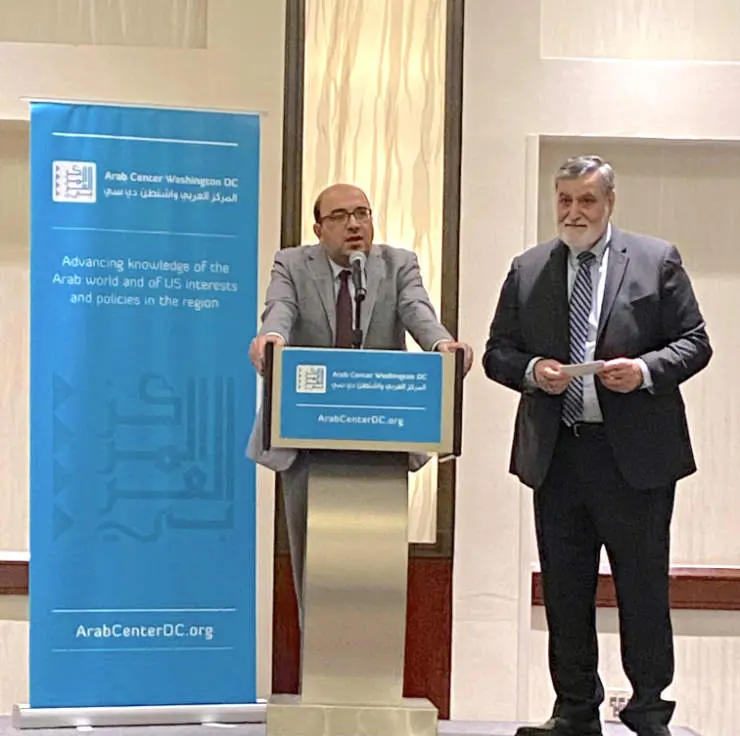
SAMI ABU SHEHADEH is one of only 10 Palestinians in the 120-member Israeli Knesset (parliament). He recently came on a tour of the U.S. to share what it is like to be a Palestinian citizen of Israel, a perspective that is rarely shared. He also came to touch base with Palestinians living in the U.S., intentionally speaking in locations where there are large numbers of Palestinian Americans, such as New York, Boston, Chicago and the San Francisco Bay Area, where he spoke in Oakland on March 24.
Shehadeh initiated his remarks by providing a little history, beginning with the mass expulsion of more than 750,000 Palestinians when the State of Israel was created in 1948. He pointed out that, at that time, only about 5 percent of the population was Jewish, nearly all of whom were not Zionists. Palestinians who refused to leave became Israeli citizens, but they were and continue to be treated as enemies, he said.
Today, Palestinian citizens of Israel—20 percent of the population—are a minority in their homeland. The discrimination they encounter on a daily basis is profound and Shehadeh shared a few examples, including the following:
- Separate educational systems for Palestinian and Jewish Israeli children;
- Palestinian children being forced to learn modern Zionist history and denied the right to learn about Palestinian history;
- A lack of essential infrastructure in some predominantly Palestinian neighborhoods (for example, the lack of a basic water supply and electricity).
“I have to listen every day to racist people saying that the fact that I brought children into the world is a demographic [time] bomb for the state,” Shehadeh said.
“My [Jewish] neighbor, his children are considered a blessing for the state. And these are the words that they use.”
In the Knesset, the vast majority of his colleagues refuse to acknowledge that Shehadeh is Palestinian, routinely call him a terrorist and habitually interrupt and ignore him. “It’s a very hostile environment,” he said. Shehadeh shared that he has also been attacked physically by security forces when he attends demonstrations.
Shehadeh ended his talk by clearly stating the Palestinian position. “We say Israel must change and acknowledge the rights of everyone,” he explained. “We want equality. We think that the colonial project should end. We believe in justice and equality for all. A Jewish state cannot be a democracy. It’s an oxymoron. No equality, no democracy.”
Rev. Michael Yoshii, who was instrumental in organizing Shehadeh’s talk in Oakland, agreed. “Equal rights for all implies that you can’t have a Jewish state and call it a democracy,” he told the Washington Report.
—Katharine Davies Samway















