















Washington Report on Middle East Affairs, March/April 2022, pp. 55-56
Waging Peace
PALESTINE DEEP Dive held its first-ever in-person event on Nov. 15, 2021 at the Knickerbocker Club in New York City. Titled “Distant Voices No More? Giving Rise to a New Generation of Palestinian Journalists,” the meeting highlighted the importance of expanding Palestinian representation in the media.
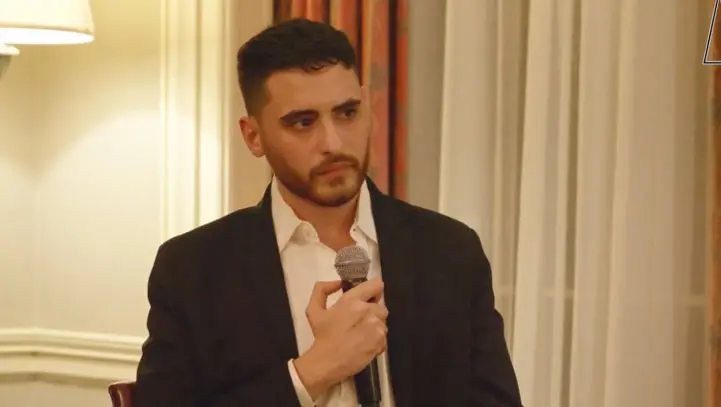
Mohammed El-Kurd, Palestine correspondent for The Nation, explained how he has used social media to put a global spotlight on Israel’s ongoing efforts to forcibly remove Palestinians from their homes in East Jerusalem’s Sheikh Jarrah neighborhood. “The news cycle is informed by social media,” he noted. “By penetrating social media, we were able to penetrate the news cycle and force Palestine to the center of the news.”
El-Kurd’s successful online efforts have made him, as well as his sister, Muna, the faces of the resistance against ethnic cleansing in Sheikh Jarrah. He said this notoriety is a blessing since it gives him a platform to defend his community, but it’s also an onerous burden.
“There are not many Palestinians in the public eye, so what I say is kind of representative of Palestinians,” El-Kurd said. The reality, he explained, is that while he is well-equipped to discuss Sheikh Jarrah, he is not an expert on all that happens in Palestine. Him being the “voice of Palestine” is thus more a reflection of the dearth of Palestinian voices in the mainstream media, he said.
El-Kurd hopes powerful voices from Gaza, the West Bank and elsewhere in Palestine will also gain access to the media. “I think the next phase in this is to empower other Palestinians, because we exist across disparate geographies, disparate legal statuses,” he said. “We are facing this dispossession differently—if you’re not getting demolished, you’re getting bombed, if you’re not getting bombed, you’re getting evicted, if you’re not getting evicted, your residency is getting revoked—and you need people who are able to narrate that with authority.”
Not only do media organizations need more Palestinian voices, they also need to listen to them, El-Kurd emphasized. He expressed exasperation that mainstream outlets only recently began acknowledging the reality of Israel’s apartheid polices after it was noted by groups such as Human Rights Watch. “These organizations reached these miraculous epiphanies decades after Palestinians had already articulated them,” El-Kurd said.
Having made his way around the media recently, El-Kurd noted that his personal witness is often treated with skepticism. “At worst, you’re ‘angry’ if you go on TV and say your opinion, and at best you’re ‘passionate,’ but they never consider that you’re a reliable narrator,” he noted. “I am facing oppression, and I should not be the defendant in a conversation when I’m speaking about my oppression.”
Columbia University professor Rashid Khalidi pointed out that, from the beginning, Zionists have placed an emphasis on being “discursive, telling a story.” This has allowed the movement to ingratiate itself with the mainstream media. “Before he became the first prime minister of Israel, David Ben-Gurion was in New York City working for four years during World War I, building up the financial and the propaganda basis of the Zionist movement’s success in the United States,” he noted.
Palestinians must learn from this and begin to insist on planting their own story in the media, Khalidi said. “What we never had was the permission to narrate,” he noted, adding that this is beginning to change with the rise of El-Kurd and other younger Palestinians.
Khalidi offered two pieces of advice to the next generation, though he also cheekily warned them “not to listen to old people.”
The first is to learn and understand history, which makes it easier to confront and uproot the arguments made by Zionists and their supporters. “They say the exact same things,” he noted. “I’ve been listening to the same lines since I was 12.”
The second piece of advice will likely be harder for some to accept, Khalidi acknowledged. “In order to win, you don’t divide up your own ranks,” he said. Instead, “you divide the ranks of the enemy. That means that sometimes you ally yourself with people with whom you are not a hundred percent in agreement with. Sometimes you accept difference and disagreement in your own ranks.”
Breaking down and changing the status quo “requires having allies who you sometimes don’t agree with fully, and that’s a very hard lesson to learn,” he added.
Pam Bailey, the founder of We Are Not Numbers, an organization dedicated to helping Palestinians share their stories with the world, said many young people she’s interacted with in Gaza tend to doubt the world cares about what they have to say.
“The first step is to let them know they have a truth that’s worth listening to,” she explained. Her organization “finds these budding writers who maybe didn’t know they were writers, didn’t know they were storytellers, didn’t know they had a voice.”
While the media tends to only report on Palestine during times of war, Bailey said she encourages her writers to share their everyday narratives, since their lives should not be defined by war.
Bailey encouraged the world not to relegate Palestinians to war pawns. “Please don’t pay attention only during a war, only when there’s loss of lives or legs,” she implored. “We should be sustaining this attention every day.”
—Dale Sprusansky















