















Washington Report on Middle East Affairs, May 2020, pp. 64-65
Muslim American Activism
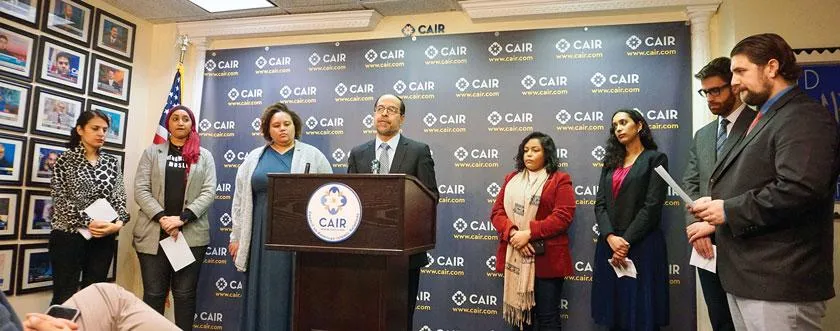
The Council on American-Islamic Relations (CAIR) gathered civil rights organizations together on Jan. 30 for a news conference in response to President Donald Trump’s expected expansion of the Muslim Ban the following day. Just a week into his presidency, Trump signed Executive Order 13769, banning foreign nationals from seven predominantly Muslim countries. That order stranded Muslim visitors from Libya, Somalia, Iran, Venezuela, North Korea, Yemen and Syria at airports and prompted ACLU lawsuits and federal court rulings to block the ban.
Fast forward to 2020: The Muslim Ban has been in effect for three years and on Jan. 31, Trump expanded the ban to 11 countries, now including most immigrants from Sudan, Tanzania, Eritrea, Nigeria, Myanmar (Burma) and Kyrgyzstan.
Robert McCaw, CAIR’s government affairs director, noted the new ban bars tens of thousands of Muslims, even those with immigration visas, from entering the United States. Nihad Awad, CAIR’s national executive director, said the ban continues this administration’s attacks on Muslims and people of color, both globally and in the U.S.
“At its core it started as a Muslim ban and it remains a Muslim ban. Adding one or two non-Muslim countries is just window dressing,” Awad declared. The ban separates families and prevents people from attending funerals and weddings. Students can’t come to the U.S. to further their education and business people can’t conduct work, Awad added. Trump’s top advisers have said Islam is a cancer and he himself has said “Islam hates us,” revealing his disdain for Muslims and people of color, Awad concluded, pledging to continue his organization’s legal fight against this white supremacy agenda.
Civil rights partners also addressed journalists, warning that the Muslim Ban is a racist and xenophobic attack on diversity. The Trump administration has a real problem with brown, black and Asian folks, which is propelling hate against our community, warned Patrice Lawrence, co-director of UndocuBlack Network.
Ryan Mace, a grassroots advocacy refugee specialist with Amnesty International, described refugees trapped in limbo and said he feared the U.S. “has abandoned the values our country was founded on.”
On Jan. 31, the administration also suspended the entry into the U.S. of foreign nationals who have been in China out of concern that they may transmit the novel coronavirus. Trump administration officials have repeatedly referred to the coronavirus as the “Wuhan virus” or the “Chinese virus,” in what many view as a xenophobic attempt to portray the virus as a threat imported to the U.S. by “others.”
—Delinda C. Hanley














