Washington Report on Middle East Affairs, March 2009, pages 60-61
Human Rights
Water Is the LifeSource

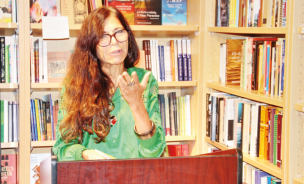
SUSAN KOPPELMAN, co-founder of LifeSource, spoke at Busboys and Poets in Washington, DC on Nov. 30. LifeSource is an initiative to stimulate grassroots movements for water access and sustainability in the Palestinian territories and Israel.
Koppelman is a Jewish American whose maternal grandmother was a Holocaust survivor and whose paternal grandfather, an early supporter of the Zionist movement, arrived in Jerusalem in 1878. Koppelman herself has been living and working in the West Bank for the last two and half years, and firmly believes Israel’s policies are interfering with Palestinians’ right to water in Gaza and the West Bank. Everyone has the right to clean water, Koppelman stated, noting that according to the World Health Organization the accepted standard of living as far as water goes is 100 liters per person per day. The average Palestinian in the occupied territories lives on less than 20 liters of water a day.
There are three major water sources for Israelis and Palestinians: the Jordan River system, the Mountain Aquifer, and the Coastal Aquifer. The Jordan River system, which straddles the borders of Israel and the territories, is completely off limits to the Palestinians by order of the Israeli authorities, Koppelman said. So much water is being diverted from the Jordan River for Israeli consumption that the river’s flow has been greatly reduced. “It is no longer a rapid river,” she said with regret, “it’s but a trickle.”
Koppelman then discussed the ground water of the Mountain Aquifer, 85 percent of which lies under the West Bank. The 1995 Oslo accords stipulated that Palestinians would have access to 20 percent of that aquifer, with Israel controlling the remaining 80 percent. A recent U.N. report, however, revealed that Israel has restricted Palestinian access to 12 percent.
The northern section of the Mountain Aquifer is where the freshest and cleanest water can be found, Koppelman explained, as opposed to the southern part, which is salty. In 1995, Israelis allowed the Palestinians to develop an additional 70 to 80 million cubic meters of water, but only from the salty lower area. Koppelman reminded her listeners that since 1967 no Palestinian may drill a new well in the basin without Israeli permission. All the Jewish settlements built since 1995, with their water networks, have caused the water table to drop so drastically that it is impossible to retrieve much water.
The Gaza Strip is downstream on the Coastal Aquifer. As early as 1933, British Mandate officials reported that the quality of water in the Coastal Aquifer was unacceptable for consumption. The Israelis use this aquifer solely for agricultural purposes, but for the Palestinians of Gaza it is the only source of drinking water available.
Until 2006, less than 10 percent of water in Gaza was fit for consumption. When Israel destroyed the water purifiers that year, purification of water has basically halted. “The water situation is untenable,” Koppelman said. “One result is a higher incidence of kidney failure in children.”
“In Gaza, the Palestinians have access to as much water as they want, but it is not fit for human consumption. In the West Bank, there are great reserves of water, but the Palestinians are denied access,” she pointed out. “There are more than 220,000 residents of the West Bank who still to this day are not hooked up to a water system,” she said. Those individuals rely on rain water or tankers for their water supply, which means they risk a greater chance of contamination.
Israelis consume three times as much water as Palestinians, noted Koppelman, who sees water rights as a human rights issue. Under the Geneva Convention, the Israelis are required to supply the Palestinians with an adequate amount of water. The law is stated clearly: Israel is not permitted to interfere directly with the Palestinians’ right to obtain water.
For more information, visit LifeSource’s Web site at <www.lifesource.ps>.
—Jamal Najjab