




Washington Report on Middle East Affairs, October 2026, p. 88-89
Obituaries
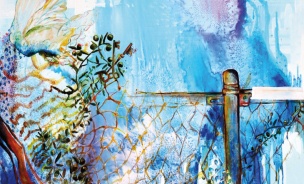
SLIMAN MANSOUR, 79, a celebrated artist, one of the founding figures of contemporary Palestinian art, died on Aug. 24, after a long illness. He was part of a generation of Palestinian artists, writers and poets seeking to rebuild their threatened identity through symbols rooted in land and memory.
For more than five decades, his paintings told the Palestinian story depicting landscapes, village life, the experiences of displacement and the Israeli occupation.
Mansour was born in Birzeit, north of Ramallah, in 1947, a year before the Nakba. He studied art in Jerusalem’s Bezalel Academy of Arts and Design and graduated in 1970. He exhibited his work extensively across the Arab world and internationally. Mansour’s works garnered many awards in recognition of his contribution to Arab and Palestinian culture.
Mansour created global images that carried messages of freedom and resistance, blending local symbols such as the olive and orange trees, keffiyeh scarf and tatreez embroidered thobes, with universal symbols of the dove and religious images.
He described art as a form of resistance and said he sought to show Palestinians’ attachment to their land, their determination to protect it and the beauty of Palestine. For many Palestinians, Mansour’s work was a visual archive of the cause itself.
His best-known work, the 1973 painting “Jamal al-Mahamel” commonly translated as “The Camel of Hardships,” depicts an elderly Palestinian porter bent beneath the weight of Jerusalem. The weary figure came to represent the Palestinian carrying his homeland, history and attachment to Jerusalem wherever he went. Reproduced on posters and postcards—and on the cover of this issue’s Washington Report—Mansour’s image has become one of the most recognizable works of Palestinian art.
“The artist has departed,” Knesset member Ahmad Tibi wrote, “but his art remains a witness to a homeland that does not disappear....”

WILLIAM IRA LIGHTFOOT, 88, international businessman and long-time friend and donor to the Washington Report, died on June 19. He published The First Half, a memoir of his life and world travels as a defense contractor. He never completed its sequel, Second Half, which would have recorded his travels, his enthusiasm (and stable) for vintage racing cars in Northern Virginia, his pride and love for his sons and grandchildren and his tireless advocacy for the Palestinian cause. After serving in the Army and working in executive sales for Raytheon Corp, Northrop Corp. and Page Engineers, he devoted hours of his retirement to reading voraciously and posting tirelessly in the comments sections of the Washington Post and other legacy newspapers.
Mary Purington Lightfoot, his wife of nearly 40 years, a nurse who was also passionate about advocating for Palestinians, died from cancer in 2003. Lightfoot teamed up with Palestine Children’s Relief Fund (PCRF) to build a family room in the pediatric cancer department in Khan Yunis Hospital in her memory. It opened in February 2023; Israel bombed it.
Although he was distraught about the genocide and mainstream coverage of it, Bill was always upbeat—energetic, curious and generous. He hoped the Washington Report could multiply its efforts to train and publish powerful stories by emerging young journalists. We will miss his calls, advice and visits.

CHRIS ANNE AFFLECK, 83, whose life was devoted to justice, died on June 2. As a young woman she taught literacy in Mississippi during Freedom Summer and later marched against the Vietnam War. After retiring from a 35-year career as a public school teacher, Affleck first traveled to Palestine in 2009. When she returned, she became an organizer with the Alliance for Water Justice in Palestine, which educates North Americans about the ways in which Israeli control over water has been used against Palestinians. She believed water is a human right; it should not be used as an instrument of oppression; and it should be distributed equitably.
Affleck traveled to Palestine with Eyewitness Palestine in July 2015 and continued her commitment to the Palestinian struggle. Many people knew her as the mother of actors Ben and Casey Affleck. Her son Ben wrote after her death that “support for Palestinians was the central cause of [his] mother’s life.” She was a committed advocate for justice who believed that witnessing injustice carried with it a responsibility to act.

LIEUTENANT COMMANDER JAMES M. ENNES, JR, 93, died on July 31. Ennes was serving aboard the lightly armed listening ship, USS Liberty, when on June 8, 1967, three days after the June war started, Israeli forces began a combined aerial and naval assault that killed 34 Americans and wounded more than 170 others, including himself. Ennes continued to serve as a cryptologic officer until his retirement in 1978. In 1979, Ennes wrote the first book on the subject, Assault on the Liberty: The True Story of the Israeli Attack on an American Intelligence Ship.
Our very first issue of the Washington Report, back in April 1982, carried a review of Ennes’ book. The reviewer wrote that after reading a book written by a lieutenant on the bridge that day, “the Israeli explanation of mistaken identity strains belief beyond reason.” Ennes concluded that the attack was predetermined and deliberate to prevent the ship from listening in and gathering evidence to show Israel was the aggressor when it attacked the Golan Heights. Ennes also dismissed the subsequent U.S. naval inquiry as “not much more than a farce,” as it suppressed testimony from the Liberty’s Captain McGonagle and crewmen which contradicted the official Israeli version of events.
The Washington Report printed more than 100 articles on Israel’s attack and the U.S. coverup, including some by Ennes <www.wrmea.org/component/tags/uss-liberty.html>. Our Aug./Sept. 2026 issue featured an article on Rep. Thomas Massie’s (R-KY) June 30 resolution to honor the men who served on the Liberty and release and declassify all records of the attack. We hope that Ennes watched those proceedings before his death.
—Delinda C. Hanley

PROFESSOR JOHN L. ESPOSITO, 86, one of the world’s most influential scholars of Islam and a tireless advocate for Muslim-Christian understanding, died on July 15, 2026, following complications from heart surgery.
Over a career spanning more than five decades, Esposito transformed the study of Islam in the West, challenging stereotypes, correcting misconceptions and insisting that Muslims be understood on their own terms rather than through the lens of geopolitical conflict or cultural prejudice. At a time when Islam was too often portrayed as an “other,” particularly after the Iranian Revolution and again after 9/11, Esposito emerged as one of the most respected scholarly voices explaining the diversity, complexity and humanity of Muslim societies.
When he joined Georgetown University in 1993, Esposito founded the Center for Muslim-Christian Understanding, later renamed the Prince Alwaleed bin Talal Center for Muslim-Christian Understanding (ACMCU) after a major endowment in 2005. Under Esposito’s leadership, the center became one of the world’s premier institutions dedicated to the study of Islam, interfaith dialogue and relations between Muslim societies and the West. Its mission—to build bridges of understanding while enhancing knowledge of Muslims in the West—reflected his lifelong intellectual commitment.
He also founded Georgetown’s Bridge Initiative, an internationally recognized research project documenting Islamophobia and anti-Muslim prejudice, and he continued to direct it even after stepping down from ACMCU.
Esposito authored, co-authored or edited more than 45 books, many of which became standard texts in universities worldwide. Among his most influential works were Islam: The Straight Path, The Islamic Threat: Myth or Reality? and Islamophobia: The Challenge of Pluralism in the 21st Century (with Ibrahim Kalin). He also served as editor-in-chief of landmark Oxford reference works, including The Oxford Dictionary of Islam and The Oxford History of Islam.
Political scientist Nader Hashemi, who succeeded Esposito as director of Georgetown’s Alwaleed Center, described him as someone whose “humanity and ethical decency reflected the best traditions of the United States and the American people.”
Hashemi wrote that Esposito sought “to understand and interpret religious politics not from the perspective of U.S. Empire but rather from the vantage point of the downtrodden, the occupied and the oppressed.”
He mentored generations of academics, opened doors for emerging voices and treated younger scholars with uncommon generosity. His work also influenced journalists, diplomats, policymakers, religious leaders and civil society organizations at a time when informed voices on Islam were desperately needed.
—Faisal Kutty