Washington Report on Middle East Affairs, November 2007, pages 60-61
Waging Peace
AFSC Search for Global Peace
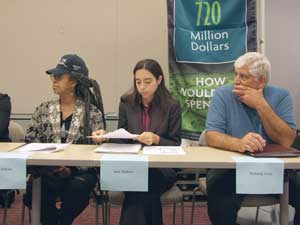
TO HELP CELEBRATE its 90th anniversary, the American Friends Service Committee (AFSC) held a panel discussion on Aug. 18 featuring eight speakers, each covering different issues related to global peace and justice. The panel discussion was part of an AFSC Middle Atlantic Region meeting of its Baltimore and Washington, DC offices. AFSC, which has been working for years to establish a just peace in Israel/Palestine, has recently published a book, When the Rain Returns, Toward Justice and Reconciliation in Palestine and Israel (available from the AET Book Club) which covers a recent trip of the International Quaker Working Party. AFSC also has focused on the war in Iraq, which it opposed from the beginning, and advocates a speedy withdrawal of American troops.
The keynote speaker at the event was Louis W. Goodman, dean of the School of International Service at American University in Washington, DC. Goodman underscored SIS’s commitment to helping students dedicate themselves to real service in the world. Also speaking were W. Clinton Pettus, regional director of AFSC’s Mid-Atlantic Region, Mubarak Awad of Nonviolence International, Sara Ibrahim of AFSC’s Project Voice, Anise Jenkins of Stand-Up! for Democracy in DC Coalition, Aura Kanegis of AFSC, Walda Katz-Fishman of Howard University, Fidele Lumeya of Church World Service, Mindy Reiser of Global Peace Services USA, and Byron Sandford of William Penn House.
Awad, the well-known advocate for nonviolent activism against the Israeli occupation, discussed Islam and the prevailing Western reaction to it. “There is a revival happening within Islam,” the Christian activist said, “and this is something that is scaring the West. The West doesn’t want Muslims to be Muslims. Rather, it wants Muslims to become Christians or Jews, or supporters of Western democracy or Western civil society; in other words, lose their Islam in all but name. But this won’t work. What we have to do is address the concepts and needs of peace and justice within a local, genuine, Islamic framework. This is why our organization has started a program to do research, first in Iran, and then the Arab states, researching examples of peace and nonviolence from within these societies.”
The other seven panelists addressed a range of themes—but all were related to AFSC’s commitment to greater equality, justice, and peace in the world.
—Basem Awad