















Washington Report on Middle East Affairs, November 2007, pages 14-15
Jerusalem Journal
Searching for Lost Fathers
By Samah Jabr
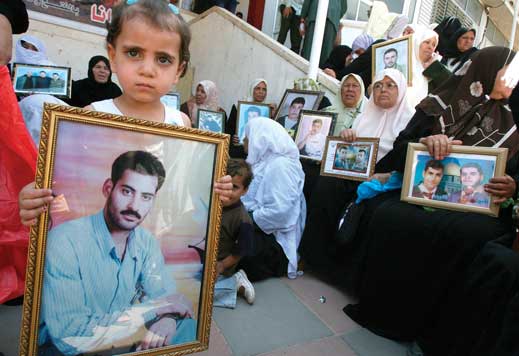
AN ELDERLY WOMAN was brought to my public service doctor’s office suffering from lack of sleep. Apparently demented, she had been hallucinating and sleepless for the past few weeks. Although she did not recognize her daughter and grandson who brought her to the clinic, and could not remember what she had for breakfast that morning, she told me proudly: I am Saida the daughter of Said Al Ali (while the name is fictitious, the story is still very true!). The patient then began reciting a poem praising her father who, according to the poem, was a very brave man, kind with the poor, arrogant with tyrants, and who on one occasion slapped a British general in the face while he was imposing a curfew on the Ramallah and Al Beireh region. Saida told me that she hears that same poem wherever she goes. “It must be recorded on a cassette!” she concluded. “Everyone is playing the same cassette!”
Saida’s relatives explained to me that her father was a local leader in the Al Beireh region, where, in the mid-1930s, he worked hand in hand with the leaders of the Palestinian revolution against the British. Since the onset of her illness Saida had not stopped talking about her father.
I was amazed at this 84-year-old woman’s need to idealizeher father as both parent and national figure. It reminded me of children’s boasting: “My father has a big car,” one will brag. “But my father’s car is bigger,” responds the other, to which the first retorts, “My father’s car is very fast,” and so on—evidence of the natural and universal need for children to feel proud of their fathers. We adults have this same need as well: to emphasise that our fathers are the best, not at all dishonorable or degraded. The difference is that, as adults, we’ve learned how to convey this more subtly.
In Palestine, however, the vicious policies of the occupation have tarnished the image of the father in the psyche of each and every Palestinian.
We see our fathers physically and emotionally exhausted; their lives are dreary and they survive at the whim of the occupier. Most have spent their lives as refugees waiting in long lines at UNRWA offices to receive their allowance of sugar and flour. We have seen our fathers forced to undress at checkpoints, yelled at by a soldier newly arrived from Ethiopia or Russia, pushed away by a tiny woman soldier holding a large gun almost as big as she is. We’ve seen them taken out of our houses in the middle of the night, handcuffed and blindfolded. Palestinian kids feel the anxiety of their fathers who cannot afford to buy them holiday clothes or schoolbooks.
Many frustrated Palestinians turn away from the painful image of their real fathers to seek the lost ideal in our national leaders. It is no surprise that many of the latter chose noms de guerre evoking fatherhood with “Abu” (“father of”): Yasser Arafat was called Abu Ammar, and Khalil Al Wazeer was known as Abu Jihad. Some names, such as Abu Ali Mustafa, have become so familiar that one can hardly remember their given name!
By presenting themselves as father figures, these leaders seek to be recognized as the authoritative protector and provider, men of power and influence, arousing emotions, such as respect and obedience, a person usually feels for his father, with whom he identifies psychologically.
Today, we have a new father figure crisis in Palestine—on the national level. One need only look at the latest photos from Gaza and Hebron, where those in power are beating up their opponents, for evidence. Gone are the leaders we admired and trusted—leaders with an inner core of integrity, confident enough to value differences and respect the other, aware that they do not have all the answers and therefore open to thoughtful influence and criticism, and willing to invest in preserving working partnerships.
Today’s leaders no longer honor and advance national values. Bowing to the god of personal power, they have confined themselves to the interests of their party alone. Because they provide us with less and less as a result, they have become largely irrelevant in people’s lives.
In additon, their leadership is problematic and disoriented. Instead they act as harsh disciplinarians. Their tough guys roam around, attempting to intimidate the people into seeing their bosses as powerful and triumphant. But the harsher they are, the more insignificant they appear in the eyes of their people, who understand that only a leader who makes his people feel secure and valued—regardless of his standing in the eyes of the world—is strong, just and important, and thus deserving of the utmost loyalty.
Nowadays, our leaders are feared, but not trusted. They paint the world in black and white, meet violence with violence, act in isolation with arrogance and hubris, and harden their hearts to the suffering and pain their actions are causing.
Not long ago, there were moral boundaries, over which our leaders stood guard. Today, we don’t know exactly where the lines are drawn, or when our leaders might be crossing them. As we see them fueling the fires of hatred instead of working on behalf of their people and nation, we realize what an embarrassment they are to our emerging national identity. This weighs heavily on people, and they seek an identity elsewhere.
This critical absence of a national father figure—and the resulting search for trustworthiness, protection, provision and an example worthy of emulation—requires a major transformation at the local level, where we must assume responsibility and discover our own resourcefulness. Palestinians need to initiate an in-depth dialogue on a national leadership based on our ideals of integrity, freedom to disagree, fairness, mutual responsibility and national unity. In assuming this responsibility, we will be restoring the lost values to our leadership and the highest aspirations to our national cause. Only in this way can we preserve for future generations the legacy of men like Said Al Ali, men who make not only their biological children, but their entire national family, truly secure and proud.
Samah Jabr is a psychiatrist practicing in the West Bank and her native Jerusalem.















