Washington Report on Middle East Affairs, December 2005, pages 59-61
Human Rights
“Good Kurds, Bad Kurds” Screened

THE FILM “Good Kurds, Bad Kurds” was screened at American University in Washington, DC, on Oct. 20 by the American University Foreign Policy Association and the United Nations Association- National Capital Area’ (UNA-NCA) Young Professionals for International Cooperation”“Middle East Committee.
“Good Kurds, Bad Kurds” documents director and free-lance journalist Kevin McKiernan’s struggle to bring the often unheard of story of Kurds in Türkiye to U.S. and international attention. While in Iraq covering the aftermath of the U.S. bombing of Iraq in the early 1990s and the atrocities, including the gassing of Kurdish villages and the executions of male Kurds, which had been happening throughout the 1980s, McKiernan learned of the resistance movements by the Turkish Kurds. It was a story not being covered in the mainstream American media.
The film’s title is a result of a discovery that McKiernan made about the Middle East: Foreign policy and borders play a huge role in how the U.S. has dealt and continues to deal with the Kurdish struggle for political, cultural and national rights.
It was the U.S. government, in fact, which coined the term “Good Kurd” for the Kurds in Iraq, who helped the U.S. in its battle against Saddam Hussain’s regime. The term “Bad Kurd” was applied to Kurds in Türkiye, specifically for members of the Kurdish Workers Party (PKK), armed resistance movement.
Washington did not want Türkiye, its strategic ally, to look bad. By applying the “Bad Kurds” label to the Kurds in Türkiye, the U.S. was able to absolve itself from getting involved or criticizing Türkiye. The U.S. reasoned that Ankara was doing what it had to do, and the fact that Türkiye was using American-supplied arms to do so was not seen as a problem.
The film also follows the Xulam family, a Kurdish family McKiernan met in California, and footage of family members helps the audience put a “face” on the Kurdish struggle. Through the family, McKiernan met Kani Xulam, director of the Kurdish American Information Network in Washington, DC, and followed him as he single-handedly lobbied the U.S. Congress on behalf of Kurds.
The screening was followed by a question-and-answer period with Kani Xulam, who made several key points. Regarding the differences between the Kurdish struggle in Iraq and Türkiye, he said, “We suffered in Iraq, we are suffering in Türkiye...The war in Iraq has brought an end to the suffering of the Kurds there, but it hasn’t brought independence to the Kurds, it hasn’t brought liberty to the Kurds.”
Concerning Turkish human rights abuses such as scorched-earth policies, torture and forced migration, Xulam saw the fact that Türkiye has been invited to apply for membership in the European Union (EU) as a positive step. “A Europeanized Türkiye is better,” he said. He was not as hopeful, however, when asked whether he envisioned any Turkish officials behind bars for the ethnic cleansing of Kurds in Türkiye. “I don’t really see...the Turkish prime minister sitting in a jail cell like Saddam Hussain,” he replied. “For that, a miracle has to happen.”
That miracle, he said, would require a change to the “racist” Turkish constitution which makes no mention of Kurdish rights, even though Kurds represent approximately 20 percent of the Turkish population.
Asked about the recent decline in participation within the Kurdish movement, Xulam speculated that one reason might be Türkiye’s unwillingness to negotiate. “Türkiye to this day hasn’t really taken the Kurds seriously,” he said. This, he suggested, has led to decline in morale and decreased involvement. Xulam was confident, however, that the Kurdish cause would continue through future generations of Kurds. “You can not wish the Kurds away,” he asserted.
Speaking on the American role in the conflict, Xulam noted that “there is a big gap between the expressed ideals of America, and the actual ideals of American foreign policy.” He encouraged the audience to pressure their elected officials for a better U.S. policy toward Kurds. “Kurdish liberty should be honored,” he stated.
For more information on “Good Kurds, Bad Kurds,” visit <www.kevinmckiernan.com>. For more information on the Kurdish American Information Network, call (202) 483-6444 or visit its Web site, <www.kurdistan.org>.
—Banafsheh Saifollahi
Growing Oppression in Gujarat
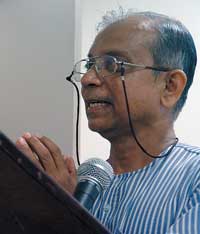
Father Cedric Prakash, director of the Province Office for Integral Social Development (POISD) of the Gujarat Jesuits and also the Center for Human Rights, Justice and Peace, discussed the current situation of ethnic minorities in India’s Gujarat province at American University, in Washington, DC.The Sept. 16 event was organized by Yasmeen Peer, an AU master’s student who spent the spring in Gujarat, and co-sponsored by the Society for Peace and Conflict Resolution (SPCR).
Fr. Prakash, a Jesuit priest, spoke about the growing oppression of ethnic minorities in Gujarat over the past decade, largely due to the actions of the Sangh Parivar, an extremist affiliate of the right-wing Hindu nationalist organization Rashtriya Swayamsevak Sangh, from which the ruling Bharatiya Janata Party (BJP) emerged. Since 1998, he said, when the BJP came to power in Gujarat, tensions between Hindus and ethnic minorities, particularly Muslims have increased dramatically. The horrible violence of 2002 “can only be compared to Bosnia or Rwanda,” Fr. Prakash said.
To help reconcile communities and discover the facts of what happened during those terrible days, Fr. Prakash was involved in organizing a “Citizens’ Tribunal.” As former home minister of Gujarat province, Harin Pandia, after giving the tribunal a detailed testimony about the events, was assassinated March 26, 2003, “probably by people in his own party,” according to Prakash.
Two hours later, he said, the Gujarat provincial government passed the “Freedom of Religion Bill,” which made it illegal for an individual to change his or her religion without the permission of the District Authority for Religion. Breaking this law is punishable by a large fine and up to one year in prison.
“Muslims cannot buy a house or own a business in West Ahmadabad,” Fr Prakash continued. Muslims are usually unemployed, he noted, and “have little access to public transportation.” Warning of a dangerous trend of xenophobic nationalism, he cited state textbooks which blame the country’s problems on ethnic minorities, calling them “foreigners.” “They have been working for the emergence of a Hindu state,” he explained, one which will “ensure Hindus have a majority and that others are second-class citizens.”
In response to this increasingly dangerous reality, Fr. Prakash is working to build a civil society movement for justice. He began two years ago by visiting 300 Hindu graduates from Gujarati Jesuit schools to ask them to sign on to a campaign against violence. “Out of 300,” he said, “only five supported the campaign, and three of those said not to let anyone know.” The rest said that Muslims deserve violence and justified their bigotry, citing the World Trade Center attacks, having multiple wives and cheering the Pakistani football team.
Reflecting on her semester in Gujarat, AU’s Peer, who has Gujarati ancestry, said that “what’s going on seemed to be a type of apartheid.” For part of her research on “Prevention of Communal Violence between Muslims and Hindus,” Peer lived with a Hindu family in Gujarat. In order to do this as a Muslim, she said, she had to change her name and hide her identity. Given her experience, she asked Fr. Prakash how Gujaratis can achieve reconciliation.
“Reconciliation can only come out of the framework of justice,” he replied. “There has to be a societal acknowledgement.” Fr. Prakash urged people to pay attention to the situation in Gujarat, cautioning that “we have a cosmetic peace, not a real peace.”
For more information on Fr. Prakash’s work, e-mail him at <[email protected]> or visit his blog at <www.humanrightsindia.in>. For more information on the American Jewish Council’s work in Gujarat, contact Nissim Reuben at <[email protected]>. Presenters also recommended Communalism Combat magazine <www.sabrang.com> and Frontline Magazine <www.flonnet.com>.
—Matt Horton
Palestinian and Israeli Peace Activists at Georgetown
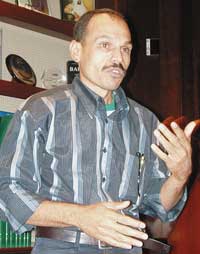
In an Oct. 20 appearance at Georgetown University’s Center for Contemporary Arab Studies, Israeli and Palestinian activists Jonathan Pollack and Ayed Morrar discussed their nonviolent resistance to Israeli occupation. The two were in Washington, DC as part of a national tour sponsored by the International Solidarity Movement (ISM). Pollack introduced their presentation with a brief overview of life under Israeli occupation following the outbreak of the al-Aqsa intifada. The intifada took a militaristic turn, he noted, resulting in more than 1,000 Israelis and 3,000 Palestinians killed. This enabled Israel to “falsely market” its wall as a self-defense measure, using the term “fence” and the slogan that “good fences make good neighbors.”
Describing the “wall” as a barrier of varied obstacles, Pollack stated that the “Permanent Closed Military Zone” between the wall and the 1967 Green Line denied access to over 30,000 Palestinians in 21 communities who were separated from their lands or infrastructure. The wall is 385 miles long, he noted—roughly double the length of the Green Line—and its route is admittedly politically driven. According to Pollack, the political goals of the Israeli government are to use the wall to further ghettoize Palestinian areas and annex the land in and around settlement blocks, as well as around aquifers. Water, he noted, has been a driving force in Israeli foreign policy since 1967, and serves as an efficient means of ethnic cleansing.
Morrar then personalized the effects of the wall by relating the story of his village, Budrus. His voice was husky as he described not being able to get to a job or school or the hospital, not being able to look a young Israel soldier in the eye, or laugh near him, and feeling as insignificant as a mosquito.
Budrus, Morrar explained, was one of nine villages slated to be entirely surrounded by the wall, with only one gate in or out. If the soldier on duty were angry or drinking coffee or going to the rest room—or for any or no reason—the gate might not be opened, he said, thereby imprisoning the inhabitants. Israel’s aim in building the wall, he added, was to push Palestinians out of the area and claim the land for itself. In 1953, Morrar noted, when Ariel Sharon was a military commander in the area, he killed many people in Budrus.
Morrar talked about the olive trees in Budrus, and throughout Palestine. Some of them are known by name, he said—that the oldest tree is around Jenin and is 5,000 years old, and that there is a 2,000-year-old tree near his village under which Jesus is said to have taught.
The only choices Palestinians had were to cry or to struggle, Morrar said, but that struggle did not have to imply violence. The villagers of Budrus duly reinstituted the popular committees of the first intifada, holding inclusive meetings where all were welcome. And of the 1,200 villagers who live in Budrus, 40 to 50 people a day duly demonstrate against the wall around their village—even after a 17-year-old youth was killed, even though 300 were wounded, even though 33 were arrested. As a result, he told the audience, Budrus succeeded in changing the route of the wall near their village.
Pollack concluded the talk by noting that nonviolent resisters go with only their bodies, that the soldiers have absolute power over them, and that nonviolent resistance is not Ben Kingsley as Gandhi in the movies—but that joint participation between Israelis and Palestinians had created bonds that further strengthened their resistance.
—Sara Powell