Washington Report on Middle East Affairs, August/September 2016, pp. 77
Diplomatic Doings
Iraqi Ambassador on U.S.-Iraq Relations
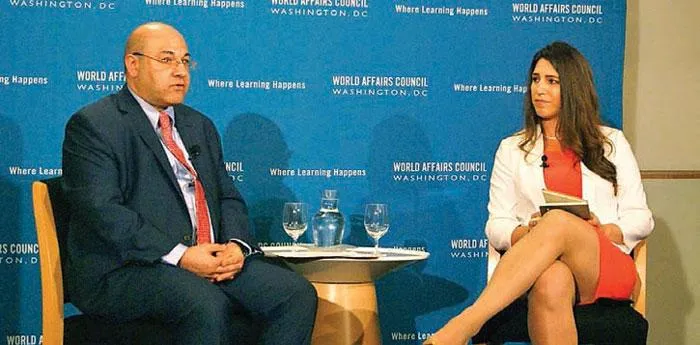
THE WORLD AFFAIRS Council in Washington, DC hosted Lukman Faily, Iraq’s ambassador to the U.S., on June 1 as part of its “Ambassador Series.” Faily, who has subsequently concluded his three-year stint in Washington, addressed pressing issues facing Iraq and the world, Iraq-U.S. relations, and his vision for the future of his country.
Ambassador Faily began by stressing the interconnectivity between the challenges facing the world—namely, refugees, human rights, nuclear issues and terrorism—and those facing the Middle East. “We as a region have had internal issues which have had ramifications across the globe,” he pointed out, “so unless the region is fixed, global challenges will always be there.”
Given this reality, Faily challenged the U.S. and the international community to do more to proactively address these issues, particularly terrorism. The U.S., he said, must determine whether or not it is willing to invest in defeating the root causes of these crises, or approach these issues with containment as its strategy.
According to Faily, it is more beneficial for the U.S. to extensively invest in Iraq. “It is important that the stability of Iraq is seeded in the U.S.,” he argued: “A) because of the richness of resources, which means an unstable Iraq will significantly cause an issue for all production. B) The epicenter of the region has always been Iraq.”
However, U.S. intervention has not always positively impacted Iraq. Faily raised the issue of the 2003 invasion multiple times, saying the U.S. “did not do their homework,” resulting in many of the serious issues Iraq faces today.
Faily did indicate that there were some positive outcomes of the invasion, however, saying, “Iraqis now have the will to think and the will to act.” He replied to an audience member who asked if the U.S. should have ever invaded Iraq, “They did not have this [will] before 2003,” under the reign of Saddam Hussain.
Faily also addressed the possibility of dividing Iraq along ethno-sectarian lines, a political solution proposed by some in the West. In his opinion, this would cause more harm than good, as determining fair borders would be nearly impossible, and sectarianism would not remain confined to any borders. “[You would be] destabilizing the region, as well as making sure that Iraq cannot function together,” Faily said. “Iraqis coexisted together long before Saddam Hussain.”
—Massarah Mikati