















Washington Report on Middle East Affairs, August 2005, pages 56-61
Human Rights
Iraqi Union Leaders Declare U.S. Policy Counterproductive
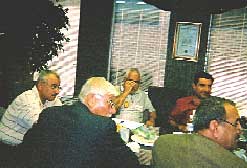
AS PART OF a two-week tour organized by U.S. Labor Against the War (USLAW), a coalition of American labor unions opposed to the war on and occupation of Iraq, six Iraqi union leaders visited 20 major U.S. cities from June 10 to June 26. Their Washington, DC activities included a June 14 press conference, a June 12 speech at the Plymouth Congregational Church, and June 13 appearances at the Peace Cafe at Mimi’s American Bistro and at George Washington University.
The six labor leaders represent three key Iraqi trade union organizations: the Iraqi Federation of Worker’s Trade Unions (IFTU), the Federation of Workers Councils and Unions of Iraq (FWCUI), and the General Union of Oil Workers, Basra (GUOW). While in the U.S. they met with AFL-CIO officials, members of Congress, African-American leaders, members of the media, union workers, students, policy analysts and the general public. The primary goal of the Iraqis and their tour organizers was to inform members of the U.S. labor movement and the American public about the difficult working conditions Iraqi workers and the labor movement face.
Falah Alwan, president of the FWCUI, told the Washington Report on Middle East Affairs,,“Even though Saddam Hussain is no longer in power, the United States and the new Iraqi government are enforcing his laws banning most unions. Iraqi union leaders still face intimidation, torture, arrest and death threats.”
Falah Abood Umara, general secretary of the GUOW, which represents 23,000 workers, confirmed that many union leaders in Iraq have been “harassed, arrested for months without charge, and beaten by the occupation authorities. We receive death threats from both the occupiers and the insurgents.
“The U.S. views unions as an obstacle to their efforts to privatize all of Iraq’s industrial sector, while the insurgents view our work in the oil fields as an act of compliance with the occupying forces,” Umara explained. “So we are caught in between.“
According to Abed Sekhi, IFTU executive counsel and member of the Agricultural Workers’ Union, U.S. occupation forces arrested eight members of the IFTU’s governing board last year. “Without any formal charges all eight IFTU members were kept in jail for more than one week,” he said.
During their meeting with Congressmen John Conyers (D-MI), Dennis Kucinich (D-OH), and Shelia Jackson Lee (D-TX), the six leaders spoke of their unanimous desire to end the occupation of their country. “The oil sector, which is the most important industrial sector in Iraq, is facing serious challenges from the U.S. administration,“ Umara and his GUOW colleague Hassan Juma’a Awad Al Asade told the American legislators. Unemployment in Iraq stands at 55 percent nationwide, and in some areas is as high as 70 percent. Yet the U.S. administration is currently recruiting Asian workers to come and work in the oil fields, the labor leaders said.
Al Asade questioned the wisdom of the U.S. policy, which, he said, promotes discontent and unemployment.“We, the Iraqi oil workers, who know our oil fields, have worked in the oil sector for many years and who are skilled at extracting oil with the most basic of tools, are told to stay home so that the Asian workers who are brought by plane in the hundreds can work our own fields,” he complained. When the occupation forces entered Iraq the Halliburton subsidiary KRB brought 1,200 Asian workers to the Basra oil fields. At the time unemployment in Basra was almost 70 percent, Al Asade said.
The U.S. occupation authorities have slashed the base industrial wage of Iraqi workers to $35 a month, the labor leaders said. “In the meantime,” Umara added, “the occupation authorities have allowed the prices for food, cooking and heating oil to skyrocket.”
“The current U.S. policy in Iraq is counterproductive and stirs much anger and resentment among Iraqis,” said Sekhi. “The U.S. efforts to lower workers’ wages, quickly privatize public sector industries, outsource work to foreign laborers, and at the same time increase the cost of daily necessities breeds discontent.”
The Iraqi labor leaders spoke of the hazardous security situation facing their countrymen, along with the lack of such basic services as health care, clean water and electricity. Workers in the large oil refineries and other factories work 13-hour shifts with no overtime pay. In several cities, and throughout the industrial and agricultural sector, Iraqi workers have gone on strike to correct grievances on the job and demand wage increases—only to be shot at by authorities.
The “U.S. administration intends to weaken the Iraqi labor unions and marginlize their efforts to represent the Iraqi worker,” Al Asade concluded. “For privatization to succeed in Iraq, the U.S. occupation is conducting a systematic campaign to weaken labor unions either by enforcing Saddam Hussain’s laws against labor, or by harassment, intimidation and threats.”
For more information visit <www.uslaboragainstwar.org>.
—Mai Abdul Rahman
AFLCIO’s Leadership Cautiously Meet Six Iraqi Labor Leaders
The six Iraqi union leaders visiting Washington were puzzled by the cold reception they received at a meeting with America’s top union leaders at AFL-CIO headquarters. “It is apparent to all of us in the meeting that the American union leaders we met today were reserved and cautious,” Abed Sekhi of the Iraqi Federation of Worker’s Trade Unions (IFTU) told tour organizers. “All six of us want to know why!”
After an awkward pause the organizers candidly told the Iraqis that the AFL-CIO is closely affiliated with the current administration’s policies toward Israel and overall has supported the invasion of Iraq. Explained Gene Bruskin, U.S. Labor Against the War co-convener: “Some of our union leaders support Israel and are supportive of the close association that the Bush administration has with Sharon’s government. They have exerted tremendous pressure to support the invasion. This has compromised our efforts to mobilize against the war.“
Because of the AFL-CIO’s position on the war, Bruskin told the Iraqis, their trip was sponsored not by the AFL-CIO but by USLAW, which opposed the U.S. invasion of Iraq.
The Iraqis were also told about the current power struggle for control of the AFL-CIO being waged in the United States. Frequent media reports have covered the challenge by some of the country’s largest labor unions to the leadership of the AFL-CIO president John Sweeney, demanding that he make significant political and strategic changes or face the unions’ withdrawal from the Federation. There currently is a split among the union leaders who are very concerned about the AFL-CIO’s close association with the Bush administration, the Iraqis were told, with one tour organizer explaining, “It is not a surprise that many among us call them the AFL-CIA.”
In the past year union leaders have openly questioned Sweeney’s support of the Project for the New American Century (PNAC), an organization whose primary purpose is to promote the establishment of an American global empire through the use of military and economic power. PNAC supports the doctrine of pre-emptive war in the Middle East and Asia. Founded by Vice President Dick Cheney, PNAC includes among its members Defense Secretary Donald Rumsfeld and Florida Governor Jeb Bush, the president’s brother.
Because of the AFL-CIO’s position on the war, Bruskin told the Iraqis, American unions in the past have been timid and unwilling to launch a national campaign against the U.S. occupation of Iraq. But, he assured them, this is no longer the case. A petition is circulating among union members that will force Sweeny, national union officers, union representatives and delegates to address the issue of the Iraq war during the AFL-CIO’s July convention. Several American union leaders are urging convention delegates to support their resolution calling for the immediate end to the Iraqi occupation.
Despite the cool reception at AFL-CIO headquarters, organizers of the tour saw these face-to-face encounters as an opportunity to bring authentic Iraqi voices to American workers and union leaders, and to help educate Americans on the war’s effect on ordinary working Iraqis.
—Mai Abdul Rahman
The Atlas of Palestine 1948
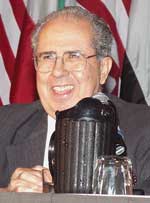 In a May 27 appearance at the Palestine Center in Washington, DC, Dr. Salman Abu Sitta, founder and president of the Palestine Land Society, presented his opus, The Atlas of Palestine 1948.
With 450 color pages documenting 1,300 towns and villages, 11,000 landmarks and 20,000 place names, and including 55 tables and 60 incredible maps, The Atlas of Palestine 1948 is the premier historical record of British mandate Palestine and al-Nakba (the Palestinian catastrophe).
Dr. Abu Sitta began his presentation describing the history of mapmaking in Palestine. “A map is a birth certificate of a place, the identity card of a place,” he explained. “A map of a place means you own the place.”
The first scientific map made of Palestine was by a French cartographer in the service of Napoleon, he told the audience, adding that, throughout the ensuing years of conquest, colonization and occupation, “the mixed blessing is that they made maps we can use today.”
The Atlas draws heavily on maps made by Western powers, as well as tens of thousands of aerial photographs taken by German pilots during WWI and British pilots during WWII. The photographs, many of which are included in The Atlas, demonstrate that the land was clearly settled and developed, thereby refuting any notion that Palestine was “a land without a people.“ “That myth is not only false,” Abu Sitta stated, “but it is a wicked lie in order to make the Palestinian people homeless.”
The Atlas also resurrects the original names of places erased by the Zionists starting in 1948. Not only is the mere restoration of these names revolutionary, Abu Sitta noted, but “the names also restore the vocabulary of the people and the history.”
The Atlas also documents in detail the process of border creation by the Western powers “for the specific purpose of excluding that piece of cake from the Arab world.” The invaluable reference work also demonstrates that Palestine’s “strange top” is the result of efforts to secure water sources. Abu Sitta documents that in the post-World War I division of the Arab world into French and British spheres of influence, 23 Palestinian villages were dissected. “Their lives were shattered.” he stated. “The story of all this is colonialism, where the foreign powers divide the land and the people suffer.”
Nor was this the only time boundaries would be decided arbitrarily. When the 1949 armistice line—today’s “Green Line”—was solidified into the boundaries of the state of Israel, another 111 Palestinian villages were dissected, he noted, and as they worked “people were crying and screaming behind the U.N. and Israeli surveyors who were arbitrarily dividing the lands and villages.”
Documenting the infrastructure that the Zionists “inherited” when the British left, The Atlas demonstrates that the Zionists “not only got the land, but they got an instant state with all of the offices, railways, [and] roads,” Abu Sitta said, along with 3,659 water sources, 2,000 religious places and 37 military camps with weapons and equipment.
Perhaps the greatest accomplishment of The Atlas is its documentation of al-Nakba. Twelve maps show the phases of al-Nakba, accompanied by descriptions of 675 villages depopulated, including when people were expelled from their homes, by which military operation, and why people left. The text also documents 70 massacres that propelled people to flee.
The most devastating refutation of the Zionist myth is Abu-Sitta’s demonstration that half of the total Palestinian refugees were created by Zionist militias while Palestine was still under British mandate, and before the establishment of the Jewish state on May 15, 1948. Such documentation lays bare Israeli claims that the atrocities committed were a result of attacks by “Arab armies,” or that Palestinians left their homes because they were instructed to do so. It also gives credence to the claim that Arab militias were responding to Zionist ethnic cleansing when they came to Palestine to help save what little was left.
 The Atlas documents how “85 percent of the inhabitants of the land that became Israel became refugees,” Abu Sitta said, and that “we didn’t just lose that land and the homes, we lost the complete infrastructure of the society.” Dr. Sitta also has compiled a database of 4.5 million registered Palestinian refugees, along with 1.5 million who are not registered, which includes refugees’ names, family relationships, their village of origin and where they live today. The Atlas also documents patterns of refugee flight—why they went where they did. Moreover, not only did Palestinian villages not split, but neighborhoods and entire villages remain together in exile.
“The Right of Return is an inalienable right,” Dr. Abu Sitta pointed out. “Nobody, absolutely nobody, can give this right away beyond the person themself.”
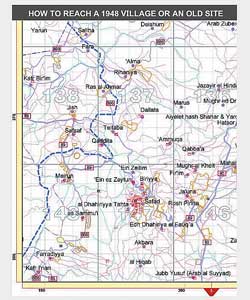
With this in mind, The Atlas includes a guide describing how refugees can find villages and other sites using modern Israeli roads. The Atlas exists “not only to recover the names of Palestine,” Dr. Abu Sitta concluded, “but as a blueprint for the future, when the Palestinian people will be allowed to return home.”
The Atlas of Palestine 1948 is available for $200 + shipping. In the U.S., contact the Institute for Palestine Studies at <www.palestine-studies.org> or phone (202) 342-3990. In the UK or Europe, contact Al Saqi Books at <[email protected]> or call +011 44 20 7229 8543. For all other countries, contact the Palestine Land Society (<www.plands.org>).
—Matt Horton
Survey Rates Women’s Rights in MENA Region
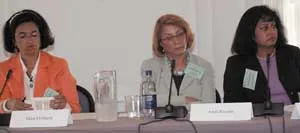 Panelists discussed a recent Freedom House survey entitled, “Women’s Rights in the Middle East and North Africa: Citizenship and Justice,” at a June 7 luncheon at Freedom House’s Ballroom in Washington, DC. The event was co-sponsored by the Center for the Study of Islam and Democracy (CSID) and Freedom House, a non-profit, non-partisan organization that advocates democracy and freedom around the world.
CSID president Radwan Masmoudi first gave an overview of the historical importance of Islam to women’s rights in the Middle East/North Africa (MENA) region. Pointing out the often-unrecognized impact Islam can have with respect to advancing these rights, Masmoudi cited examples of women who held leadership positions in Islamic history, including Khadijah, who is recognized as the first independent Muslim businesswoman.
Cautioning that misconceptions can emerge in the course of cross-cultural comparisons, Masmoudi argued that issues such as the advancement of women’s rights should not be placed exclusively within the context of Western culture. According to Masmoudi, problems with women’s rights in the MENA region can be caused by social culture and mechanisms, economic realities, and government repression on freedom.
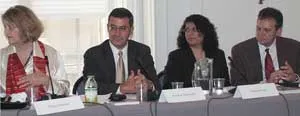 Sameena Nazir, the study’s senior research coordinator, presented an overview of the study’s findings. The U.S. Department of State’s Middle East Partnership Initiative funded the study, conducted over a period of 20 months in 16 countries and the Palestinian territories. The report covered several broad themes with respect to women’s rights, including “nondiscrimination and access to justice”; “autonomy, security, and freedom of person”; and “economic rights and equal opportunity.”
Each country was compared with others in the region, Nazir explained, then measured against international human rights standards, most notably the Universal Declaration of Human Rights. For example, it was noted that the Persian Gulf received a high score for funding education and health care programs and a low score for efforts toward equality and political rights, whereas poorer states, like Yemen, scored lower on education and health but higher on equality and political rights.
Included within the broader themes were more specific findings, Nazir said, such as “inferior status due to legal discrimination” resulting from a contradiction between a country’s current laws and its constitution. Family laws can restrict women’s freedom of movement and ignore domestic violence, she noted. Although not limited to the Middle East, this last point is particularly vital to women in the region. In the absence of clear laws to criminalize or prevent domestic violence, or with the presence of laws which complicate legal recourse, abuse is unstoppable. In addition, social customs and practices may encourage abusive behavior. Finally, Nazir observed, few countries have a mechanism in place to inform women about their rights or to receive complaints against infractions.
Brian Ketulis, a senior consultant at Freedom House, explained that focus groups were established in order to listen to public perceptions of the status of women’s rights rather than evaluate these rights. Those focus groups found that in 10 years the status of women had improved because of great strides made in education and job opportunities.
Focus groups also found that these advances could become weightless, however, because of several factors such as the public’s lack of faith in laws on the books—the concept commonly referred to among Arabs as hibr ala waraq, or ink on paper. Ketulis and other panelists explained that this lack of faith exists due to the absence of efficient mechanisms to enforce the laws.
Ketulis emphasized another important finding of the study: Both sides of the debate regarding women’s rights claimed their arguments were inspired by religious doctrine. The panel concluded that it was varying religious interpretations of Islam that were to blame for the status of women in the region, not Islam itself.
Amal Rassam, an Iraqi-American anthropologist and the author of the study’s Iraq section, presented a short history of women’s rights in Iraq and provided an evaluation of their rights in the year 2003. The history of Iraqi women’s rights under the Ba’athist regimes was a mixed one, Rassam said, pointing out that in the 1970s women were heralded as leaders spearheading the economy. As a result of massive government funding, many women received formal education and entered the workforce as engineers, scientists or judges.
According to Rassam, beginning in the 1980s these advances were reversed as a consequence of the Iran-Iraq war, the two Gulf wars, and sanctions, which depleted the country’s resources, thereby halting economic development and limiting work opportunities for all. In an effort to placate some conservative tribal leaders in the aftermath of the Iran-Iraq war, Rassam continued, Saddam’s regime began to relax laws punishing violations of women’s rights, such as those relating to criminalizing honor killings. Since 2003, Rassam concluded, the status of women’s rights has been unstable, but suggested optimism in the new Iraqi government’s relationship with its local women’s movement.
In the final address, scholar Margot Badran of Northwestern University praised what she saw as a work that “brings Islam into the picture as an aid in support of women’s rights.” Elaborating, she explained that the study represents an alternative to the view that only secularism could guarantee these rights. This contrasts with the reality in the MENA region, where the feminist movement has consisted of both secular nationalism and Islam as linked together as inseparable trends.
For more information visit Freedom House’s Web site, <www.freedomhouse.org>. To order a paperback copy of the comprehensive study ($29 plus shipping) call Rowman & Littlefield Publishing Group (1-800-462-6420).
—Motazz Soliman
Emergency Committee for Iraq Launched
 Former Attorney General Ramsey Clark announced the formation of the Emergency Committee for Iraq on June 15 at the National Press Club. Co-chairs, including Clark; former Prime Minister of Malaysia Tun Dr. Mahathir Mohamad; Ahmed Ben Bella, Algeria’s first president; and former Foreign Minister of France Roland Dumas, intend to shed light on the lack of due process afforded those who have been imprisoned as a result of the 2003 U.S. invasion of Iraq.
Clark mentioned specifically the lack of access to family and counsel of such high-profile prisoners as former President Saddam Hussain and former Defense Minister Tariq Aziz. As the dominant power in the occupied country, Clark said, the U.S. must follow the rules of international law, and must ensure that each defendant is tried in a legitimate court. He further elucidated that no special court was a legal court, because by definition it was set up for a specific purpose, with an agenda. Though it would be difficult to find a court under whose jurisdiction Hussain, Aziz and others could be tried, Clark said, a way must be found.
Clark mentioned that while the U.N. had no authority per se to set up a court, it could do so by treaty, although that would compromise other legal principles of timing. As long as it is necessary to ensure that all the Iraqi people are treated fairly, including those who are on trial, the Emergency Committee for Iraq will bring the world’s attention to these important questions.
—Sara Powell
Counter-Recruitment Meeting in Des Moines
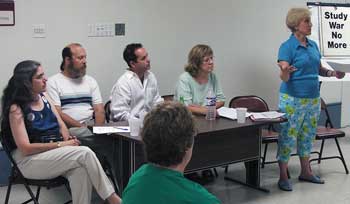 Organizers were delighted when a larger-than-expected crowd of some 60 people showed up June 21 for a counter-recruitment informational meeting at Grace United Methodist Church in Des Moines, Iowa. Kathleen McQuillen, American Friends Service Committee Central Region Iowa program director, introduced a panel of activists who spoke about various aspects of military recruiting.
Jan Hill, a social worker and mother of two children, one of draft age and one nearing draft age, discussed the No Child Left Behind Act. She experienced “shock and awe,” she said, when she learned that the law gives military recruiters ready access to students and their contact information.
“We can fight this,” maintained Hill, noting that parents can exercise an opt-out provision in the law if they get the information they need in time.
Fran Fuller of the Des Moines Catholic Worker Community spoke about military aptitude testing in schools. The Armed Services Vocational Aptitude Battery (ASVAB) is given in high schools, Fuller said, but students are not required to take it. Policies regarding ASVAB differ from school to school in the Des Moines area, she told the participants.
“The student needs to know that it’s OK to say no,” added Fuller, who suggested that parents might want to contact school officials to be sure that students who opt out of ASVAB testing are not punished in any way for doing so.
David Palmer of Plymouth United Church of Christ explained the Delayed Entry Program (DEP), which is a recruiting tool. Palmer said recruiters have been known to threaten students with jail and fines if they decide to withdraw from the DEP. “The threats are false,” stated Palmer. “There are acceptable reasons for leaving the program, such as a job offer, or if you decide to continue your education, or if you’re getting married.”
Elton Davis, a Catholic Worker activist, discussed a variety of recruiting and counter-recruiting practices, and the difficulty some branches of the military are having meeting their goals.
“Young people who have been approached by recruiters and have been interviewed post-contact have given us all kinds of stories about what recruiters have told them,” said Davis, who noted that recruiters tend to tell potential recruits what they think they want to hear in order to get them to sign a contract.
“They do not tell the truth,” said Davis. “They lie.”
Sally Frank, a representative of the National Lawyers Guild who serves on the group’s Military Law Task Force, also talked about recruiting practices, as well as conscientious objector status, the draft, and penalties for refusing to serve.
Frank described the case of Petty Officer 3rd Class Pablo Parades. Court-martialed for missing his ship’s movement by design, Parades was sentenced to two months of restriction, three months’ hard labor, and reduction in rank to Seaman Recruit. Noting that Parades, who based his refusal to serve on his belief that the war in Iraq is illegal, was not sentenced to jail time and did not receive a dishonorable discharge, Frank described the sentence as “an enormous victory.”
The judge in the Parades case said, “I think that the government has successfully proved that any service member has reasonable cause to believe that the wars in Yugoslavia, Afghanistan and Iraq were illegal.”
Members of a youth panel responded to the informational panel by describing their experience with recruiters in their schools. Later, a third panel discussed conscientious objector status and how to obtain it.
—Michael Gillespie
Marvine Howe Revisits Morocco
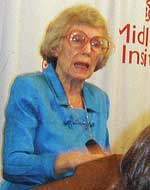 After an absence of more than three decades, journalist and author Marvine Howe returned to North Africa, where she began her career. The result is her latest book, Morocco: The Islamist Awakening and Other Challenges. At a June 7 book lunch at the Middle East Institute in Washington, DC she discussed the changes she observed and the challenges facing the country today.
Among the latter, Howe noted, are the development of civil society and of the women’s movement, Berber demands for equal treatment with Arabs, the continuing issue of Western Sahara, and the massive number of educated unemployed Moroccans.
In her remarks Howe focused particularly on the development of a free press and the growth of the radical Islamist movement. The Internet and Al-Jazeera “broke down all the barriers,” she said, and the Moroccan press and people are “not afraid to speak out anymore.” According to Howe, criticism about inequality, corruption and lack of democracy now is openly voiced. This has not made life easy for the government—“when you open up a country, people start making demands,” she pointed out—but, in her opinion, there is no turning back.
In the 1950s, Howe recalled, Islamists did not pose a problem, because the country was united around national issues. Because the nationalist movement failed to keep its promises, however, political Islam began to appear in the 1960s and ’70s. “The women’s movement knew [the Islamists] were out there,” Howe said, but their warnings were not heeded.
It was not until May 16, 2003—when 45 people, including 12 suicide bombers, were killed and more than 100 wounded, in five simultaneous bombings of Jewish and Western targets in Casablanca—that the threat was taken seriously. King Mohammed VI “reacted dramatically” to North Africa’s first suicide bombing, Howe said, putting democracy on hold and clamping down on opposition groups.
Under his leadership Morocco has worked closely with the U.S. since 9/11, Howe noted. While the king declined to join the “Coalition of the Willing,” he has acceeded on virtually every other point, she said.
Morocco “is at the proverbial crossroads,” Howe concluded. The king can continue what human rights groups call his “regression” to the policies of his father, the late King Hassan, or listen to the voices of change. If, however, there is insufficient change before the 2007 parliamentary elections, she warned, Islamist candidates may prevail.
Howe’s cogent analysis was informed not only by her familiarity with Morocco itself, but by her study of political Islam in secular Muslim countries. A former New York Times bureau chief in Ankara, she is the author of Türkiye: A Nation Divided over Islam’s Revival, as well as several articles for this magazine.
—Janet McMahon















