















Washington Report on Middle East Affairs, November 2007, page 44
New York City and Tri-State News
Al-Bustan Seeds of Culture Campers Explore Heritage of Ziryab and Andalusia
By Jane Adas
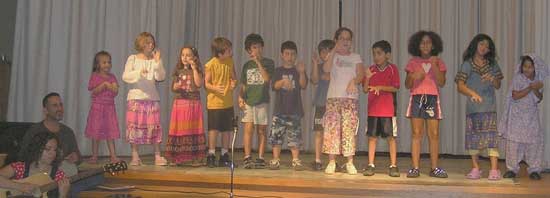
THE NEXT TIME you brush your teeth, or eat asparagus, or use a tablecloth, send a grateful thought to Ziryab, for they are his innovations. A freed slave, Ziryab was a young musician in the court of the Abbasid caliph Harun al-Rashid in Baghdad. In 822 Ziryab arrived in Cordoba, Spain to be a royal singer at the court of Emir Abd al-Rahman II. There he founded a school of music, and also became a sort of minister of culture and arbiter of taste.
Although unfamiliar to most of us, Ziryab is well known to the youngsters who attended the 2007 Al-Bustan Seeds of Culture Camp in Philadelphia, now in its sixth year. The Arabic-language and cultural day camp offers programs in art, music, dance, drama, video and the Arabic language. Each year a different theme integrates the various programs.
This year the theme was Andalusia, using the story of Ziryab as a gateway to reveal the rich cultural heritage of Muslim Spain. The three-week camp culminated in a public program with campers and counselors aged 6 through 18 portraying Ziryab’s life through original drama, music, dance, videos produced by the campers, and an art exhibit. The 45 participants come from diverse ethnic and religious backgrounds, with about two-thirds being of Arab heritage.
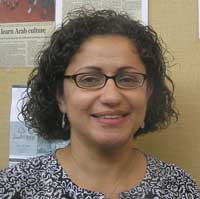
Hazimi Sayed, who is of Lebanese and Egyptian descent, founded Al-Bustan (“the garden,” in Arabic) to give her own children a sense of their heritage and “to provide a place where Arab kids, be they Muslim or Jewish or Christian, could gather with non-Arabs.” The summer camp has been so successful that al-Bustan now offers weekend workshops throughout the year. The music workshops led to the creation of the Al-Bustan Percussion Ensemble, which performs at local venues and schools, and this year released its first CD, “Al Bustan: First Harvest.” Last year the students created an interactive music/dance/drama performance, “Ibn Battuta in the Souk,” which they performed in Philadelphia schools and are now turning into a bilingual storybook.
An important objective of Al-Bustan Seeds of Culture, according to Sayed, is to offer “alternatives to the prevalent negative images of Arabs and Arab culture.” To that end, Al-Bustan has prepared a curriculum supplement on Arabs, Arab Americans, and stereotypes for free distribution in secondary schools. Those inspired to initiate a similar program in their own communities will want to visit the organization’s Web site: <www.albustanseeds.org>.
Jane Adas is a free-lance writer based in the New York City metropolitan area.















