















Washington Report on Middle East Affairs, November 2007, pages 34-35
The Subcontinent
Not Playing by the Book: Politics as Usual in Pakistan
By M.M. Ali
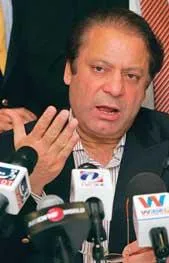 | 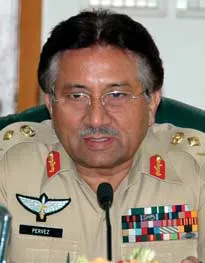 | 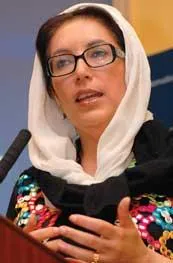 |
| (L-r) Pakistan’s former Prime Minister Nawaz Sharif, President Pervez Musharraf, and former Prime Minister Benazir Bhutto (AFP Photos). | ||
DESPITE THE FACT that this is an election year in Pakistan, uncertainty reigns. This is because the game of presidential politics currently has three players: President Pervez Musharraf, and former Prime Ministers Benazir Bhutto and Nawaz Sharif. Each has his or her own hurdles to overcome. Musharraf wants to remain in office for at least another five years but, confronted by an unfriendly judiciary and the poor standing of his own political party (Muslim League Q), he must seek outside support for his incumbency. With Washington’s support, he has been negotiating with Bhutto, who remains in exile in London under charges of corruption and misappropriation of public funds. The cases against her are now pending in Pakistan courts.
Sharif, who recently met several times with Bhutto to discuss their opposition to Musharraf, knows Bhutto will dump him immediately if the president is willing to strike a deal with her. Therefore, Nawaz decided to return from his exile in London on Sept. 10. All roads leading to the Islamabad airport were blocked and his party activists were jailed. (Sharif, it will be recalled, convicted of “hijacking” the plane of the military’s then-Chief of Staff Musharraf, was released from jail in 1992, thanks to the intervention of Saudi Arabia, and exiled for 10 years.) Upon landing in Islamabad, Sharif was immediately taken into custody and deported to Jeddah, Saudi Arabia.
In addition to these strong-arm tactics, Musharraf once again disregarded the authority of the Supreme Court. (His attempt to remove the court’s Chief Justice did not succeed.) Sharif’s supporters have already filed a petition with the Supreme Court charging the Musharraf government with contempt of court and called upon the Supreme Court to rule that Sharif should be allowed to return. A general strike was held throughout the country on Sept. 11, under severe government-imposed restrictions on assembly and movement.
By sending Sharif into exile again, however, Musharraf may have invited yet another problem. Sharif’s wife, Kulsum Nawaz, has announced that she will return to Pakistan from London to keep the agitation against Musharraf alive. She may be followed by Sharif’s brother, Shahbaz Sharif, who so far has remained in London.
Bhutto announced on Sept. 14 that she will return to Pakistan from London on Oct. 18. Apparently, her talks with Musharraf so far have been unproductive—although they have compromised her position in opposition circles. She knows she must return if she is to make another run for prime minister.
Musharraf has said he will formally announce by Oct. 16 his decision to run for another term as president. While both Bhutto and Sharif insist that he abandon his uniform to run for the civilian position, his treatment of Sharif indicates that Musharraf is willing to use force if necessary to remain in office. There has been talk of a state of emergency being declared, with its suspension of civil rights and delay of elections. In this environment, a Supreme Court decision on the Sharif petition could be critical.
In an unrelated case, the government banned the entry into Karachi of Imran Khan, president of the Tehrik-e-Insaf (Justice Movement) party. When in defiance of the order he flew to Karachi on Sept. 12, he was put on an outbound flight and returned to Lahore.
Turmoil in Waziristan
Resurgent Taliban and al-Qaeda forces in Pakistan’s North and South Waziristan tribal area bordering Afghanistan have targeted Pakistani army and police troops in recent weeks, killing or capturing scores of Pakistani men in uniform. In the first week of September alone, no fewer than 150 Pakistani soldiers were kidnapped, and Islamabad is still trying to negotiate with the Taliban for their release. The military appears helpless, and tribal elders have been called upon to help. Nevertheless, Pakistan is cooperating with the U.S.-led coalition force in its efforts to oust al-Qaeda from the area.
Suicide bomb attacks in the North West Frontier Province (NWFP) have become a routine occurrence since the government’s July military action against the occupants of the Red Mosque and a women’s madrassa (school) in Islamabad. The Mosque has remained closed since an attempt to hold Friday prayers there ended in violence. More recently, bomb explosions have occurred in the fortified military garrisons in Rawalpindi, a military area adjacent to Islamabad
Indian Opposition Parties Criticize Nuclear Deal With U.S.
Following Prime Minister Manmohan Singh’s Aug. 13 statement that India’s nuclear agreement with the U.S. “does not restrict” it from engaging in future nuclear weapons tests, a U.S. State Department spokesman said the nuclear deal would be “terminated” in the event of such a test. This exchange, reported in the Aug. 15 edition of the English-language daily the Hindustan Times, created an uproar in the Indian parliament. Left-wing opposition parties in particular demanded that the nuclear agreement with the U.S. be scrapped, and several Senate meetings had to be adjourned after being shouted down by the opposition. The opposition Communist and right-wing BJP parties have even joined together to form a committee to address the controversy and demand a clarification from the government.
Delhi is well aware of the tremendous benefits it will receive from the U.S. offer to share nuclear technology. Naturally, however, it wishes to gain all it can from the deal, without sacrificing its sovereignty. While the government can point to the opposition to show Washington that not all Indians are convinced of the merits of the agreement, for all intents and purposes it is a done deal.
Prof. M.M. Ali is a specialist on South Asia based in the Washington, DC metropolitan area.














