















Washington Report on Middle East Affairs, November 2007, pages 38-40
Special Report
UAE Seeks Regional Stability, Warns Against War on Iran
By Delinda C. Hanley
UNDER THE AEGIS of the Abu Dhabi-based National Media Council, 13 American newspaper publishers and columnists from Colorado, Iowa, Kansas, Missouri, Montana, New Jersey, Ohio and Washington, DC, including American University Prof. Edmund Ghareeb, set off on a fact-finding trip to the United Arab Emirates this past summer. Our first surprise occurred as we boarded a comfortable Etihad Airways direct flight from New York City to Abu Dhabi. Unlike U.S. carriers, which are cramming in seats and taking away service, UAE’s national airline provides ample leg-room and excellent food, so we were able to hit the ground rested and running.
The next surprise was our realization that we were traveling with a media giant in our midst. Here in Washington, Dr. Ghareeb is a Middle East history and politics professor at the School of International Service at American University and an expert on the Gulf states, Kurds and media issues. In the Middle East, he’s a popular journalist who is frequently interviewed by major media outlets. His presence opened doors this writer never knew existed in a country I’ve visited off and on for two and a half decades.
As a result, we spent an action-packed week meeting a dozen cabinet-level officials and shuttling between the capital, Abu Dhabi, where most government offices are located, and Dubai, where businesses and tourist attractions abound. Dubai and Abu Dhabi joined five other emirates—Ajman, Al Fujairah, Sharjah, Umm Al Qawwain and Ras Al Khaimah—in 1971 and 1972 to form the United Arab Emirates.
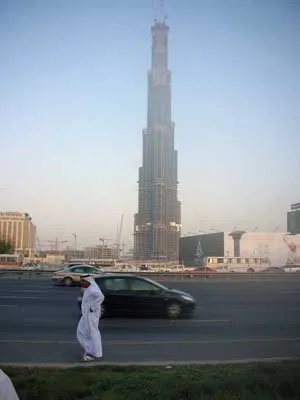
As most Americans know, the UAE’s economy is booming. Dubai’s strategic location at the crossroads between East and West has made it a leading business hub. Slightly smaller than the state of Maine, the UAE shares borders with the Sultanate of Oman, Saudi Arabia, the Persian Gulf and the Gulf of Oman. Sleek skyscrapers pierce the sky, and everywhere one looks there is a crane nearly three times the size of the Statue of Liberty. Experts say one-third of the world’s cranes can be found in the UAE, constructing offices and residential spaces which are bought up before they’re completed.
Less than 20 percent of the UAE’s 2006 population of 4.1 million (not including tourists) were UAE citizens. Most residents are Muslims (80 percent Sunni and 16 percent Shi’i,) with the remaining 4 percent Christian or Hindu.
While the UAE’s main exports are petroleum and natural gas, its citizens know the country doesn’t have enough of either resource to relax. And that was another surprise. The UAE business people, government officials and journalists we met made caffeinated Americans look mellow and laid-back. There isn’t a moment to waste in this new frontier where hard work and vision are creating a successful modern nation.
Minister of State for Foreign Affairs Mohammed Hussain Al Sha’ali gave his American visitors a forthright overview of U.S.-UAE relations in this post-9/11 era. Having spent 15 years in the United States (at the U.N. in New York and as UAE ambassador to Washington from 1992 to 1999), he said, “I enjoyed my stay in the U.S, before 9/11. I enjoyed friendship and hospitality when I visited every state including Alaska. At that time it was easy to move and meet people. We looked at the United States as a role model.”
The attacks of Sept. 11, 2001; Americans’ subsequent obsession with security; and its heavy-handed treatment of Arab students and other visitors in U.S. airports and cities all have had a profound effect on business, Sha’ali told us. “I personally hesitate to go there myself,” said Sha’ali, who hasn’t traveled to the United States in six years. “I don’t want to expose myself to humiliation.”
The Dubai Ports World controversy in 2006 was another nightmare for both the UAE and Washington. The state-owned firm purchased the British-based Peninsular and Oriental Steam Navigation Company, which already managed six U.S. ports. Americans—obsessed with the fact that two of the 9/11 hijackers came from the UAE and had drawn funds from bank accounts in Dubai, the banking center for the Gulf—ignored the fact that the port of Dubai has the reputation of being one of the best run in the Middle East. After three weeks of election-year rhetoric on the part of U.S. legislators, who called the deal a “threat to national security,” and constant Arab-bashing from mainstream media, Dubai Ports decided to sell its U.S. operations to an American owner.
“I understand the politics behind the decision,” Sha’ali said. “We decided not to make an issue out of it. Relations between our two countries are more important than the project.”
The former diplomat was much too polite to point out that other countries are lining up to do business with the UAE and hoping to entice their students to study in countries other than the U.S.
“The UAE is striving for economic progress and stability in a region which has witnessed many wars,” Sha’ali continued. “We are building a country which could be an example of stability in our region. The UAE formed a new government peacefully [in February 2006], which is focused on education and social welfare.
“There is excellent cooperation with the GCC [other Gulf Cooperation Council members are Bahrain, Saudi Arabia, Oman, Qatar and Kuwait] on economic and oil issues,” he noted. “We work together on counter-terrorism measures and to fight human trafficking.
“We’re sitting in a region that is going from bad to worse,” the foreign minister cautioned. “Lebanon has problems. Iran is a real threat to the region. But the most devastating situation is in Iraq. No one knows how that problem will be resolved. The United States is an occupying power and your president says ”˜we have a plan.’ But every day 100 more people are killed and every one of them has relatives who are affected. The longer the war goes on the more difficult it is. Nobody knows how to close this Pandora’s box.
“Our countries tried to advise the U.S. not to go in to Iraq without a plan,” Sha’ali recounted. “Because of arrogance no one was willing to listen to advice from the region. Military might should be couched in wisdom. The U.S. didn’t analyze the situation before invading. They dismantled the country’s education, health care and security system.”
U.S. occupation authorities eliminated Iraqis’ jobs and tried to govern and police an entire country. As a result Iraqis, who lived in peace together for thousands of years, are divided and headed for civil war.
“We have Shi’i and Sunni in every city in every country in the region,” the foreign minister pointed out. “You cannot divide the world on a religious basis...If Iraqis were left alone they could govern themselves like we do in this country.
“I think the [Iraqi Prime Minister Nouri] al Maliki government has failed,” he said. “He wasn’t able to form a real national government which represented all its people.
“Whose interests are served by occupying Iraq?” Sha’ali asked his American guests, many of whom had left New York believing U.S. soldiers were in Iraq to bring democracy to the region. “Who are the giants making money in Iraq now?” he asked.
“It’s time for the United States to clearly state that it doesn’t want to stay in Iraq,” he stated. “Give Iraqis a clear plan of what they need to do and an acceptable withdrawal date. There should be regional cooperation in any plan,” he added. “The GCC is ready to play a constructive role in Iraq.
“No country is able to occupy another nation or beat a resistance movement,” he warned. “The people of Iraq deserved peace, security and stability after Saddam Hussain. It hasn’t happened.”

The UAE has received refugees from Iraq, but the government fears that the chaos in that country could spill over and encourage extremists in the Gulf.
“The Israel/Palestine conflict is an open wound,” Sha’ali continued. “The last Arab Summit restated our balanced and reasonable peace initiative,” he noted, but Israel ignored it. “Until that problem is solved we will continue to have instability in the region. We must encourage Hamas and Fatah to work together, and we must all support peace.”
Turning to Iran, Sha’ali said that the UAE has normal relations with its neighbor, which exports goods via the UAE. “We don’t want to see another war. It would be devastating not just to countries in this region but to the world economy. We [in the UAE] would be the first victims of war,” he said. “Thirty years of investment in our cities and oil industry are at stake.
“We all agree that Iran should not acquire nuclear capability,” Sha’ali continued, “but there are economic and diplomatic pressures that can bring Iran to abide by international norms. No country can live by itself without trade...People forget about politics when there is trade,” he noted with a smile.
“The U.S. has to work hard to change its image abroad,” Sha’ali said, explaining, “We, your friends, your allies, pay a price for supporting the United States.”
Unfortunately, he said, 9/11 shut the doors on people who were talking and listening to each other. But, he argued, America wins no friends by launching new TV stations like Al Hurra, the Arabic-language American satellite TV channel based in Virginia. Instead, “you change your image by deeds.
“Many Arabs feel like the West has exploited them for 200 years,” Foreign Minister Sha’ali concluded. “Make peace in Israel/Palestine a first priority and, I assure you, most of the other problems will disappear.”
The American delegation also met with Mohamed Yousef, chairman of UAE Journalist Association at the National Media Council (recently replacing the UAE’s Ministry of Information). Yousef described exciting new amendments to the GCC’s printing laws which will encourage freedom of expression and end an environment of self-censorship.
The American journalists were the guests at a grand dinner at the home of Minister of Higher Education Sheikh Nahyan bin Mubarak Al Nahyan, who discussed the proliferation of foreign universities in the Gulf. “We are at the crossroads between West and East and the world is getting smaller,” he told us. “We are becoming a knowledge-based society and will no longer rely only on oil revenue.”
The UAE spends billions for development projects in Arab countries, including Iraq, the sheikh noted. “We can’t live on an island. Our region must live together in peace and security.”
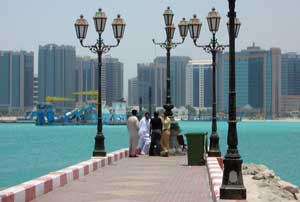
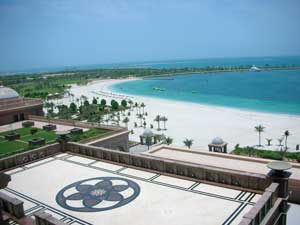
We learned about the UAE’s growing tourism industry from Sheikh Sultan bin Tahnoon Al Nahyan, chairman of Abu Dhabi Tourism Authority, and Hani Jaber of the ministry’s marketing division. UAE hopes to attract 3 million tourists a year by 2015. Tourists already enjoy first-class hotels, golf courses, horse- and camel races, and pristine beaches. By 2012 tourists will be able to visit the Louvre Art Gallery and Museum now under construction in Abu Dhabi. In 2009 the legendary Queen Elizabeth 2 cruise ship will open as a floating luxury hotel in Dubai. We toured Dubai’s unforgettable Burj al Arab Jumeirah, one of the world’s best hotels, which resembles a billowing sail, as well as Abu Dhabi’s new Capital Center, an enormous conference center and exhibition hall which is sure to bring even more business tourism.
Dubai’s six-year-old Media City is a huge campus which has become a hub for 1,200 companies, including TV stations along with newspapers and journals which publish 450 titles using excellent local facilities. After meeting Sinbad Al Mahaire, Jamal Al Sharif, Dr. Amina Al Rustamani and Mohamed Al Mullah, it dawned on us: Hollywood will face stiff competition when Dubai’s Studio City is complete. The latter will have 14 sound stages, post-production services, and a film academy.
We met Ali Al-Ahmed, the young director of the Abu Dhabi TV station, who described the transformation of Arab TV after the first Gulf war. “We’ve earned our audience,” he said. “People have switched from CNN, BBC and VOA to Abu Dhabi TV.“
Najla Faisal Al Awadhi, a former TV journalist, who is a member of the UAE’s Federal National Council (FNC)—equivalent to a parliament—spoke to us about issues that concern her constituents: the environment, sustainable development, modernization and women’s rights. She said she and her coworkers were passionate about building their nation.
Minister of Energy Mohammed bin Dhaen Al Hameli described UAE’s appreciation of the “skilled and unskilled workers who have come from all over the world [190 different nations] to enjoy life here,” as well as the challenges his nation faces, including security issues.
Salah Al Shamsi, chairman of Abu Dhabi”˜s Chamber of Commerce, described the UAE’s efforts to develop education and infrastructure in its cities and rural communities. With 97 percent of the economy based on oil, the Emirates are working to diversify and create jobs for their nationals.
Abdul-Aziz Al Ghurair, speaker of Dubai’s FNC, described his young nation’s efforts to catch up with the rest of the world and ensure that “UAE citizens participate in their country’s success story.”
Explaining that UAE’s parliament is 50 percent elected and 50 percent appointed, he boasted that 23 percent of its members are women. The Emirates, he quipped, have opted for “evolutionary democracy instead of revolutionary democracy like you chose in America.” Al Ghurair discussed the UAE’s 10-year plan to improve free education and health care, adding, “We have to get it right. We cannot afford to fumble.”
During a visit with Anwar Gargash, the FNC’s minister of state, the subject, as usual, turned to Iran. Like his countrymen, Gargash also recommended diplomatic pressure. “If the United States strikes Iran, it is irrelevent whether the attack is successful or not,” he insisted. “It will hurt America’s image. Why strengthen the radicals and feed the wave of fundamentalism and extremism in our region?
“If I were President Bush’s adviser I’d say stay away from Iran,” the minister concluded. “I’d say he should get engaged in making peace between the Arabs and Israel.”
Delinda C. Hanley is the news editor of the Washington Report on Middle East Affairs.















