















Washington Report on Middle East Affairs, November 2007, pages 41-42
European Press Review
German Paper Says Türkiye “Will Never Turn Away From Europe”
By Lucy Jones
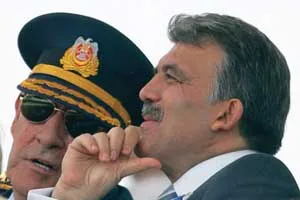 THE AUG. 28 election of Abdullah Gul as Türkiye’s new president—the first politician with an Islamist background to become head of state since the creation of the secular Turkish Republic in 1923—was viewed with a touch of apprehension by the European press.
The following day, the London Times described Gul’s election as “a victory for democracy,” noting that his reputation abroad was that of a modernizer. “It is fair to take him at face value, as a modern Turk committed to reform,” the paper wrote. It was impossible to forget what Gul represented, the paper said: the desire of many ordinary Turks to have a stronger voice in politics and in the country’s institutions. Noting that the “authentic voice of many Turks is conservative and Islamist,” however, the paper went on to characterize the election as a setback for secularism. “It accurately reflects the new strength of the conservative, low-key Islamic voters from the heart of Anatolia, at the expense of the secular cities,” it concluded.
According to the U.K.’s Telegraph the same day, Gul would have to work hard to keep the army at bay. “Türkiye’s military leaders have already forcibly removed four governments over the past 60 years,” it reminded its readers, “and there are understandable fears that it might be tempted to do so again.” The newspaper went on to say that such a move would be “foolhardy as it is unnecessary.” It continued: “Mr. Gul’s wife may offend secularist sensibilities by wearing a headscarf in public, but the former foreign minister is not about to turn Türkiye into an Iranian-style theocracy. Mr. Gul is a moderate Islamist who, as the architect of Türkiye’s attempts to join the European Union, seeks close ties with the West, not friction. Indeed,” the Telegraph concluded, “he is precisely the kind of democratically elected Islamic leader the West should encourage, which is why Brussels is being short-sighted in persisting with its delaying tactics over Turkish entry.”
Switzerland’s Neue Zürcher Zeitung of Aug. 29 also warned that democratic legitimacy did not ensure protection against military takeovers. “The party of President Gul and Prime Minister Erdogan has to deepen military reforms already tackled and anchor the principle of the subordination of the military under politics in the country’s culture,” the paper argued. “This task requires the right instinct and judgment.”
But Germany’s Frankfurter Rundschau of the same day deemed it still too early to predict which path the country would take. “Türkiye will not be able to quickly become all round EU-compatible,” it commented, “but it will never turn away from Europe.” The paper went on to suggest that, “As president, [Gul] can take moderate conservative skeptics along on the long road to liberal democracy.”
Denmark’s Jyllands-Posten of Aug. 29 also thought it premature to say whether fears that Islamists would undermine the secular state were justified. “Now, the only question that counts is whether Gul is the right man for the presidency: Whether he will be capable to fulfill Türkiye’s wish to join the EU and whether the generals, as well as the secular Turkish elite, will concede him the possibility to do his job,” the newspaper said.
In Spain, that day’s ABC wrote, pessimistically, that Islamists now control all the civil institutions in Türkiye. The previous day, El Pais reported that the Turkish army had warned of what it calls the “Islamic danger” which will come following the election of President Gul.
In France, La Croix editorialized on Aug. 29 that it mattered a great deal to the entire world that democracy and prosperity be strengthened in Türkiye, as the country is situated between Europe and the Middle East. “This process is significantly stimulated by the perspective of a rapprochement to the European Union,” the French Catholic daily wrote. “That is why it is important not to block negotiations and at the same time leave the decisive question open: an association with the EU or full membership.”
What Price Is Society Willing to Pay For Security? Asks German Paper
The Sept. 5 announcement by German authorities that they had arrested two Germans and a Turk suspected of planning huge bombings led Deutsche Welle’s Marcel Furstenau to hope the following day that Berlin won’t rush to take the opportunity to shore up support for draconian anti-terrorist measures. (There have been calls in Germany for police-controlled monitoring of computers.)
“Suspected terrorists were caught without the state needing to infringe civil rights,” Furstenau pointed out. But, he noted, the security situation “is likely to become more complex...since the potential perpetrators are not only foreigners, but also apparently include young Germans who have converted to Islam....Hopefully,” he concluded, “politicians and the media will deal sensitively with this development.”
“On the political side, of course, the left and the right in Germany seem content to use the foiled attack to promote their policy positions,” wrote Spiegel Online Sept 7. “The conservatives are saying that the planned attack is proof that the state should allow online surveillance of terror suspects,” it noted, “while the left side of the political spectrum is saying that the foiled attack is proof that online surveillance isn’t necessary.”
That day’s Süddeutsche Zeitung rejected proposals to allow online surveillance. “The German security apparatus can already do a lot; but if Interior Minister Wolfgang Schauble has his way, it will do everything. If the state gains access to private computers, then the question arises: Why should our few remaining restraints on state power—protections against forced or drugged interrogation, laws against eavesdropping on defense attorneys’ conversations—remain in place?” the newspaper pointed out.
“This is about the important question of what price a free society is willing to pay to ensure a certain level of security,” Financial Times Deutschland noted the same day. “Every anti-terror law has an effect but there are also side effects. It is right that more state surveillance will increase security. But it is questionable how much more security is really to be gained through invading people’s privacy.”
Die Welt on Sept. 7 compared the terror threat today with that of the 1970s, when the Red Army Faction (RAF) was terrorizing Germany. “Terrorism has changed in the last 30 years and, contrary to back then, it now very much poses a threat to the state. The reasons for that are many. Contrary to the RAF, terrorists are now able to get their hands on weapons that make mass murder possible...Contrary to back then, terrorists are today part of a worldwide network that has almost endless resources and can hit the West where it wants. And Islamist extremists can also fall back on a large population that has lived in Germany for decades,” the newspaper wrote.
Bush’s “Vietnam Speech” Said to Show Determination to Stay in Iraq
“President Bush is seeking to redeem the Vietnam War,” wrote BBC world affairs correspondent Paul Reynolds on Aug. 23, following the U.S. president’s speech to the Veterans of Foreign Wars. In that speech Bush presented Vietnam as part of a pattern of American operations in the Far East in which Japan had been democratized and South Korea liberated. “Vietnam was a war, Bush suggested, that was worth fighting. And his message was clear—so, too, is the war in Iraq,” Reynolds said. “The U.S. withdrawal from Vietnam, Bush argued, led to more suffering, not less. Just as it would, he implied, in Iraq, with the added danger in Iraq, he claimed, that al-Qaeda would be emboldened. The fact that President Bush is making these arguments,” Reynolds concluded, “shows how determined he is to stay in Iraq.”
That day’s El Pais agreed that “Bush has woken up the ghost of Vietnam” in order to garner support for a continued presence in Iraq.
Iraqi Soccer Victory United Country, Says Spain’s El Pais
The victory of the Iraqi national soccer team in the Asia Cup was hailed by the UK’s Guardian of July 30. “The team, which includes Sunnis, Shi’i and Kurds, beat three-time champions Saudi Arabia 1-0 in Jakarta—in a match that briefly brought together a country now known only for its brutal divisions,” the newspaper editorialized. In the past, the national soccer team was directed by Saddam Hussain’s “hideous son, Uday, who was reported to have tortured players who did not meet his expectations,” it continued. “Sport will not solve Iraq’s problems. But [on July 30] the country cheered as one, from Kirkuk to Basra, and that was something to cherish,” the Guardian concluded.
“For a day or two the country was united in support and celebration,” wrote El Pais on Aug. 2. “Now though, the players say they are fearful of returning home in case they are killed. Baghdad would be the place for their homecoming celebration,” the paper noted, “but they fear it would also be ideal for a terrorist attack.”
Lucy Jones is a free-lance journalist based in London.















