















Washington Report on Middle East Affairs, May-June, 2010, Pages 57-58
Human Rights
Women's Struggle for Progress
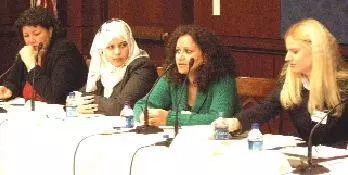
AT THE Capitol Visitor Center in Washington, DC, the watchdog organization Freedom House publicly released on March 3 the findings of a new study entitled "Women's Rights in the Middle East and North Africa." The 600-page report, which took two years to complete, found that the status of women's rights had improved in 15 of the 17 countries, including the West Bank and Gaza, surveyed. Kuwait, Algeria and Jordan demonstrated significant gains, whereas Iraq, Yemen, and the Palestinian Territory actually saw a worsening of conditions for women.
Sanja Kelly, a senior researcher and managing editor at Freedom House, who oversaw the project, introduced the report and presented the key findings. She warned against misconceptions of women's status in the region, noting that the findings demonstrate "a diverse spectrum of the status of women across the region." The same spectrum may be applied to individual countries, she added, where conditions for women vary according to generational, socioeconomic, sub-regional, and cultural divides.
The report revealed that progress was most marked in the areas of education, economic empowerment, and political representation. "Labor force participation is on the rise," Kelly explained. The change was especially notable in Qatar and Algeria, where female labor force participation rates rose by 6 percent. Kelly suggested that the larger number of women in the workforce resulted from higher literacy rates and educational opportunities. While every country exhibited improvements in female education, Gulf states particularly excelled. "Female literacy is highest in Kuwait, Qatar, and the UAE," Kelly pointed out, with all three boasting female literacy rates above 90 percent. Moreover, women vastly outnumber men at the university level. In Qatar, for example, the ratio of women to men stands at 287:100.
The political sphere is also gradually becoming more inclusive to female participation. The implementation of electoral laws establishing quotas for minimum female representation levels has been a crucial development. Kelly highlighted the case of Kuwait, where women received full political rights in 2005 and elected four women parliamentarians in 2009. Gains such as these, however, must be considered relative improvements. Women in the Middle East and North Africa remain "the most repressed of any region in the world," cautioned Kelly. Domestic violence, harassment, legal and social discrimination, and prejudicial attitudes remain a harsh reality for women of the region.
Rana Husseini, award-winning journalist at the Jordan Times and author of the chapter on Jordan, praised the report for "giving a just image of women in the Middle East and North Africa" that corrects distortions present in the Western media. An expert on "honor crimes," Husseini exclaimed that Jordan has made the momentous decision to consider the murder of a woman to be no different from the murder of a man. The policy change, she noted, "was the greatest achievement of the women's rights movement in Jordan." Husseini also highlighted the opening of the first government-run women's shelter, which in a semantic nod to cultural sensitivities is called "a family reconciliation house." Among the problems that face Jordanian women, Husseini emphasized ongoing inequality in citizenship laws and an unacceptable personal status code.
Former Washington Post correspondent Huda Ahmed, author of the report's chapter on Iraq, vented her frustrations about the paradoxical rate of progress in Iraq. "The problem is that every step forward is met with 10 steps back," she said. Ahmed also lamented the incongruity between the high expectations of Iraqi women, who anticipated greater social and political freedoms from the 2003 invasion, and the indifference of the U.S., which did not include "women's rights [as] part of the agenda back in 2004." The increase in violence has taken an especially hard toll on women as it has restricted their mobility, limiting their involvement in education, business, and politics. Violence perpetrated against women in the form of "rape, honor killings, and genital mutilation" has sadly "rocketed in number," she revealed.
Dalia Ziada, director of the North Africa Bureau of the American Islamic Congress and an Egyptian women's rights activist, noted that Egypt is making progress on a legislative level; however, "the implementation of improved legal rights for women does not extend onto the streets." In other words, constitutional guarantees and provisions intended to protect women's rights are not properly enforced, if at all. "Women's rights in my country are only for decoration," she contended. Ziada concluded by imploring the international community to exert greater pressure on Egypt and the rest of the region to improve the status of women. She warned, however, that international efforts should not be directed at the government. "There are civil society groups and grassroots women's organizations to deal with," she asserted.
For more information on Freedom House and access to the full report, visit <http://freedomhouse.org/template.cfm?page=383&report=86>.
—Andrew Blakely















