















Washington Report on Middle East Affairs, August/September 2021, pp. 60-61
Music and Arts
For centuries, Yemenis have been migrating to many parts of the world—as traders, merchants or labor migrants—and at other times fleeing war and persecution.
On June 10, the Middle East Institute’s Arts and Culture Center and the Focus on the Story International Photo Festival co-hosted a panel featuring Yemeni artists to discuss “Migration in Perpetuity: Yemeni Voices from the Diaspora.”
Thana Faroq, presently based in the Netherlands, was born and raised in Yemen, where she developed her passion for photography. “Holding the camera was an act of empowerment,” she said. “I concentrated on documenting the displacement in Yemen through the point of view of women, children and girls. I wanted to photograph what happened inside the households, not outside on the front line.”
In her photo book, I Don’t Recognize Me in the Shadows, Faroq documents her journey from Yemen to the Netherlands, from one refugee camp to another. “I wanted to figure out the war, the escape, the transition, the unfamiliar—everything,” she said. “So photography was a way to process it all...to create a memory archive of all of my emotions, the nostalgia, sadness, anger.”
Faroq places a particular emphasis on visualizing her trauma through photography. “Creating this work enabled me to tackle the trauma and confront it on my own terms,” she explained. Her new project, “There is a Blue Sky Today and No Rain,” is a multimedia venture to create an emotional history. “I am exploring the complex emotional interior landscape of women in exile in a visual way,” she explained.
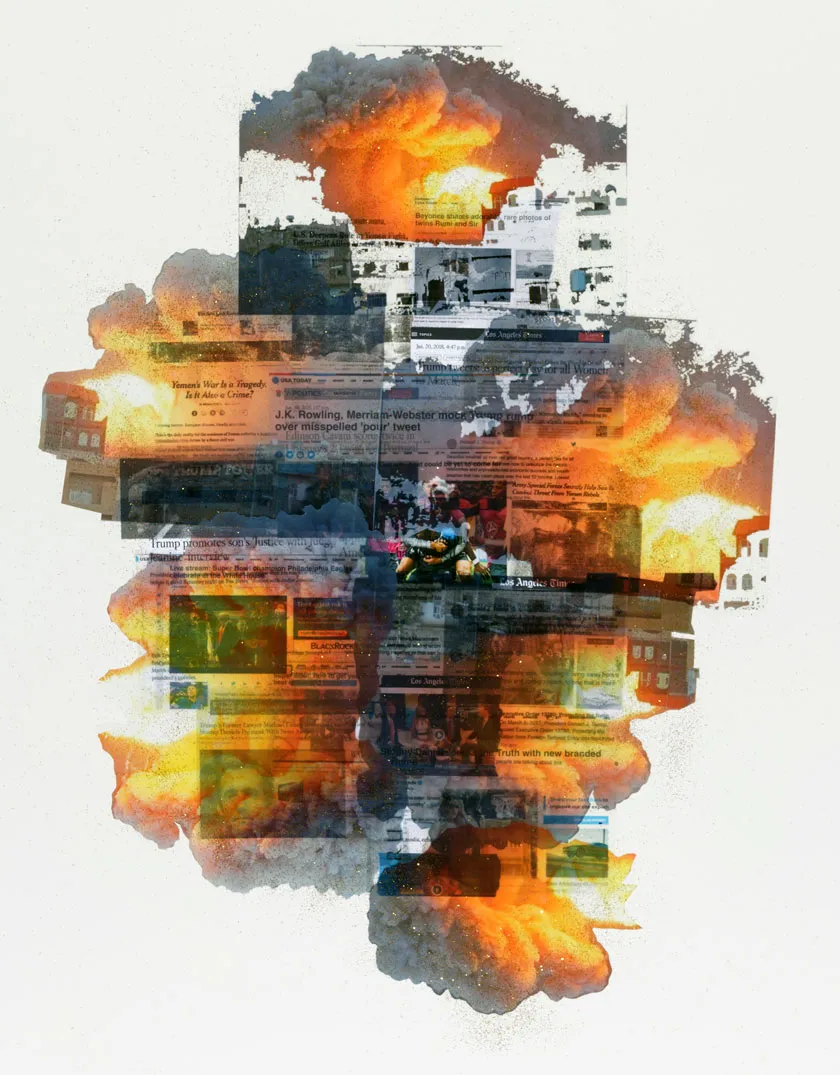
Born and raised in Chicago and now based in Los Angeles, Yasmine Nasser Diaz utilizes mixed media collages, immersive media installation, fiber etchings and videos in her works. “Collage inherently is an apt medium for a child of immigrants or someone who encompasses third world identity,” she noted.
Diaz relates to “taking images and materials that come from different places, produced by different people from different backgrounds and forcing them to live together on this piece of paper,” she said. “Many of us feel made up of odd parts in this new home where we don’t necessarily feel at home.”
Shaima Al-Tamimi, a Yemeni-East African visual storyteller, presently splits her time between Qatar and the UAE, where she grew up. Prior to the war, which began in 2014, migration was commonplace for Yemenis. It “is embedded into our lives,” she explained.
Al-Tamimi created a project with the Arab Documentary Photography Program that she eventually turned into the film “Voices from the Urbanscape,” which reflects her family’s efforts to move back to their homeland. Using old photos, letters, memorabilia and family stories, she pieced together her family’s journey.
“I really wanted to take back control of our narrative,” she explained. “In the media the story [of Yemenis] is told by non-Yemenis. I never saw people like me on TV or in books. I wanted to connect with my ancestors…and to correct and explore the narrative about why we left Yemen in the first instance.”
—Elaine Pasquini















