















Washington Report on Middle East Affairs, August/September 2025, pp. 47-48
Three Views: The 12-Day Israel-Iran War
By Dale Sprusansky
IN THE WAKE of Israel’s attack on Iran and the ensuing 12-day war, several think tanks held events to assess the impact of the conflict and what it means for the future of Iran’s nuclear program.
Thomas Countryman, former assistant secretary of state for international security and nonproliferation, dismissed the Israeli notion that Iran’s nuclear program was on the verge of being weaponized. “It is the same threat that [Israeli Prime Minister Binyamin] Netanyahu has repeated many times,” dating back to 1992, he noted during the National Iranian American Council’s (NIAC) June 27 briefing on Capitol Hill. “There was no immediate threat to Israel of an Iranian nuclear weapon.”
He pointed out that both the U.S. intelligence community and international experts agreed that Tehran had not yet decided to develop a nuclear weapon. “Iran had more fissile material than it had at any time in its history, thanks to the United States’ violation of the JCPOA [Joint Comprehensive Plan of Action] agreement [2015 nuclear deal], but had not made a decision to weaponize, nor could it do so rapidly,” he pointed out.
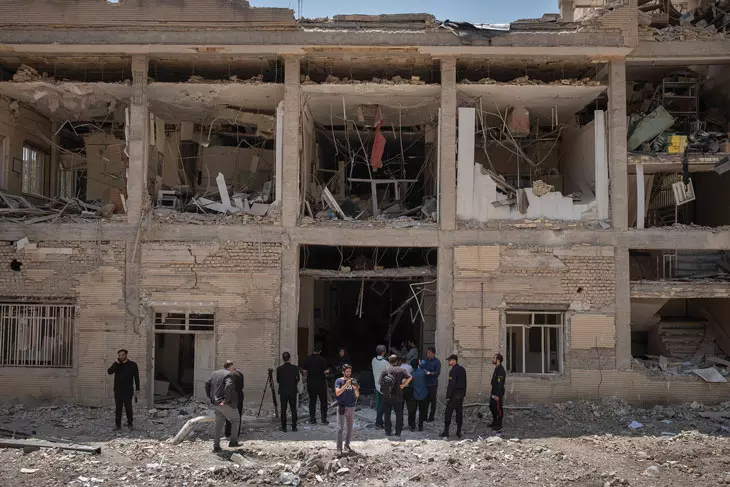
The joint U.S.-Israel targeting of Iran’s nuclear infrastructure was “without question a significant strike,” he said, as Iran suffered the assassination of nuclear scientists and damage to its facilities. However, the extent of the physical damage remains unknown, despite bold claims by the U.S. and Israel. “Whether this has set back Iran’s program by months or years or decades is something that we can speculate on, but we cannot be certain of” until independent inspectors are permitted to tour the impacted sites, Countryman stated. In late June, Iran threatened to suspend all cooperation with the International Atomic Energy Agency (IAEA) and its inspectors due to the agency’s failure to condemn the U.S.-Israeli attacks.
Countryman’s best guess is that Iran suffered significant but not existential damage to its nuclear program. “If only a small number of those centrifuges are still available to operate, if the 60 percent enriched uranium has been, as the Iranians say, preserved and not destroyed in the military action, then we’re talking about months for the ability to move to a crude nuclear device; we’re talking about years to the ability to miniaturize a device and put it on a missile that could strike Israel,” he said.
Hamid Dabashi, a professor of Iranian studies at Columbia University, believes the Israeli aggression will prompt Tehran to develop a nuclear weapon. “There is no doubt in my mind that Iranians will move toward weaponization of their nuclear program,” he said during the Arab Center Washington DC’s (ACWDC) virtual program on June 26. He noted the imbalance of the attack: Israel, a nuclear power that is not a signatory to the Nuclear Non-Proliferation Treaty (NPT), attacked Iran, which lacks a nuclear weapon and is a member of the NPT.
Assal Rad, a non-resident fellow at ACWDC, said the West’s overarching support for Israel’s illegal attack shows the complete collapse of the international system they purport to uphold. “Clearly the system has failed,” she said. “How do we allow a genocidal state to attack other sovereign states, and then…the states that lead that [international] system condemn not the genocidal state—not for its genocide nor for its aggressions—but condemn the state that is being attacked. That is a system that has been completely inverted; it no longer serves any real purpose.”
Sina Toossi, a senior fellow at the Center for International Policy, noted that while Israel did inflict damage on Iran’s nuclear and missile programs, it failed in its effort to impose regime change. This, he said at the NIAC event, shows the misguided thinking of those who assumed the Islamic Republic was fragile and would collapse under a little pressure. The opposite was true: the Israeli aggression caused many, even those opposed to the regime, to rally around their country. Dabashi, who can’t return to Iran due to his political beliefs, echoed this sentiment and said he instantly rose to defend the sovereignty of his country once the war began. “The nature of Iranians’ commitment to their homeland transcends ideology,” he said.
Toossi believes neither Israel nor Iran achieved a strategic victory in the war. Israel was able to establish a large degree of air superiority over Iran, hit significant targets and humiliate Iran by revealing the degree to which its intelligence agency was able to infiltrate its borders and launch attacks from within Iran. Meanwhile, Iran was able to constantly launch waves of missiles at Israel, forcing the country to live on edge and rapidly deplete its supply of interceptors—which are expensive and hard to quickly replenish. While most of its missiles were shot down, those that broke through caused notable damage to military and civilian targets within Israel.
“We saw at the end of this 12-day conflict that the cost for Israel was also mounting,” Toossi said. Daniel Levy, president of the U.S./Middle East Project and a former Israeli negotiator, agreed with this assessment on a June 26 webinar hosted by the Türkiye-funded SETA Foundation. “Israeli society was, I think, somewhat shaken by what happened,” he said. “Israel’s staying power was under question” and Israelis were wondering how long their country could survive a war of attrition.
NIAC president Jamal Abdi said the aftermath of the war shows that diplomacy was always the wiser path. The JCPOA, which Trump unilaterally withdrew from in 2018, would have set Iran’s nuclear program back 15 years by imposing restrictions and ensuring close monitoring. “At the time critics said, ‘we’re just kicking the can down the road, we need a permanent solution,’” he noted. However, now, “we dropped the biggest bombs on [the] Fordow [uranium enrichment plant] and other sites and it bought us maybe a couple of months, maybe a couple of years—at most five years.” Plus, Iran’s program has now been driven deeper underground, meaning the world no longer has eyes and ears on what Iran is doing. Additionally, the attack may prompt Iran to race to a nuclear weapon. “We have now tested both propositions and I would say diplomacy worked a hell of a lot better than dropping bombs,” he said.
Dale Sprusansky is managing editor of the Washington Report on Middle East Affairs.















