Washington Report on Middle East Affairs, August/September 2021, pp. 56-57
Waging Peace
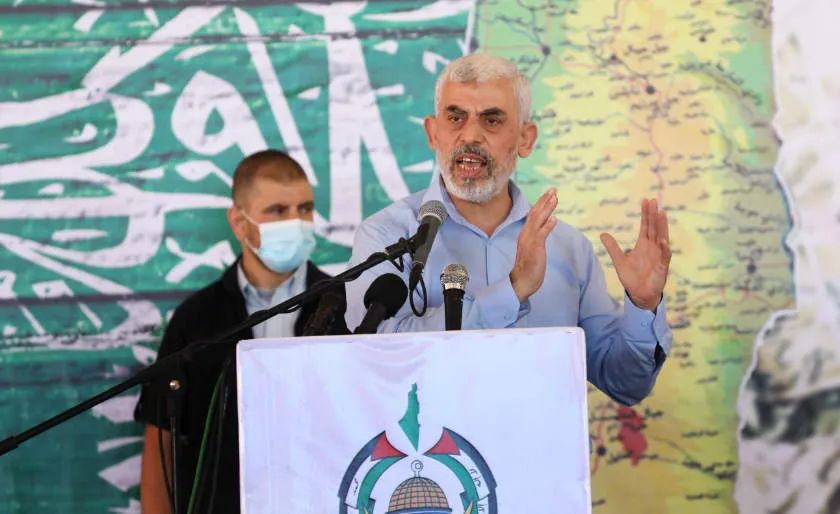
As the cycle of war and reconstruction continues in besieged Gaza, could direct talks between the United States and Hamas be a way to foster a new paradigm? The National Interest Foundation posed this question to a group of experts on a June 10 webinar.
Peter Beinart, a popular columnist and professor at the City University of New York, noted that Washington recently began negotiating with the Taliban, a group with vastly more baggage vis-à-vis the U.S. than Hamas. “It seems to be hard to make a conceptual argument that suggests there’s a reason to talk to the Taliban but not to Hamas,” Beinart said.
He also pointed out that the U.S. already communicates indirectly with Hamas through intermediary countries, such as Egypt and Qatar. Beinart reasons it would be more fruitful if Washington were to just directly hold such talks.
Beinart dismissed the notion that talks would legitimatize Hamas, which is classified by Washington as a terrorist organization. The decades-long “peace process” led by the U.S. and endorsed by the Palestinian Authority (PA) is what actually gives Hamas credibility, he argued. Palestinians, he noted, have progressively lost more freedoms and more land during the post-Oslo Accords era, and yet they see the PA maintain the status quo with Israel. “Hamas’ main source of legitimacy is really the sense that it might be able to get things for the Palestinian people that the Palestinian Authority cannot get,” Beinart said.
Diana Buttu, a Palestinian-Canadian lawyer and former adviser to the Palestine Liberation Organization, echoed this sentiment. She said that everyone in Palestine besides the PA “realizes that the United States is not going to do anything for us, that liberation is not going to come through the Congress, it’s not going to come through the hands of the Americans, and in fact, if anything, it’s going to be the primary obstacle to it.”
Buttu also posited that the U.S. position toward Hamas is largely a reflection of Israel’s desires. “If you look at why it is that the United States is not engaging with Hamas, it’s not for U.S. reasons, it’s entirely for Israeli reasons,” she said. Buttu noted that the present reality ensures a fissure between the West Bank and Gaza and keeps a deep divide between Fatah and Hamas—all to the benefit of Israel.
Beinart noted that there’s an irony behind Washington criticizing Hamas for blunting the chances of peace. Israel has disregarded key provisions of Oslo and “pretty explicitly not accepted the two-state solution,” he pointed out. “You’re asking Hamas to recognize Israel, but what is Hamas going to reasonably expect to get in return, given that it’s very very unlikely that Israel would respond by recognizing a legitimate, viable Palestinian state?” he asked.
Edward Gabriel, president of the American Task Force on Lebanon, conceded there’s no reason to believe the U.S. will reach out to Hamas in the near-term. Activists and scholars need to instead focus their energy on convincing the Biden administration to emphasize Palestinian human rights and call out Israel for its myriad abuses of basic rights, he said.
Former congressman Jim Moran said the U.S. must recognize the deepening inequality between Palestinians and Jews living under Israeli authority. The U.S. needs to construct a long-term policy that is “consistent with the universal values which we purport to ascribe to,” he said.
—Dale Sprusansky