





All books featured in this new section are available from Middle East Books and More, the nation’s preeminent bookstore on the Middle East and U.S. foreign policy. www.MiddleEastBooks.com • (202) 939-6050 ext. 1
Washington Report on Middle East Affairs, June/July 2022, p. 62
Middle East Books Review
Internment: A Novel
By Samira Ahmed, Little, Brown and Company, 2020, paperback, 400 pp. MEB $10.99
Reviewed by Delinda C. Hanley
 From the first page of Internment, this reader felt queasy, right along with the 17-year-old Muslim American narrator, Layla Amin, whose neighbors in a small college town are at a book burning. Those books include poetry written by her recently fired professor father, as well as other “banned books, dangerous books.” Set in a horrifying near-future United States, Samira Ahmed’s best-selling novel doesn’t seem far-fetched. Not when daily news reports reveal that parents, school boards or even governors are initiating book bans and threatening criminal charges against public school librarians and teachers for making certain books available.
In fact, schools and libraries have long been the canary in the coal mine in the United States. Back in the Oct./Nov. 1999 issue of the Washington Report, I wrote about phone calls and notes we received from librarians and teachers fighting self-appointed “thought police,” including parents, staff or patrons who purged our magazines from shelves and class discussions about conflict resolution because they “disturbed” readers.
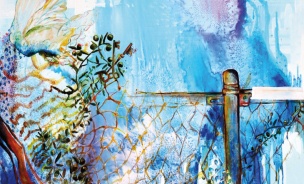
Samira Ahmed’s book depicts what can happen when “thought police” are given free rein. Before long, Layla and her family have a lot more than book burnings to worry about. In quick succession, starting two and half years earlier, an Islamophobe who vowed to make America great again was elected president. Nazis marched on DC, a Muslim ban was enacted and U.S. borders were closed to stop chain migration and “illegals.” Muslims like her parents were fired from public sector jobs. Marking “Muslim” as your religion on the census resulted in your name being added to a registry. Like the Japanese Americans during WWII, Muslim American citizens on that registry are rounded up, relocated and locked in internment camps.
“I don’t understand how this is happening,” Layla whispers to her parents, her voice barely a scratch, as they pack the one bag they each may carry as they’re forced to leave their home. “How can we be dangerous to the state? A poet, a chiropractor and a high school senior?” Her father, a philosopher as well as a poet, explains, “It’s not about danger. It’s about fear. People are willing to trade their freedom, even for a false sense of protection…There never was a democracy yet that did not commit suicide.”
The Amins and other Muslim families are assigned trailers located in segregated blocks divided by ethnic and cultural backgrounds—Arab, South Asian, Persian, Black, etc. But Layla notes, “each of us, to a person, has the same look: abject fear.” Layla looks around the cavernous auditorium where the director of Camp Mobius is stating the rules to new arrivals, and thinks, “Again, I’m struck by the Americanness of the throngs of people. Every race, dozens of ethnicities, different ways of dressing, and, certainly, widely varying opinions about politics and life and Islam. But I guess that’s the old America. Now we all have one thing in common—a religion that makes us enemies of the state. The state all of us are citizens of, the one most of us were born into.”
A spoiler alert isn’t required. This all happens in the first chapter! It’s how our feisty heroine meets this shocking fate that is so inspiring. If the state’s hope was to isolate, divide and conquer Muslims behind fences, razor wire and guns, the Muslim American community rallies to save itself. While the older folks organize daycare, schools, book clubs, vegetable plots and exercise classes, Layla and her new friends become daring revolutionaries.
America is represented in books, movies and songs as a melting pot, a mixed salad, a shining city on a hill, Layla thinks, as she is hauled away in handcuffs to a secret site after breaking camp rules. “America is the country where a skinny kid with a funny name can defeat the odds and become president. But America doesn’t seem like any of those things anymore. Maybe it never was.”
Ahmed’s book, a New York Times best seller, may be written for ages 12 and up but readers of every age will find it a gripping page-turner. And just maybe it will challenge Americans to speak up and resist when they encounter thought police, hate and ignorance.
Delinda C. Hanley is executive editor of the Washington Report.