















All books featured in this new section are available from Middle East Books and More, the nation’s preeminent bookstore on the Middle East and U.S. foreign policy. www.MiddleEastBooks.com • (202) 939-6050 ext. 1
Washington Report on Middle East Affairs, November/December 2026, pp. 82-83
Middle East Books Review
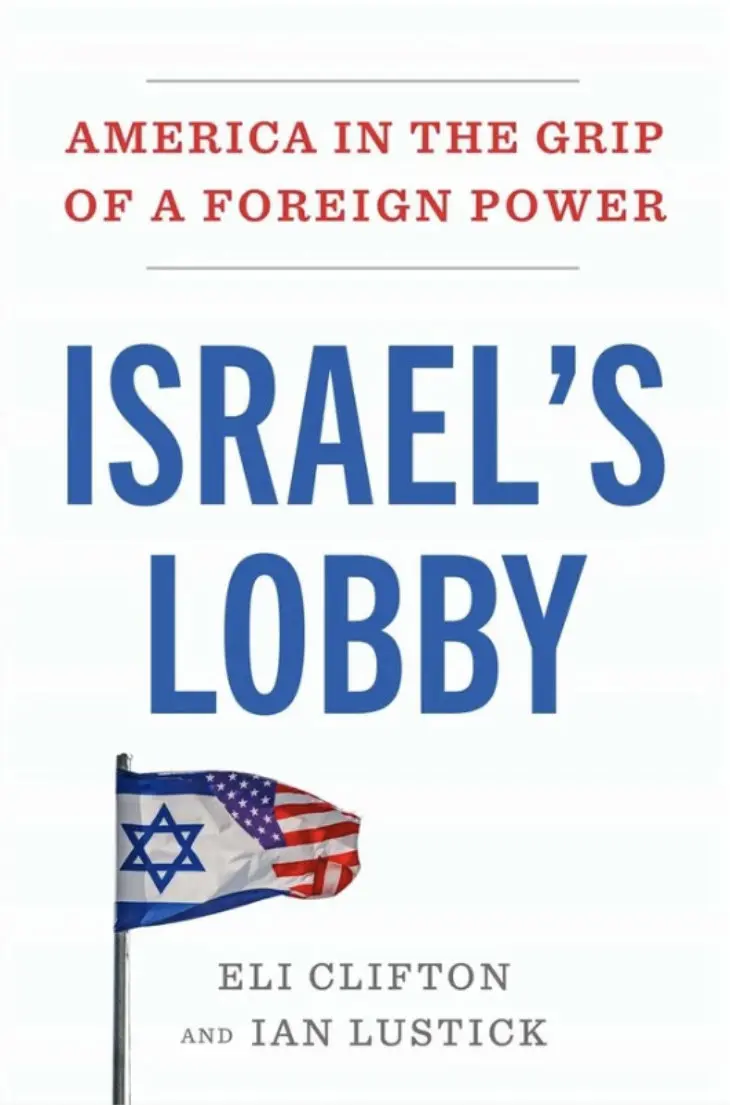
By Eli Clifton and Ian Lustick, Atria/One Signal Publishers, 2026, hardcover, 304 pp. MEB $29
Reviewed by Jack McGrath
LONG SEEN AS the ultimate third rail of U.S. politics, Israel’s influence in the United States is facing an unprecedented public reckoning. For decades, unconditional political, diplomatic, military and economic support for Tel Aviv has served as a cornerstone of U.S. foreign policy, transcending partisan divides. Although Israel has hemorrhaged public support in recent years, the establishment consensus in Washington has proven far more durable.
Explaining this growing disparity requires an examination of the special interests that sustain U.S. support for Israel and the political and financial mechanisms through which they exert influence.
In Israel’s Lobby: America in the Grip of a Foreign Power, investigative journalist Eli Clifton and political scientist Ian Lustick expose the financial networks behind an “out-of-control foreign influence operation.” The authors assert that the lobby has pressured successive administrations into taking actions detrimental to U.S. interests, spearheaded a domestic repression campaign on college campuses and facilitated Israel’s regional rampage. Israel’s Lobby argues that pro-Israel interest groups are particularly dangerous because they combine the influence of an oligarchical elite empowered by permissive campaign finance laws with an erratic Israeli state dependent on the U.S. to enable its behavior and shield it from consequences.
Israel’s Lobby serves as a worthy follow-up to the 2007 classic, The Israel Lobby and U.S. Foreign Policy by professors Stephen Walt and John Mearsheimer. While the similarities between the books are apparent, Israel’s Lobby distinguishes itself through journalistic prose that often reads more like a longform exposé than academic analysis.
Since the 2000s, the pro-Israel lobby has undergone a profound transformation from a collection of highly influential advocacy organizations with relatively modest budgets into a financial colossus willing to spend more than $30 million on a single Senate primary. The lobby’s evolution resulted from two landmark 2010 campaign-finance decisions, Citizens United v. FEC and SpeechNow.org v. FEC, which opened the door for individuals and corporations to make unlimited contributions to independent political groups. The American Israel Public Affairs Committee (AIPAC), which typically refrained from directly financing candidates, entered this new arena in 2021 with the creation of a political action committee (PAC) and the super PAC, United Democracy Project. Since then, these two organizations have spent approximately $300 million to advance Israel’s interests.
Clifton and Lustick follow the money beyond AIPAC, tracing the sprawling network of donors and organizations that spend hundreds of millions of dollars to ensure that there is “no daylight” in the U.S.-Israel relationship. Clifton and Lustick contend that, as Israel’s standing with the American public has deteriorated, the lobby has increasingly compensated with increased political spending. Since 2010, nine megadonors with “a documentable preference for unconditional U.S. support for Israel” have spent over $1.7 billion in political contributions. This bipartisan clique includes casino magnate Miriam Adelson, tech billionaire Larry Ellison, former New York City Mayor Michael Bloomberg, LinkedIn cofounder Reid Hoffman, WhatsApp founder Jan Koum and Hollywood producer Haim Saban.
Israel’s Lobby contends that “Israel-first” donors helped reinforce the Biden administration’s support for the Gaza genocide despite public backlash. Of the 25 oligarchs who donated over $900,000 each to the Biden Victory Fund by May 2024, nine had either vocally supported Israel or donated to pro-Israel organizations. In a telling exchange, Democratic megadonor Haim Saban condemned the Biden administration’s threat to restrict arms transfers if Israel invaded Rafah, warning the president that there are “more Jews who care about Israel than [Muslim] voters who care about Hamas.” The Biden administration ultimately declined to enforce its “red line,” allowing Israel to level the city.
In response to pro-Palestine protests and college encampments, the lobby waged an all-out offensive against academia under the guise of combating anti-Semitism. Clifton and Lustick detail the tactics used by the Anti-Defamation League (ADL) and likeminded organizations to “remove critical discussion of Israeli policies from the public discourse.” In 2025, the Trump administration launched over 60 investigations of universities for alleged anti-Semitism, cut $11 billion in federal funding for higher education and revoked more than 6,000 student visas. The authors charge that the lobby did more than any other interest group to build “the legal and administrative machinery for the Trump administration’s attack on American universities.”
Recent trends, including Israel’s unfavorable rating among 60 percent of Americans and the success of Democratic primary candidates against AIPAC-backed opponents, suggest that the days of unequivocal U.S. support for Israel are numbered. However, the authors caution that the lobby still possesses “many tools in its arsenal to deflect, delay and deny the transmission of these public sentiments into policy.”
Across a succinct 227 pages (excluding the bibliography), Clifton and Lustick shed light on the financial and political mechanisms that maintain the “special relationship” between Washington and Tel Aviv. As the bipartisan consensus on Israel continues to fracture, Israel’s Lobby offers unique insights into the forces determined to preserve it.
Jack McGrath is the director of Middle East Books and More.














