















All books featured in this new section are available from Middle East Books and More, the nation’s preeminent bookstore on the Middle East and U.S. foreign policy. www.MiddleEastBooks.com • (202) 939-6050 ext. 1
Washington Report on Middle East Affairs, November/December 2026, pp. 83-84
Middle East Books Review
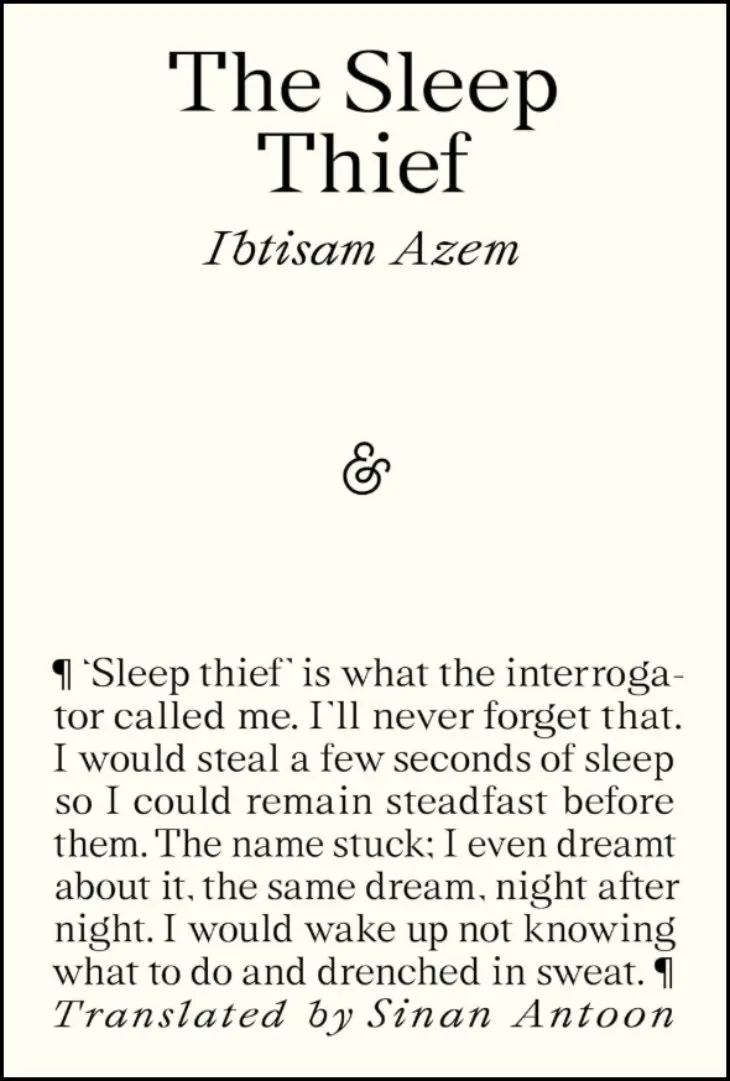
By Ibtisam Azem, translated by Sinan Antoon, And Other Stories, 2026, paperback, 112 pp. MEB $18.95
Reviewed by Ida Audeh
MOST OF THE RATHER ordinary events described in The Sleep Thief and recounted by protagonist Gharib Haifawi occur over the span of only a few days but carry a generational weight. Born just before the June 1967 war, the tormented Gharib is as quirky as they come. As his surname conveys, he hails from Haifa; his first name can mean “stranger” and also “oddball.” He doesn’t feel at ease anywhere, and it soon becomes apparent that his lack of ease is political: as a Palestinian in the Jewish state, he is always under surveillance and constantly subjected to the bigotry of the majority group: “Fear lurks and eats me from within. It spreads everywhere inside me. It turns ordinary objects into burdens that carry meanings greater than they can hold.” It is a hard way to live.
Gharib has another name: the sleep thief, a reference to his ability to snatch moments of sleep whenever he could when he was in prison, because he was often deliberately sleep deprived (in other words, tortured) by prison wardens. In the novel’s opening scene, he is dumped by the side of a road and spat on by the Israeli authorities, the state’s way of releasing him after serving an 18-month sentence for participating in a demonstration years earlier.
Throughout the book, Gharib recalls ordinary life events, and through these we learn that the lives of the Palestinian citizens of Israel are in many ways defined by the rupture caused by the Nakba.
A few examples: Gharib recalls his resentment at being forced to peddle avocados to supplement his father’s income; the avocados came from what had been his father’s prosperous farm, which he had been forced to sell cheaply to the state. And thus the state impoverishes some (not all) of its citizens and makes child labor essential to family incomes. It takes him longer than his Jewish peers to finish university because he must work to pay tuition; most scholarships require army service, which immediately disqualifies Palestinian students.
He visits an Israeli friend living in Ayn Karim, who is at pains to tell him that the (Jewish) owner of the home values its aesthetic, apparently expecting that this erases any resentment Gharib might feel over the ethnic cleansing of the original owners of these homes, now refugees in distant lands. What was intended as reassurance makes him physically ill and forces him to leave abruptly. The street names also irritate him, because “each street has two: the one that is written, and the one warring with memory. Their names and ours.”
The novel is full of schizophrenic moments like these. A final example: Gharib takes an uninterested Jewish classmate to the historic Russian compound, aka Moskobiyya, now an Israeli prison notorious for its torture of Palestinians. He attempts to educate her about its origins: built for Russian pilgrims in the 19th century, it was eventually bought by Israel from the Soviet Union and paid for in Jaffa oranges because Israel lacked hard currency. (This is known as the Orange Deal.) This deal between two parties, one that doesn’t own the land and the other who is not entitled to buy it, not to mention the method of payment, enrage him; his companion can’t understand what the fuss is about.
Author Ibtisam Azem takes readers into the psyche of someone who has recurring nightmares and who has to navigate a nightmarish present while haunted by the past. After only a few pages, the reader feels the oppressive malaise of a life lived in a hostile environment.
One of the book’s inadvertently comical moments occurs in the Lydda airport, usually a place of high stress for Palestinian travelers. He goes early and braces himself for abuse, but instead he is treated like an ordinary traveler; the experience so discombobulated him that, spooked, he abruptly canceled his trip and returned home, forfeiting his ticket. The scene powerfully conveys the parallel universe that has become the norm for non-Jews in the Jewish state.
The Sleep Thief ends with a surreal scene: Gharib is set upon by dogs that bite him but don’t draw blood, as though he is made of rubber. He is accused of attacking the dogs and must defend himself. A policeman intervenes and asks for identification papers, but Gharib has none and rejects any identification as a citizen of the state or even as a Palestinian—insisting simply that he be seen as a human being. He is a Palestinian in Israel who is forced to assert his right to exist in a state that prefers he would leave. (In Azem’s brilliant and highly recommended second novel, The Book of Disappearance, they oblige.) By insisting that his humanity trumps the state’s documentation of belonging, Gharib reclaims the geography.
Ida Audeh is senior editor of the Washington Report on Middle East Affairs magazine.














