















Washington Report on Middle East Affairs, November/December 2026, pp. 56-57
Canada Calling
By Candice Bodnaruk
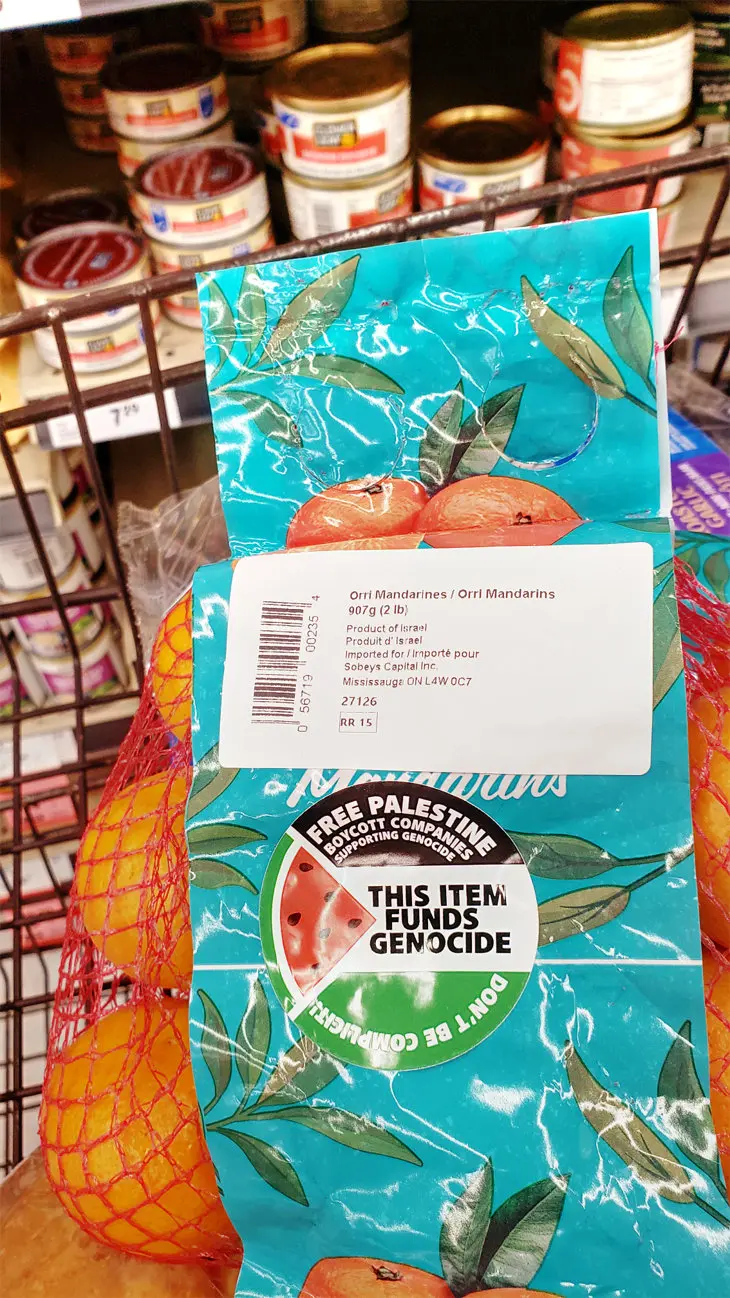
OVER THE PAST FEW MONTHS, Canada joined Australia, France, Germany, Italy, the Netherlands, New Zealand, Norway, and the United Kingdom in condemning Israel’s E1 settlements and settler violence. At the time the government advised businesses against bidding for construction tenders for illegal settlements.
At the 81st U.N. General Assembly in September 2026, Canada’s Prime Minister Mark Carney also pledged $100 million (CA) in aid for Palestine. Canada has provided more than $600 million in aid to Palestine since October 2023.
Also in September, Canada (along with 11 European countries) announced that it plans to impose restrictions on trade with illegal Israeli settlements. It is not clear what such restrictions will look like.
A national survey commissioned in June 2026 by Canadians for Justice and Peace in the Middle East (CJPME) found that 26 percent of Canadians support ending the Canada-Israel Free Trade Agreement (CIFTA) outright; 28 percent said it should be reformed. The same Nanos Research poll reported that 41 percent of Canadians believe Canada should do more to “sanction Israeli settlements.”
CJPME also says Canada’s decision to restrict settlement goods does not go far enough: “In order to address the gravity of Israel’s crimes of occupation, apartheid and genocide, Canada needs to impose broad sanctions against any Israeli structures that uphold illegal conduct in Occupied Palestine.”
The ban may also be difficult because currently Canada does not distinguish between settlement and non-settlement Israeli goods. According to the Government of Canada, since the original CIFTA came into force in 1997, two-way merchandise trade has more than tripled, now at $2.1 billion.
Meanwhile, Canadian direct investment in Israel was $2.8 billion in 2025, while Israeli direct investment in Canada was $3.9 billion.
In August, Anita Anand, Canada’s Foreign Affairs Minister, wrote on X: “Canada advises businesses not to participate in acts that directly or indirectly support or facilitate illegal Israeli settlements and associated violence. Canada’s longstanding position has been that Israeli settlements in the West Bank and East Jerusalem are illegal under international law. Businesses should align their operations with responsible business conduct standards and refrain from engaging in economic and financial activities associated with these settlements.”
Global Affairs Canada also issued its own advisory, stating that any engagement in, or connection to, settlement-related activities represents significant legal, financial and reputational risks, adding that Canadian companies operating abroad are expected to respect human rights.

Amnesty International argues Canada’s measures to restrict trade with Israel fall short of meeting the International Court of Justice (ICJ) instructions to states “not to render aid or assistance” in maintaining Israel’s illegal occupation of Palestine.
CJPME also pointed out that goods are only a small segment of the Israeli settlement economy, adding that the policy will not apply to other forms of economic activity that benefit illegal settlements, such as finance and investment, real estate and donations to charities.
Canada’s main imports from Israel include machinery and equipment, scientific and precision instruments, electronics, plastics, miscellaneous chemical products, gas turbines, LCDs and medical instruments. However, CJPME notes that the Canadian government does not distinguish between trade with Israel compared with settlement trade. Illegal settlement goods are labelled as “Israeli” and are given preferential trade benefits.
CJPME notes CIFTA is particularly problematic as it also applies not only to Israel but also to the Occupied Palestinian Territories. Palestinians, moreover, were never a partner or signatory to CIFTA at all and currently Canada-Palestine trade represents only 0.68 percent of the total goods traded under CIFTA.
While welcoming Canada’s announcement, Just Peace Advocates called it insufficient, adding the Canadian government must end all support of Israel’s illegal settlement enterprise.
Anand’s office told the Washington Report their office had yet to determine what Israeli goods would be impacted but said restrictions would come about “in the coming months.”
CANADIANS LOOK HARD AT THEIR PENSION INVESTMENTS IN ISRAEL AND GENOCIDE
Canadian activists are gearing up again to hold the Canada Pension Plan Investment Board (CPPIB) accountable for continuing to invest in Israeli companies that support genocide. The CPPIB decides how to invest the contributions of more than 22 million contributors and beneficiaries.
Every two years the board is legally required to hold stakeholder meetings across the country. This year they will be held in Vancouver, Ottawa, Winnipeg, Saskatoon, Halifax and St. John’s. Palestinian solidarity activists plan to attend the meetings, ask questions and film the discussions.
According to Just Peace Advocates, the CPPIB has invested more than $54 billion (CA) in 120 war crime complicit companies which represent 6.9 percent of all CPPIB investments. The list of companies includes five Israeli companies: Hapoalim Bank, Bank Leumi, Delek Group, Israel Discount Bank and Mizrahi Tefahot Bank.
Other companies complicit in the Israeli occupation of Palestine on the list of investments include General Dynamics, Hewlett Packard Enterprises and Caterpillar.
ISRAEL PAVILION ORGANIZERS TRY TO CURTAIL PEACEFUL PROTEST
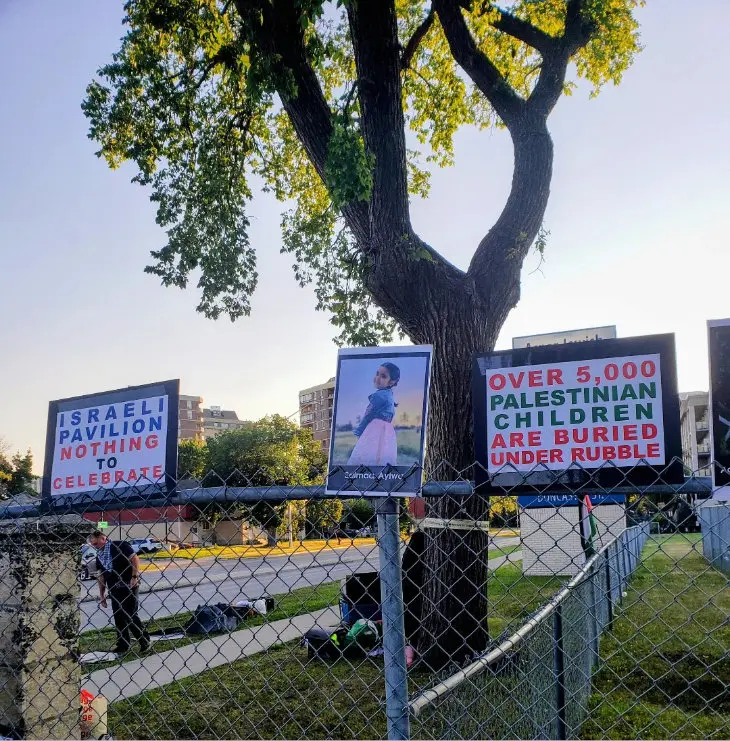
Each year festival organizers attempt to limit a peaceful protest of the Israeli Pavillion at the Folklorama, Winnipeg annual cultural festival. Demonstrations showing solidarity with Palestinians began in 2014, during Israel’s 51-day war on Gaza, and have continued ever since.
Canada’s Combatting Hate Act, Bill C-9, which went into effect in July 2026, created a new criminal offense of “intimidation” that applies to protesters near buildings like synagogues, churches, daycares, schools and many other spaces. The intimidation offense refers to a person engaging in any conduct where the intent may be to provoke a state of fear in a person or impede their access to a space.
Palestinian Solidarity groups say the act is too vague and is designed to limit speech critical of Israel. Organizations like the Canadian Constitution Foundation point out that under Canada’s Criminal Code intimidation is already illegal, yet in this new context critical speech comes with a 10-year maximum prison sentence.
What Bill C-9 didn’t do was specify the size or location of bubble zones around the protected institutions. Bubble zones are legal, police, or municipal perimeters that restrict protests, demonstrations, or approaching individuals within a specific distance of sensitive locations.
When organizers of the annual Israeli Pavilion demonstration arrived on site in August they found the entire street where protesters usually gather blocked off. Instead, the protest was relegated to an area several blocks away along with a police presence for the entire evening. Still, organizers were able to make their opinions heard as visitors were required to drive past them on the way in and out of the pavilion.
The theme of the action this year was June’s United Nations Independent International Commission of Inquiry on the Occupied Palestinian Territory, including East Jerusalem, and Israel, which concluded “Israel targets Palestinian children.”
Organizers also created a live exhibit featuring Palestinian hostages. Protesters held candles, read poetry and sang “We Shall Overcome.” People were once again encouraged to write to Folklorama board members requesting that they ban the Israeli Pavilion from the festival.
Candice Bodnaruk has been involved in Palestinian issues for the past 14 years through organizations such as the Canadian BDS Coalition and Peace Alliance Winnipeg. Her political action started with feminism and continued with the peace movement and the No War on Iraq Coalition in 2003 in Winnipeg.















