Washington Report on Middle East Affairs, March/April 2026, pp. 58-59
The Middle East in the Far East
By John Gee
ISRAEL’S TIES WITH CHINA have deteriorated in recent years and look set to worsen.
The damage to Israel was self-inflicted. Its behavior toward the Palestinian people has certainly been a factor in the cooling of relations, but probably equally significant have been actions taken by the Zionist state that China regards as directly harmful to its interests.
The main problem that Israel has faced in developing its ties with China has been how to do so without putting at risk any of the advantages of its relationship with the U.S., its primary supporter. Even some of Israel’s strongest cheerleaders in Congress have, in the past, warned Israel against pursuing trade deals that they believed would result in advanced (largely U.S.-developed or funded) technologies being sold to China. They foresaw that China would learn from the imported goods and produce its own enhanced versions that would both strengthen its own economic and military capabilities and help it compete on favorable terms with U.S. companies.
In 2000, the U.S. compelled Israel to cancel the agreed sale of the Phalcon early warning system to China: four airplanes had been due to be fitted with it. It was argued that it would have advantaged China over Taiwan. In 2005, Israel was obliged to sign an agreement to consult the U.S. on arms exports after Washington objected to its upgrading Harpy assault drones that it had earlier covertly supplied to China. Israel’s submission to U.S. pressure made it crystal clear to the Chinese leadership that, whenever Israel was forced to choose between the U.S. and China, it would bow to the U.S.
There remained scope for China to expand trade and to take advantage of Israel’s need for low-cost foreign labor to undertake the jobs Israelis do not want to do and which their government would prefer not to have Palestinian workers do. An agreement to supply 6,000 Chinese construction workers was signed in 2017, although it has apparently only been partially fulfilled.
China condemned Israel’s brutal assault on Gaza and its aggressive expansion of settlements in the West Bank but did not break diplomatic relations or boycott trade with Israel. Israel could have chosen to bide its time in the hope of restoring the pre-October 2023 status quo as the (bogus) ceasefire took the international spotlight off its continuing war on Palestine.
Instead, it has taken a step that is regarded by China as highly provocative. It has strengthened its ties with Taiwan.
The island of Taiwan, ruled by Japan from 1895 to 1945, was returned to China after World War II. In 1949, it became a refuge for Chiang Kai-shek and remnants of the Kuomintang regime, defeated by the Communists in a civil war. For the new Beijing government, the country was the People’s Republic of China (PRC), while for Chiang’s regime, still claiming to represent China as a whole, it remained the Republic of China (ROC). The two had in common a view of the oneness of China and a rejection of Taiwan as a separate country: at issue was who ruled China.
The PRC has never left any doubt about its view concerning Taiwan’s status. From the very beginning of its drive to achieve international recognition after 1949, the PRC made the establishment of diplomatic relations with any country conditional upon recognition of the PRC administration as the sole government of China (including Taiwan) and the withdrawal of recognition from the ROC. The PRC’s position has been strengthened as its economic and political weight on the world stage has grown: only 11 countries, plus the Vatican, still recognize the ROC, and half of them are small island nations.
Like many other states, Israel has maintained little-publicized links with Taiwan, including in arms deals, but this has changed in the past two years.
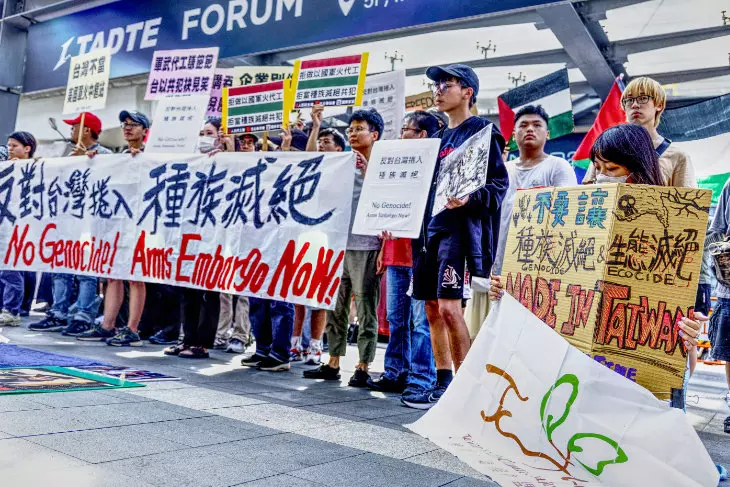
In February 2024, when Israel’s genocidal assault on Gaza was four months old, members of Taiwan’s parliament, the Legislative Yuan, set up the Taiwan-Israel Congressional Association, which claims to further people-to-people links and promote co-operation in various fields.
In May 2025, Lai Ching-te of the Democratic Progressive Party (DPP) was inaugurated as president of Taiwan. The DPP, which has promoted civil rights and democracy in Taiwan, is viewed with hostility by the PRC because of its advocacy of a sovereign (essentially independent) Taiwan. Tension between the PRC and Taiwan has increased since Lai’s inauguration: Lai has been more assertive than his predecessors in advocating an independent status for Taiwan and has sought to strengthen its armed forces, while China has staged demonstrations of naval and air power close to Taiwan.
One of the states that Lai has courted has been Israel.
In September 2025, Lai received six visiting Israeli Knesset members. In October, his deputy foreign minister, Francois Wu, met Yinon Aharoni, director-general of Israel’s Ministry of Welfare and Social Affairs in Taipei, Taiwan’s capital. Wu is reported to have made a secret visit to Israel in early December.
Also that month, Ohad Tal, co-chair of the Knesset Caucus for Strengthening Relations With Indo-Pacific Countries, made his second visit to Taiwan in a year, meeting Taiwan’s vice president, foreign minister and other officials. Tal is a member of Bezalel Smotrich’s Religious Zionist Party, which advocates the expulsion of all Palestinians from their country. He had previously visited Taiwan in May with a multiparty Israeli group.
In October, a 200-member delegation from the American Israel Public Affairs Committee (AIPAC) descended upon Taiwan. It hosted a dinner at which President Lai was effusive in his praise for Israel.
He lauded the “tireless contributions of AIPAC members to regional peace” in the Middle East during the past two years, which would be news to many Americans.
Lai said, “Taiwan, the United States and Israel may be geographically distant, but we are all firmly committed to freedom, human rights and the rule of law. We stand on the frontline against authoritarianism, defending our way of life and our fundamental values.”
He added, “Israel’s determination and capacity to defend its territory provides a valuable model for Taiwan. I have always believed that Taiwan needs to channel the spirit of David against Goliath in standing up to authoritarian coercion.” He spoke of plans to build an air defense system “inspired by Israel’s Iron Dome and the U.S. Golden Dome.”
Informed observers in Taiwan, as well as foreigners respectful of its post-Chiang Kai-shek liberal regime, were disturbed by Lai’s speech, which they thought harmful to Taiwan. One Reddit user, caffcaff_, made the following comments, which seemed to reflect the sentiments of many people.
“Israel is not ‘David’ anymore, it’s Goliath with a PR team.
“A nuclear-armed apartheid ethnostate openly committing war crimes, running a surveillance-industrial complex exported globally, and getting $3.8 billion a year in U.S. military funding while levelling refugee camps and children's hospitals with American bombs.
“And that’s a model for Taiwan?
“If you want to win the world’s moral high ground maybe don’t compare yourself to a regime being dragged to the ICJ [International Court of Justice] for genocide….
“Taiwan is a pluralistic, multicultural democracy. Israel is a theocratic settler-colony built on displacement and demographic supremacy.
“Taiwan isn’t occupying anyone. Israel is quite literally bulldozing homes and annexing land.”
Some commentators saw Lai’s remarks to AIPAC as not so much about Taiwan’s relationship with Israel, but as an effort to cultivate ties with a powerful U.S. lobbying group that he hopes will reinforce figures in the U.S. favoring more confrontational policies toward China.
John Gee is a free-lance journalist based in Singapore and the author of Unequal Conflict: The Palestinians and Israel.