Washington Report on Middle East Affairs, August/September 2026, pp. 88-89
Book Talks
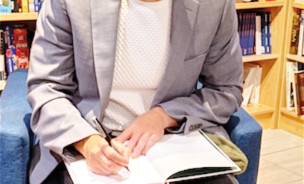
PALESTINIAN ACTIVIST and author Sami Awad told a packed room at the Friends Meeting of Washington, DC on June 28 that the most important work facing Americans today is to confront longheld myths about Israel, understand the depth of Palestinian trauma and commit to a new form of solidarity that goes beyond dialogue and political slogans. Speaking at a special gathering titled “A Sacred Awakening: Resisting Apartheid and Empire,” Awad said the future of Palestinians depends not only on what happens in Gaza and the West Bank, but also on how people in the United States choose to respond.
The event was sponsored by the Quakers’ Peace and Social Concerns Committee and led by Michael Beer, codirector of Nonviolence International.
The central message Awad delivered—and the one that shaped the entire conversation—was that peace cannot be built on myths, silence or fear. It must begin with truth, trauma healing and a shift in consciousness.
He began by addressing the devastation in Gaza since Oct. 7, 2023. Awad said Palestinians had long warned the world about the Israeli violence they face, but global attention only surged after mass casualties. “It’s taken a genocide to wake most people up,” he said. “And the question I’m living with is: is it too late?”
Awad said he called his cousin in Gaza as soon as he realized the seriousness of the events unfolding that day. His mother’s side of the family is from Gaza, and several relatives lived in Nuseirat, one of the first areas bombed. He urged them to flee immediately. “They are the lucky ones,” he said. “We don’t know what will happen next.”
His family’s roots in Palestine stretch back centuries. His grandmother, widowed and displaced in 1948, taught her children and grandchildren never to seek revenge but never to ignore injustice. “That shaped everything,” he said. “We grew up with two stories at once—the brutality of occupation and a commitment to peace.”
Awad’s uncle, Mubarak Awad, founded the Palestinian Center for the Study of Nonviolence in Jerusalem in the 1980s. His work with Israelis and Palestinians led to his arrest and deportation by Israeli authorities, who labeled him a threat. Awad said that moment pushed him to dedicate his life to exploring the power of nonviolent resistance.
Though Awad is an ardent advocate for peace, he believes the institutionalized “peace process” is not just flawed, but also intentionally deceptive.
The Oslo peace process never offered a real path to Palestinian statehood, he said. He argued that Israeli leaders across the political spectrum supported settlement expansion and land confiscation, making a twostate solution impossible from the start. “It died the moment it was introduced,” he said. “It was never meant to happen.”
He also criticized decades of dialogue programs funded by international organizations. For 25 years, he said, Palestinians were not allowed to fully express grief, anger or trauma because funders wanted dialogue sessions to appear successful. “Dialogue became marketing,” Awad said. “We were receiving money to convince our people that the twostate solution was the best solution.”
He said Palestinians must now set the agenda, terms and outcomes of any joint engagement with Israelis. He is preparing a document outlining new guidelines for dialogue and cooperation.
Awad’s new book, The Sacred Awakening, explores how spiritual transformation can shape political action. He said traditional peacebuilding models fail because they ignore collective trauma and rely on rigid formulas. “I learned seven steps to peacemaking in school,” he said. “I went back to Palestine, and it didn’t work.”
He argued that both Israelis and Palestinians bring deep historical trauma into negotiations, shaping fear and identity. Without addressing trauma, he said, political agreements cannot succeed.
Awad also spoke about his Christian upbringing and said Jesus modeled active resistance to injustice, not passive acceptance. “Jesus didn’t avoid injustice,” he said. “He challenged leaders, broke unjust laws and took direct action.”
He described the Beatitudes as a roadmap for healing and transformation, not a list of blessings. Becoming a peacemaker, he said, requires grief, humility and a hunger for justice. “If you’re not being persecuted for peacemaking, you’re not doing it right,” he said.
During the question and answer session, an audience member asked how to respond to critics who say nonviolence is ineffective during military escalation.
Awad said nonviolent leaders in Palestine are being arrested or killed, making organized resistance nearly impossible. But he said nonviolence remains powerful because it aims to pull power away from oppressive systems. “What nonviolence is about is how we pull power away from those who are committing violence,” he noted. He said authoritarian systems have evolved, and nonviolent strategies must also evolve.
He ended by urging Americans to stay engaged, especially as public opinion shifts away from Israel. “This is the time to push forward,” he said. “Not to relax.”
Awad’s message was clear: peace requires courage, honesty and a willingness to confront painful truths. And for Palestinians, he said, the future remains uncertain—but not hopeless. “As long as there are two Palestinians in the land,” he said, “we will survive.”
—Brittany McAlister