






Washington Report on Middle East Affairs, August/September 2024, pp. 58-59
Diplomatic Doings
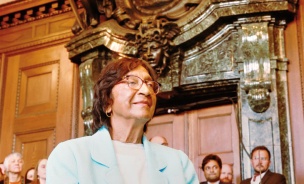
Lakhdar Brahimi, a former Algerian freedom fighter and senior United Nations diplomat who mediated conflicts from South Africa to Afghanistan, discussed his career at an event hosted by the United States Institute of Peace (USIP) on May 21. Speaking with acting USIP president George Moose, the 90-year-old negotiator reflected on his career and offered his perspective on Israel’s devastation of Gaza. Brahimi is a co-founder of The Elders, along with former President Jimmy Carter, Nelson Mandela and other global leaders working for peace, justice, human rights and a sustainable planet.
Brahimi’s storied career spans 58 years, during which he served as an ambassador, foreign minister, under-secretary-general of the United Nations and U.N. special envoy to South Africa, Haiti, Afghanistan (twice), Iraq and Syria. As the Arab League’s special envoy for Lebanon from 1989 to 1991, Brahimi oversaw the passage of the Taif Agreement, which ended Lebanon’s 15-year civil war.
The diplomat’s lifelong foray into international politics began in 1956, when he left college in Paris to join the Algerian National Liberation Front (FLN) and represented the anti-colonial insurgency in Indonesia. After Algeria achieved independence from France, Brahimi became a career ambassador and forged ties with other national liberation movements, including the African National Congress (ANC). Several decades later, Brahimi served as the United Nations special envoy to South Africa, where he oversaw the 1994 election that swept ANC leader Nelson Mandela to the presidency.
Amid the Taliban’s first seizure of power in 1997, the U.N. appointed Brahimi as special envoy to Afghanistan. “In that period, the international community as a whole, including the humanitarians, practically refused to talk to the Taliban,” Brahimi recalled. The need for communication became evident when the Taliban killed nine diplomats in an Iranian consulate and took more than 100 Iranians hostage in the summer of 1998. In response, “The Iranians massed 200,000 soldiers [on their border] and were planning to invade Afghanistan,” he explained. Following an appeal by Iran’s then-President Mohammad Khatami, “[U.N. Secretary-General] Kofi Annan told me to go there, and I saw Muhammad Omar, the leader of the Taliban. We took quite some time, effort, and so on, but we managed…to get the bodies of the nine Iranians [returned] and all the hostages [released].”
Brahimi pondered how history would have unfolded if more governments engaged with Omar prior to the 9/11 attacks. “Talking to people is not bad, and it can be extremely useful,” he emphasized.
After the U.S. invasion of Afghanistan, Brahimi returned to Kabul to help “put together the beginning of a republic,” but “things started to deteriorate in 2004 and went on deteriorating” as Washington’s focus pivoted from Afghanistan to Iraq. Although he rued the Bush administration’s rejection of diplomacy in the lead-up to the Iraq war, Brahimi nonetheless became the U.N. envoy to Iraq in 2004 at Washington’s request. He resigned after six months, denouncing the head of the U.S. occupation, Paul Bremer, as “the dictator of Iraq.”
Given his role in Algeria’s liberation struggle, Brahimi’s position on Palestine is consistent. Prior to Oct. 7, many leaders in the U.S. and elsewhere merely thought of the Palestinians “as a nuisance” that could be managed by Israel, he noted. While acknowledging that “there were some horrible things that happened” during Hamas’ attack, Brahimi asserted that “what has also happened is that Palestinians took the fight inside Israeli territory and have defeated, for one day, the Israeli army.” The Oct. 7 attack “changed things throughout the world, not only for the Palestinians,” he argued, “so now I think that people are starting to accept that the nuisance is not going to go away, that the nuisance are people who have rights and they are not going to give up those rights.”
Brahimi pointed to the international community’s overwhelming support for Palestinian statehood as evidence of a global paradigm shift. He reminded the audience that the U.S. cast the sole veto against Algeria’s resolution to recognize Palestine statehood in the U.N. Security Council and was one of nine nations to oppose it in the General Assembly. Brahimi emphasized the importance of diplomatic recognition, as “if the U.N. accepts the state as a member, then you will have the state of Israel occupying the state of Palestine,” which provides more leverage for the U.N. to broker a resolution.
The diplomat is hopeful that Palestine will one day be fully recognized as a state. “It will not be done in one month or one year, or even perhaps five years, but it can be done, and I think it will be done if the most important countries in the United Nations really live up to their responsibility,” he said.
—Jack McGrath