







Washington Report on Middle East Affairs, November/December 2026, pp. 12-13
Daily Life and Shattered Dreams in Gaza—Writers Share Their Stories
By Nada Hamdona
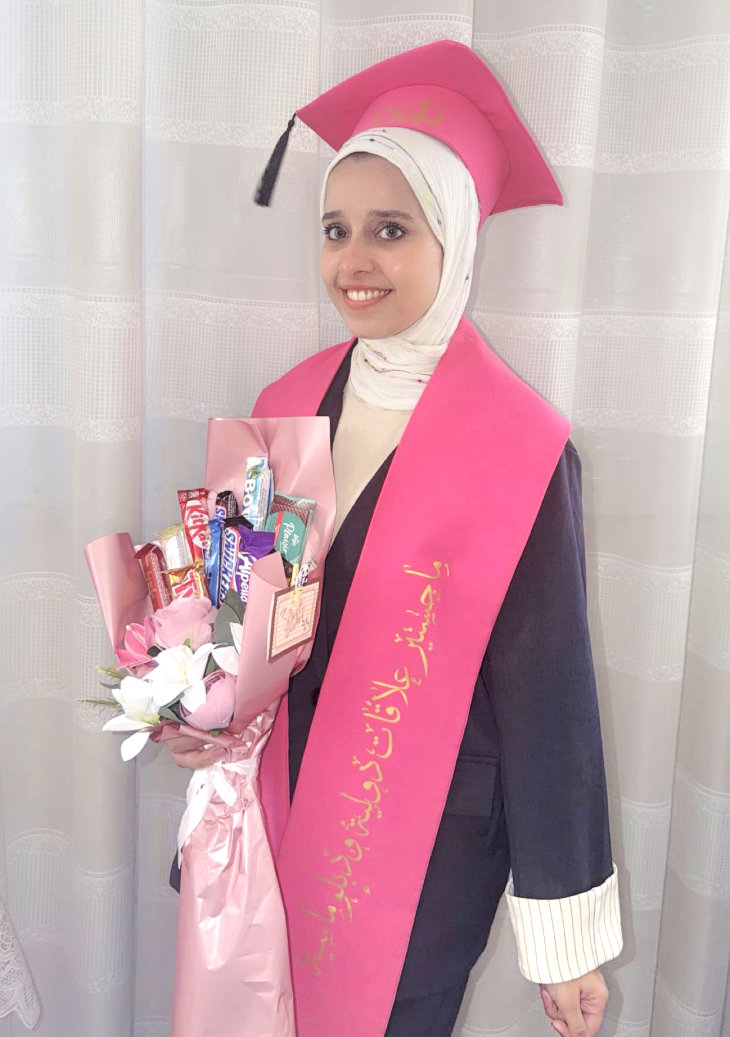
IN EARLY JUNE, I finally got the email I had been waiting for: Goldsmiths University of London had granted me conditional admission to pursue a master’s degree in its Creativity, Policy and Society program.
I read the email over and over again. To make sure this wasn’t a dream, I turned off and then restarted my phone. For the first time since the start of the war, I felt that my efforts were finally starting to pay off and that the future was smiling at me.
Looking back, reaching that moment felt almost impossible, given the journey that brought me there.
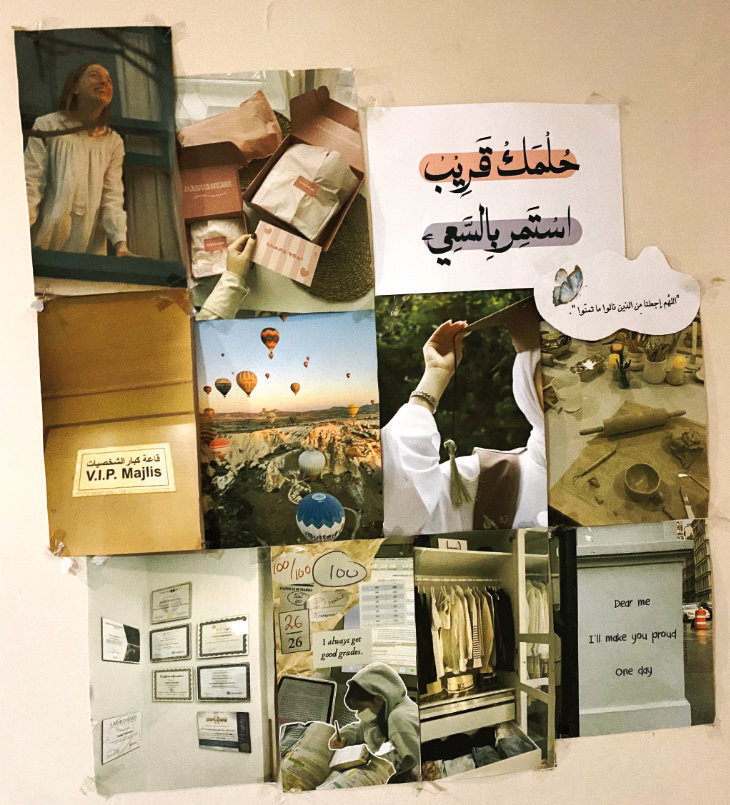
Above my bed I had hung a sentence: “Dear me, one day I will make you proud.” That sentence became my life’s goal. I’ve had so many dreams since I was a kid. One of my most passionate dreams was to study abroad—especially in the United Kingdom, given my love of languages, my degree in English Language and Literature and Education.
I started to study languages a few years ago; eventually, I was able to begin working with English and Turkish as a translator. I used to search online for universities in the UK and Türkiye; I could imagine myself there. But I had not considered the challenges I would actually face. There was a simple reason: I am from Gaza, the land of hardship and destruction. I forgot that the fulfillment of a dream does not depend only on how much a person works for it; it is also influenced by some circumstances that are beyond their control.
When the war started, I sat for hours on end every day asking myself the same questions: Why should I go on studying and working when death can strike at any time? What is all of this for?
I realized, then, that thinking about the future can become a luxury for someone struggling every day simply to survive. I put my dreams aside for many long months and convinced myself that I had to wait until the war ended before I could return to my life.
I had a comfortable life before the war. My father’s furniture and fabric business was thriving and everything seemed possible. But the war took all that away; my father literally lost everything, and with no guarantees of survival for anyone, I knew that I had to take full responsibility for my own life.
I developed a strict discipline in balancing work and my studies. Every morning I would wake up early to go to my job as a translator, return home to assist my mother with the household chores and then devote four to five grueling hours studying for my master’s degree in International Relations and Diplomacy. The learning environment was very rough. With online classes, the constant blackouts made studying an uphill battle. I was often forced into potentially dangerous conditions just to try and find a weak internet signal to attend my lectures.
The terrible food shortages and famine were also very much on my mind. I remember saying to my mother that if I could only get a cup of Nescafé I would forget all this unbearable exhaustion. The war showed me parts of me that I never knew existed, and it made me want to work harder on my self-development. I had loved reading before the war, but I had never tried my hand at writing. During the extreme boredom and complete lack of internet—especially in northern Gaza—I needed an outlet to release my energy and pass the time. I began writing in a journal every single day, documenting my feelings and recording small moments that brought me joy. Writing became my sanctuary.
One day, while I was sitting inside a tent reading a book, my eyes fell on a sentence that changed the way I looked at things. Its meaning was simple: “You may die, but at least live in a way that makes you proud of yourself.” Those words were exactly the reminder I needed at that moment; I couldn’t control the war, but I could control what I did with the time I had left. I resolved I would not let the war diminish me.
To finish the enrollment process for Goldsmiths, I began collecting the required paperwork, but the issuance of official documents like my transcript and bachelor’s degree was taking longer than expected. I made repeated attempts to get in touch with the university and follow up, but the deadline set by the British university passed before I could submit the required documents.
And with that, the opportunity had vanished. I didn’t lose it because my grades weren’t good enough or because I didn’t deserve it. I lost it because the war damaged the educational institutions I relied on and interfered with the issuance of official documents.
A student from Gaza is not competing with students worldwide on the basis of grades and other achievements. Time constraints, power outages, blocked crossings, interruptions at universities and delayed paperwork are other challenges they face. But this reality leads to so many questions: How can a student who fulfills all academic requirements miss out on a chance due to uncontrollable circumstances? How can a war we never chose cause a university education, which ought to be the start of a new chapter, to become a dream that has to be put on hold?
My experience is neither unique nor exceptional. I’ve had conversations with dozens of Gazan students who have gone through similar experiences and endured similar suffering. Some people who were awarded full scholarships lost them because their universities were unable to provide the necessary paperwork in a timely manner. Others were granted full admission, but the closed crossings prevented them from leaving Gaza. Others received great offers from universities, but the scholarships were only partially funded, making it impossible for them and their families to pay for living expenses, travel and insurance—especially since the war caused thousands of families to lose their jobs.
Losing an opportunity is not the only thing that hurts. It is the persistent sense that you must demonstrate that you are entitled to things that students in other parts of the world consider commonplace and uncomplicated, such as the freedom to study, earn a degree, apply to universities and travel.
I refuse to let this story end in disappointment. I might not have made it to the university of my dreams. I might have missed a chance that I thought would transform my life. But my adventure is far from over.
And I hope that the next time a student from Gaza applies to a foreign university, he or she will be able to go forward without repeatedly having to demonstrate that they are worthy of life.
Nada Hamdona is a translator and Arabic, English and Turkish language teacher who majored in English and graduated with a bachelor of arts degree in education. At Al-Aqsa University’s Faculty of Arts, she earned a master’s degree in international relations and diplomacy. She is training with We Are Not Numbers, a project to amplify the voices of young Palestinian writers. Her mentor was Corinne Segal.