








Washington Report on Middle East Affairs, August/September 2024, pp. 16-17
Five Views: Daily Life, Shattered Dreams and Hope in Gaza—Young Writers Share Their Stories
By Dana Besaiso
“NOW THAT YOU ARE OUT, you should focus on your future and leave everything else behind.” Everyone I met after evacuating Gaza to Egypt has given me that advice. But how could I forget when vivid scenes of horror are engraved deeply inside my brain?
PSYCHOLOGICALLY UNWELL
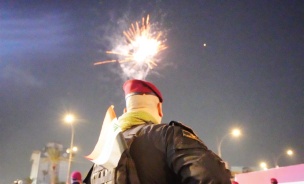
On my last night in the Gaza Strip, on Jan. 8, the sky was lit up by Israeli firebombs that paved the way for the F-16s to carpet-bomb Nuseirat refugee camp. My sister, Lama, and I were wrapped up in one another, reciting the Qur’an and praying that we would still be alive when day breaks.
“Do you think we will die tonight before we get a chance to leave Gaza?” I asked while gazing at the firebombs through the window across from me.
Lama gazed into my eyes. “No, I believe God is so merciful that he will get us out of this horrible night,” she reassured me.
Now that I am out, I keep reliving this scene. Every night, as I look out at the street lights from my window, I see only firebombs.
I am a witness to one of the century’s most horrific genocides. I am a witness to destruction, murder and mutilation. How can I forget all of that and move on with my life? How do you expect me to?
Every time I hear the sound of an airplane taking off, I expect it to be an F-16 missile and take cover. But these planes are friendly; they are flying over me to transport people from one country to another. I am not used to such planes; all the ones I know drop missiles and two-ton bombs on my people.
Everyone around me thinks that we are ultimately free once we are out of the war zone. They are clueless to the mental war we have inside our heads. They don’t know that we fear sleep because nightmares from the war days haunt us. They don’t know that we can still hear the zanana—an armed Israeli drone that constantly buzzes as it conducts surveillance of the Gaza Strip—24/7 even though we are far away from it.
When I watch a video or hear a voice-recorded message from a friend with that sound in the background, my heart starts racing.
THE HEAVINESS OF GAZA
“Start looking for a job opportunity or an internship. You should look for a university to study in since your university was demolished in Gaza,” they say. But how could I? When in my head, I am still there. I have never left Gaza.
A famous proverb goes: “You can take the girl out of Gaza, but you can never take Gaza out of the girl.”
Gaza lives within me; I cannot breathe any air that is not in it. In my eyes, all vast places are small, all green plants are dull, and all happy moments are sad. After all, they are not in Gaza, they were not made in Gaza.
Whenever I meet with my Palestinian friends who evacuated Gaza, we all try to console and cheer each other up saying that the genocide will be over soon. We discuss plans we are making for our future.
But deep down, we all know that we are lying.
We all go to our residences—because they are not home—with that heavy luggage of emotions: whether it is missing home and all of our lifelong belongings that were demolished by Israeli warplanes, checking on old memories of places that were bombed and nowhere to be found anymore, mourning the martyrdom of close friends and family members, or worrying for the remaining family members in Gaza. That heaviness is the constant companion of anyone who evacuated Gaza without their whole family.
Either way, we are still in a much better place than our friends and families who are in Gaza, staying in tents, and resisting the brutal genocide with their words and actions because they are filled with the utmost belief that they have the right to exist and live peacefully.
FAILURE TO IMPLEMENT HUMAN RIGHTS LAWS IN GAZA
“Human rights are indivisible” is the most important lesson I learned in law school.
“The Universal Declaration of Human Rights articles come as a package deal; you cannot exclude any of the 30 articles from any human being. They are granted to everyone once they are born,” my professor said.
However if you are Palestinian, that package can be ripped apart and separated. We surely are not granted the right to life, liberty and security stated in Article 3, but we must fight for it.
Rafeef Ziadah, a Palestinian poet and human rights activist, wrote, “We Teach Life, Sir,” and surely we do. But we do not want to keep on teaching it; we simply want to live it.
We do not want to lose more than 38,000 people, many of whom are children, to prove to the world that we deserve to live.
“I wish I could shrink you into small-sized peas and swallow you inside of me again so I can protect you, so you never know the taste of fear,” my mother would often say to my sisters and me.
I am sorry, mother. Your little girl grew up to witness and smell death all around her. She now no longer believes in human rights laws. She grew up to know the taste of fear. How she wishes you could shrink her and swallow her and keep her safe. To know what it means to be safe.
Dana Besaiso is a law student and a writer at We Are Not Numbers (WANN), a project to amplify the voices of young Palestinian writers.