















Washington Report on Middle East Affairs, August/September 2024, pp. 13-15
Five Views: Daily Life, Shattered Dreams and Hope in Gaza—Young Writers Share Their Stories
By Faress Arafat
AFTER MORE THAN 250 days of relentless bloodshed in Gaza, more than 36,000 lives have been lost, and more than 80,000 have been injured. The bombings and massacres continue unabated, claiming dozens of lives every day, including children and women. Each day brings new stories of losses. I wake up to the news of another martyr or injury, shedding tears as my heart aches for what I see and hear. But the news of the martyrdom of my colleague at Al-Shifa Hospital, Hind Al-Nuwairi, affected me more deeply than other losses.
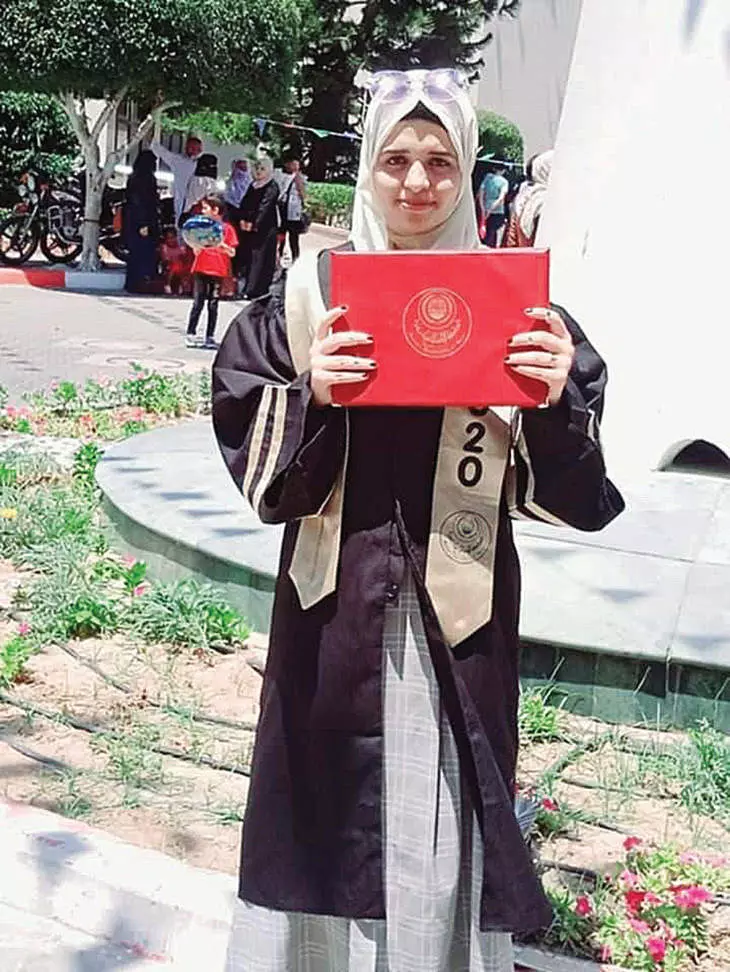
Hind was a real nurse and an angel of mercy. She treated the injured and sick as if they were her own family. I learned of her tragic death from my friend and Hind’s brother, Bilal, who is also a nurse.
I reached out to Bilal after I had been forced to leave Al-Shifa Hospital along with everyone else. Bilal and I had been out of touch for a few months by then. I left a message, asking about what had happened to him and how his sister Hind and her unborn child were doing.
For about a week, there was no response from Bilal. Then, suddenly, I received some voice messages from him. In his first message, he asked about me. I could hear the sadness in his voice, as if something was constricting his vocal cords. In his second message, he broke down in tears, unable to utter a complete word.
Bilal told me he lost the most precious thing he had—his support in life, the ones he wished happiness for. He began to recount the story that had shattered his heart. One day in February 2024, after having finished a 24-hour shift at the Gaza European Hospital where he worked as an intensive care unit nurse, he wanted to go to the home in which he and his family had been displaced. But before heading home, he went to the market to buy some cinnamon sticks; his father liked to drink tea mixed with cinnamon.
While walking in the Al-Nuseirat market, Bilal heard a loud explosion. He didn’t know where it came from but felt as if something had gripped his heart. A few minutes later, he saw a neighbor in the market who told him that the explosion was near the house where they were staying and asked him to call to check on his family.
Bilal took the phone and tried to call his father or any family member, but his phone battery had died. He became certain that something bad had happened to his family—that they were either injured or martyred. He used his neighbor’s phone to call his friend, an emergency room nurse at Al-Awda Hospital in Al-Nuseirat. His friend answered, and Bilal quickly asked who was killed, as if he was already sure the bombing was at his family’s house. The nurse replied, “Your father, brother and sister Hind are all martyrs.”
Bilal cried when he recounted his story to the Washington Report. But when his friend gave him the news, Bilal didn’t cry or collapse; time stopped for him. He even lost his hearing and sight for a few seconds, as if he had died and returned to life as a soulless body. Then he ran to Al-Awda Hospital to see his loved ones.
When he arrived, the medical teams were trying to extract the baby from Hind’s womb. She had been nine months pregnant when she was killed. The baby survived, the only family survivor of a bloody massacre—but only for two days.
Bilal told me about his last exchanges with Hind. In retrospect, it was as though she knew that she didn’t have much time. She had told Bilal she was going to the obstetrics and gynecology department to check on her unborn baby, who was due in a few days, and then she would come to visit them. She said she would bring him lots of gifts and his favorite food if she found it, and she would stay up with him and plan for the future. Both his father and Hind wanted Bilal to get engaged.
But that missile was enough to destroy their dreams. After seeing the bloodied bodies of his family in the hospital, Bilal fainted. When he woke up, he began to understand what had happened to him and his family. It wasn’t just them; his uncle’s family of five were killed, and they have not yet been pulled out from under the rubble.
Bilal now relives his memories of happy times with his family and frets about the future. He has lost everything without warning.
Bilal lost his sister; I lost a dear colleague. I remember Hind and her hard work as we worked together in the emergency department before the war began. She would talk about her future plans, how she would raise the child she was carrying, what she would teach him. She treated us like her brothers, giving advice in work and life. I will never forget how hard Hind worked during the war, despite her exhaustion as her pregnancy progressed. She was focused like a laser on her patients. I remember her telling me, “The dying need someone to comfort them, and I will be here for them.”
Faress Arafat graduated from the Islamic University of Gaza with a bachelor’s degree in nursing in October 2023. He trained with We Are Not Numbers (WANN), a project to amplify the voices of young Palestinian writers. After living in a tent with his family and working in a medical facility in a camp in Rafah, he evacuated to Cairo.















