















Washington Report on Middle East Affairs, May 2026, pp. 29-30
Daily Life and Shattered Dreams in Gaza—Writers Share Their Stories
By Sara Serria
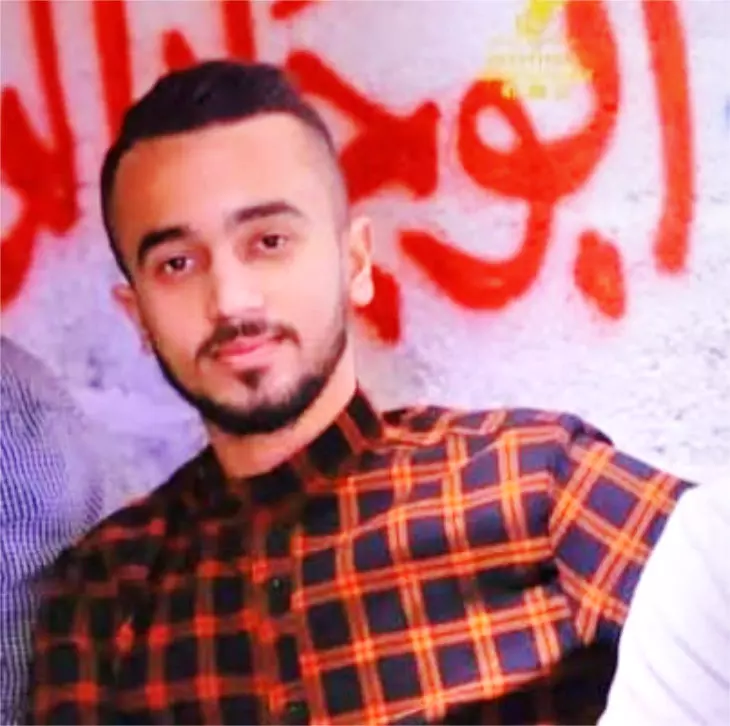
AFTER NEARLY A YEAR of detention in Israeli prisons, my brother Obaida returned home bearing scars of torture and a profound silence born of the cruelty he endured and his struggle to survive. This is a story of reunion, of unspeakable horror, and of how healing sometimes begins with something as small as an apple shared at home.
On Feb. 15, 2025, after nearly a year of detention, my brother Obaida, 24, was released from Naqab Prison. He is my only brother and is two years older than me. For eleven months, we knew where he was being held, but we did not know what was happening to him, how much he was suffering, or whether he would walk out alive.
That first night, Obaida sat with us in an intimate family gathering. Our father and mother were there; so were my sisters and their children, our uncles and aunts, neighbors and relatives. We had returned to Gaza City just two weeks earlier, and though our home bore the scars of war, burned walls and missing doors, it pulsed with warmth and anticipation.
With playful humor, Obaida smiled and said, “Come on, tell me everything I missed while I was gone. And do not leave anything out. I mean it.” We tried.
We told him about the empty chairs at family gatherings. About how certain names were no longer spoken in the present tense. At one point, my father quietly slid his phone across the floor toward Obaida. On the screen was a photo of my uncle Adnan’s home, flattened into gray dust. Obaida stared at it for a long moment, then looked away.
We told him how my sister Heba had given birth to a baby boy and named him Mohammed. How my sister Islam, an Arabic teacher, had begun giving free lessons to displaced children, asking them to pray every day for Obaida’s release. How our mother refused to cook any of his favorite meals, insisting she would only make them once he came back. And I told him that I had written my first story about him.
Exhaustion soon overtook us. My mother, father, Islam and I had walked for six hours to Khan Yunis, where prisoners are released, to meet him. Families gathered there in clusters, waiting, crying, collapsing into one another’s arms. Tears of joy mingled with tears of sheer physical depletion.
Obaida himself was barely able to stand. He had lost 20 kilograms (44 pounds) in prison. His feet dragged against the floor when he walked. His beard had grown thick and his eyes shimmered constantly, as if holding back something heavier than tears.
What struck me most was how he felt both completely familiar and somehow distant. He was right there in front of me, same voice, same face, but it felt as though part of him had not yet returned. His body looked worn down, drained of strength. And yet I could still see who he used to be.
At moments, it felt as if no time had passed at all. His laughter filled the room when he teased my sister Asmaa asking, as she cried, “Are you crying because you missed me, or because your kids are driving you crazy?”
When we took too long hugging him, my aunt Yusra laughed, “Come on, let me hug him too. I missed him so much.” Obaida smiled and replied, “Don’t worry, Auntie. You’ve got the biggest share of my hugs.”
We laughed. We talked. But beneath it all was a shared silence. We all sensed there were things too heavy to touch yet.
At first, I did not know how to approach him. I wanted to ask everything, what he had endured, how he survived, but the words would not come. I was afraid of reopening wounds that had not yet begun to close. So I stayed beside him. That felt like enough.
Obaida was supposed to undergo a medical check-up at al-Hilal al-Ahmar Hospital to assess the damage caused by prison conditions. He refused. He said he could not wait, not another hour, not another minute, without seeing us.
That evening, we laid out dinner for him. Falafel, foul, hummus, salad, eggs, simple home food. He took one bite, then stopped. When my mother gently urged him to eat more, he looked at her apologetically and said, “I cannot. I am afraid my stomach will hurt. I have gotten used to eating very little.”
The next morning, Sunday, Feb. 16, we gathered again in the only remaining room of our burned home. Obaida sat on a mattress between me and my mother, who fed him slices of his favorite fruit, apples.
Our father looked at him quietly and asked, “What happened, son. How were you arrested?” Obaida sighed deeply. Then he began.
He told us he had been heading south, hoping to reach us in al-Mawasi, where we had been forcibly displaced. He stayed behind in Gaza with our father, who refused to leave the home he had known all his life. Obaida could not abandon him.
He wanted to surprise us, to arrive suddenly, see our mother’s face light up. But at what was called the “safe corridor” near Wadi Gaza, Israeli soldiers stopped him. Dozens of young men were detained with him. They were held for hours, surrounded by weapons and shouting.
Then came the night. “They had already dug the pit,” Obaida said quietly. “More than two and a half meters deep.” They were forced to wear white, like burial shrouds. Armed soldiers surrounded them. Orders were barked. Everything they carried was thrown into the pit. “We were pushed down like sacks of potatoes.”
A soldier climbed to the edge and opened fire wildly, without aim. Obaida said, “I stopped breathing because fear froze the air inside me.”
Blood streamed down the face of a man beside him. A hand shook, then went still. Obaida whispered the shahada, the declaration of faith. Then came the shovels. “Soil fell on us in waves,” he said. “It buried the wounded alive.”
Only those who could still stand were dragged out. Seven men emerged. “I was one of them,” he said. “Not because I was spared, but because I could still stand.”
He was transferred to Sde Teiman Prison. For 94 days, he was blindfolded, shackled and deprived of light. He was beaten, humiliated, forced to kneel for hours, attacked by dogs and deprived of sleep. He ate rotten food, moldy bread and decaying apples.
Later, at Ofer Prison, the abuse turned psychological. They mocked him for his name, which means servant of God. They punished him for it. Winter came. He wore a short-sleeved shirt. His blanket was paper thin.
The first Hebrew word he learned was “lechem,” bread.
Two weeks before his release, soldiers showed him footage of the destruction of al-Shuja‘iyya. “Do you like what Hamas did?” they asked. He said nothing.
“They told us,” Obaida said softly, “that they killed our families. That we would never leave.”
Today, Obaida lives with us in al-Mawasi, Khan Yunis. He is trying to rebuild. To rest. To breathe.
The scars remain, in his body, his memory and the silence that sometimes overtakes him. He still flinches at sudden sounds.
But every morning, my mother cuts him an apple. And he eats it slowly, as if tasting freedom itself.
Sara Serria studies English translation at the Islamic University of Gaza and will soon graduate. Her professional ambition is to take up translating literary works and poems at a U.S.-based publishing firm and to continue writing journalistic articles. She is training with We Are Not Numbers, a project to amplify the voices of young Palestinian writers. Her mentor was Claire Ruppert.















