Washington Report on Middle East Affairs, October 2025, pp. 18-19
Daily Life and Shattered Dreams in Gaza—Writers Share Their Stories
By Donya Abu Sitta
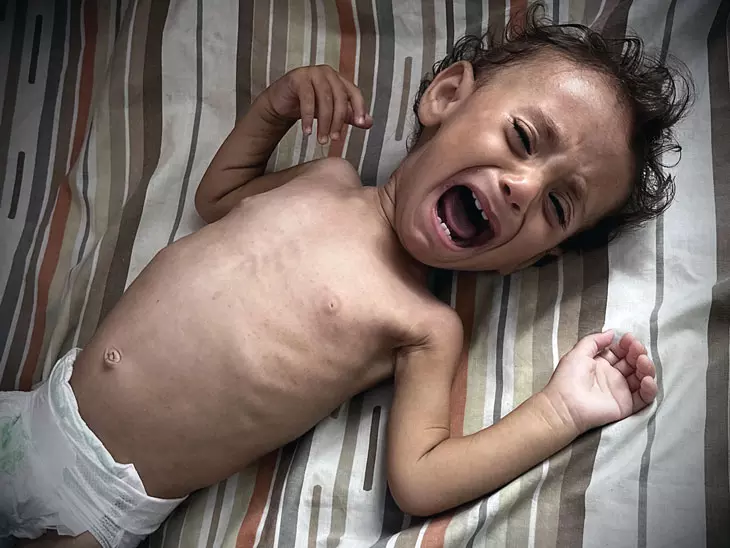
IN THE HEART of the central region of the Gaza Strip, where electricity has been cut, clean water is scarce, and the simplest means of living have been extinguished, an anxious atmosphere prevails. It is not only because of the bombardment, but also from the cries of hunger from frail, thin bodies of children who have yet to complete their first year of life. Famine has crept in with steady, cold steps, slipping into the tents of the displaced and into hospital rooms. It clutches every person in Gaza.
Under Israel’s complete siege that has been imposed since March, the food system in Gaza has collapsed. The markets are almost empty, aid is depleted, and accessing money is nearly impossible, because banks are closed or paralyzed. The lack of liquidity has placed the commission for withdrawing cash at 50 percent. UNICEF-supported nutrition centers report a 50 percent increase in the number of children seen in their facilities between April and June. This is an unprecedented man-made disaster.
Famine has reached the fifth and final, most dangerous stage in the Gaza Strip. I spoke with Dr. Diana Al-Roumi, a nutritional health specialist who works in a temporary field hospital set among the crowded tents of displaced people. (For security considerations, the name of the town has been withheld.) Mothers and children crowd together, waiting for a medical examination or a scrap of food.
BETWEEN LIFE AND DEATH
During the first week of June, a father entered the field hospital carrying his son, 4-month-old Ahmed, wrapped in a tattered, thin blanket. The child moaned softly: his small body seemed to have lost much weight. The father had lost his job as a street vendor at the beginning of the genocide, and he could barely withdraw money from his bank account. The price of a can of formula milk exceeded 50 shekels. And with the scarcity of supplies and the collapse of markets, finding milk has become a miracle in itself.
He told Dr. Diana that he was unable to provide milk or food for his child. He had been able to purchase powdered milk but realized it was not suitable for his son’s age. He was forced to give it to him anyway.
After sharing this story with me, Dr. Diana explained: “The disaster isn’t merely the lack of suitable milk, but also the absence of any safe alternative. Baby Ahmed arrived to us in a state of severe malnutrition with extreme dehydration, and he was suffering from electrolyte disturbances and a deficiency in the essential vitamins that any infant needs.”
Ahmed was admitted to the emergency department, provided with fluids, and a therapeutic nutrition plan was initiated. But the intervention might have been too late, she acknowledged; his body was already very weak.
Dr. Diana observed: “What we’re witnessing isn’t just a crisis, but a complete collapse. Since the beginning of the war, we used to receive one or two cases of malnutrition daily, but over the past few weeks, we’ve started seeing seven to 10 new cases daily, all of them in children under the age of five. A large number of breastfeeding mothers are suffering from malnutrition, preventing them from producing milk for their children.”
There was no doubt in her mind: “The situation has gone beyond the warning stage; we are facing a real famine.”
Dr. Diana indicated that the most common symptoms that she has seen at the field hospital are muscle atrophy and severe weight loss, bone protrusion and absence of subcutaneous fat, chronic diarrhea and vomiting, loss of appetite and complete motor lethargy.
She added that bodies in a state of prolonged hunger become unable to respond to treatment quickly, which may lead to organ failure or silent death. These symptoms have started to become visible, even in adults.
HOW DID WE REACH THIS STAGE?
Before the genocide, Gaza relied heavily on imports, humanitarian aid and agriculture. However, with the complete siege currently imposed by the Israeli regime, these channels have been unavailable. No trucks are entering, and no food supplies are leaving the warehouses. According to an article published on Think Global Health, as early as April 2024 more than 40 percent of farmland was rendered unusable. The markets have become empty, and, if there are goods available, their prices exceed the residents’ ability to pay.
The price of baby formula, for example, increased from 20 shekels (nearly $6) to more than 50 or 70 shekels ($16 or $20) when it is available at all. Baby food (such as Cerelac) has become almost nonexistent.
Additionally, the lack of electricity and water makes the sterilization of milk or the preparation of food for children dangerous.
BREASTFEEDING MOTHERS ON THE BRINK
“We receive dozens of women who suffer from severe malnutrition, and some of them don’t produce milk at all,” Dr. Diana said. “Their bodies are exhausted by hunger, anxiety and poor living conditions.”
Dr. Diana recalled a 24-year-old mother she had met, Um Haneen, who had given birth in June. “She came to us crying, saying that she had eaten only one meal of rice in the past two days and was drinking unclean water.”
She was diagnosed with severe anemia and a deficiency in calcium and vitamin D. She was unable to breastfeed or even walk.
HOPE REMAINS
Medical and humanitarian teams continue trying to do everything they can to save lives.
“We work without salaries, without sufficient equipment, but we cannot leave,” the doctor noted. “Every child we save gives us a reason to be here.”
She wanted to convey an urgent message: “Time is running out. Famine isn’t a future event, but a daily reality in Gaza. We need an immediate and safe humanitarian corridor for the entry of food, milk and nutritional supplements.”
Famine is visible everywhere—in the temporary corridors, in the makeshift clinics, in the hearts of mothers and the cries of children. And often, by the time it is reported, it is already too late.
Donya Abu Sitta is a content writer and translator, studying English language at Al-Aqsa University. She has volunteered as a translator and writer for the Hult Prize, Youth Innovation Hub, Science Tone, Eat Sulas and Electronic Intifada. She is training with We Are Not Numbers (WANN), a project to amplify the voices of young Palestinian writers.
(Advertisement)