






Washington Report on Middle East Affairs, November/December 2014, pp. 53
Human Rights
Syria’s Heroes Bring Humanity to War Zone

As government forces and rebel groups continue their bloody fight for the future of Syria, the unimaginable suffering of the country’s citizens worsens.
In the midst of this war that has dehumanized so many, one group of brave Syrians is working to stand up for the dignity of all people, regardless of their religious or political beliefs.
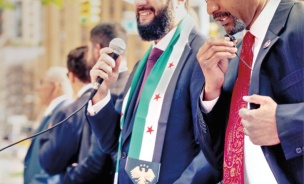
Known as the “White Helmets,” the 600-member Syrian Civil Defense organization assists civilians who have been injured by bombings and other acts of war. In the last six months alone, the group of volunteers has saved more than 2,500 lives. On Sept. 30, two members of this group appeared at the United States Institute of Peace (USIP) in Washington, DC to share their story.
Khaled Harah, who works in Aleppo City, began by recalling one of his team’s more moving incidents. After a residential building was bombed from the air, the group worked 16 hours to save a days-old baby. Lacking powerful equipment, the team relied mostly on their hands to dig through the rubble and had to temporally halt their search because the Syrian Air Force resumed airstrikes in the area.
As USIP staff played video of the heroic rescue, many in the typically stiff think-tank crowd became emotional. The narrator of the short clip concluded by summing up the group’s philosophy: “unarmed and impartial, they’re on the side of life.”
Raed Salah, head of Syrian Civil Defense in the Idlib governorate, stressed that the group is partial to life, not politics. “Anyone who kills innocent civilians is our enemy,” he said. Given their apolitical humanitarian nature, Salah said, most groups in Syria do not object to their presence.
Asked how he and his peers mentally cope with the traumatic nature of their work, Salah said they try to remain hopeful. “When we rescue a person, we give them new life and this gives us hope to continue,” he explained. “We believe we can do something and we have to contribute.” Nonetheless, he conceded that it’s easy to despair, especially on days when most of the bodies they find under the rubble are lifeless.
During their time in Washington, Salah said, his group asked the U.S. government for more resources. The U.S. previously gave the organization $6 million for uniforms, vehicles and other equipment and has promised an additional $4.5 million for more equipment, he said. Harah added that a lack of proper equipment has prevented the group from saving more lives.
Dr. Samer Attar of the Syrian American Medical Society, who has participated in two medical missions to Syria, provided additional information on the humanitarian situation in Syria. “I saw horrible things, brutal things,” he recalled, noting that many of his patients (many of them children) were wounded in sniper attacks.
While doctors on the ground have limited supplies, Attar said he was impressed by their ability to make do. “It’s amazing what you can do with very little,” he noted. However, Attar stressed, situation is dire. He pointed out that many hospitals have been incapacitated and that due to a lack of space many patients have to share beds or be operated on in the hallway.
Attar concluded his remarks by praising the doctors and first responders who work in Syria. He noted that many have the means to flee the country but choose to stay and assist those in need. It’s important, he stressed, to remember that good people remain in Syria.
For more information visit https://www.whitehelmets.org/
—Dale Sprusansky