















Washington Report on Middle East Affairs, January/February 2022, pp. 60-61
Films
IN 1991, Israel ratified the U.N. Convention on the Rights of the Child (CRC), which stipulates that children must not be unlawfully or arbitrarily detained and must “not be subjected to torture and other cruel, inhuman or degrading treatment or punishment.” Despite this, Israeli forces target Palestinian children for arrest; in many cases, Palestinian children are detained multiple times. In the first three months of 2021, 230 Palestinian children were detained by Israel. On average around 700 children face detention annually. According to the Palestinian branch of Defense for Children International (DCIP), 85 percent of the children arrested last year were “subjected to physical violence.”
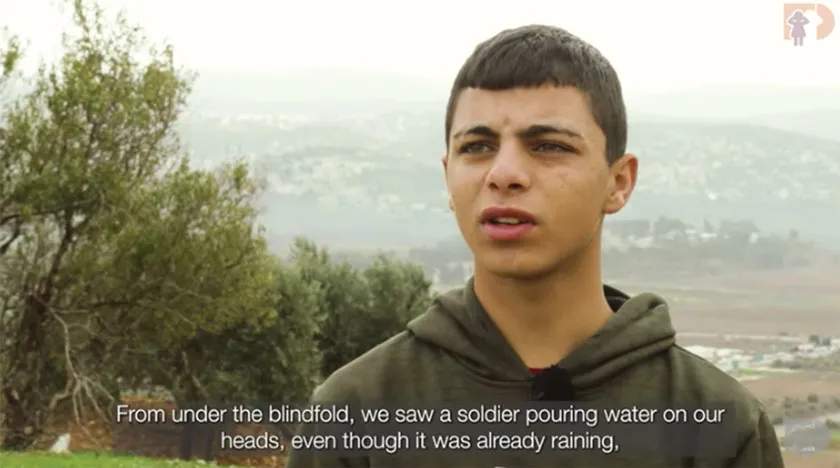
As the new documentary “Caging Childhood: Palestinian Children in Israel’s Military Detention System,” jointly produced by DCIP and the American Friends Service Committee (AFSC) underscores, Israel’s violation of the CRC is common. The film follows the stories of 16-year-old Osama, who was held at gunpoint while Israeli soldiers knelt on top of him; 17-year-old Qusai, who was arrested in his home at 3:00 in the morning; and 17-year-old Islam, who was forced to sleep outside in the cold overnight while he was being detained. Through their voices, the film highlights the various types of violence, arbitrary detention, arrest, mistreatment and torture the children endure, as well as the emotional and psychological impact of being targeted by Israel’s security system.
The inaugural screening and virtual panel discussion took place on Universal Children’s Day, Nov. 20, as part of DCIP and AFSC’s #NoWayToTreatAChild campaign, which aims to end the Israeli military detention of Palestinian children. The panel was moderated by Zeina Ashrawi Hutchison, a Palestinian-American rights activist and community organizer, with discussants Manar Al-Amleh, international advocacy officer at DCIP, based in Ramallah, and Brad Parker, leader of DCIP’s legal advocacy efforts on Palestinian children’s rights.
Al-Amleh explained that the film highlights the situation Palestinian children face and noted that the three children who agreed to tell their stories did so as part of their own healing process while understanding that their stories would also help draw attention to the overall issue. She explained that many of the detained children continue to struggle with PTSD, depression and a lack of self-esteem as a result of their mistreatment.
She explained that the separation from their families and the isolation in detention causes psychological damage that has long-term effects on the children’s’ development. For instance, the longer a child spends in military detention, the more difficult it is to reintegrate into school and resume their life. And, like their adult peers, the experience leaves lingering trauma from the psychological torture and physical abuse.
Parker explained that under the military court system, the children are not allowed to see lawyers for days and are often moved around to different detention centers in the West Bank. Families often spend a lot of money just to locate their child and to hire attorneys to secure their release. He pointed out that the most difficult thing for these children is not being allowed to see anyone who can help or advise them and the language of interrogation and “confession” being Hebrew.
While both speakers acknowledged the efforts of a few in Congress, like Rep. Betty McCollum (D-MN), to protect Palestinian children, their hope is that the film will be used to activate and educate around the plight of Palestinian children. The group has also put together a discussion guide for hosting a screening of the film.
Resources and the film can be accessed online at: <https://nwttac.dci-palestine.org/documentary_caging_childhood>.
—Julia Pitner















