















Washington Report on Middle East Affairs, June/July 2026, pp. 79-80
Music & Arts
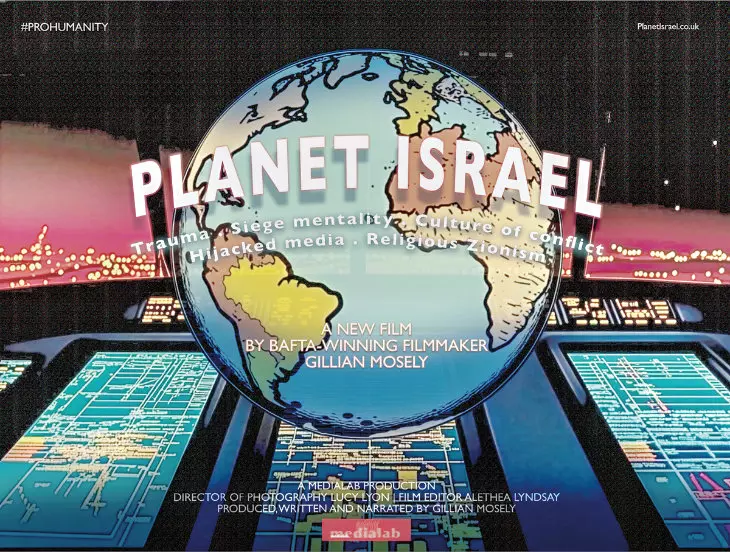
THE ONLINE EVENTS I host for the Britain Palestine Project often affect me in such a way that I need to write about them. The April 23 preview screening of “Planet Israel: A Cautionary Tale,” followed by a live Q&A with its director, BAFTA-winning filmmaker Gillian Mosely, was one of those occasions.
Set almost a year after Oct. 7, 2023, this feature-length documentary uses interviews, artificial intelligence animation and archival footage to explore how Israeli society, so steeped in its own individual and collective trauma, justifies such violent attacks on Gaza carried out in its name.
“Planet Israel” opens with footage from Oct. 7. It is a harrowing reminder that Hamas killed 1,200 people that day, including more than 300 soldiers and police officers, in addition to the hundreds of hostages taken. [Ed: Israeli investigations admit an unknown number of Israelis and foreign workers were killed by friendly fire and the possible application of the “Hannibal Directive.”] These victims were mainly from kibbutzim around the Gaza border, but the fear and grief spread throughout Israel and into the national psyche.
What followed was a military retaliation of unprecedented scale and horror. More than 75,000 Palestinians have been killed, thousands more are still under the rubble, and at least 20,000 of these are children. That is at least 1 in 33 people in Gaza, and we know that this is a vast undercount because it includes only those deaths that were documented by authorities, not those buried in the rubble. We know these numbers aren’t simply spread out evenly throughout the population, either. Whole families and entire family lines have been wiped out. U.N. agencies report that 10 percent of the population of Gaza (2.2 million before the war) have been killed or injured.
All this at a time when most schools, hospitals, universities and other institutions have also been destroyed. Israel has been credibly accused of committing genocide and arrest warrants have been issued for top Israeli officials, including the prime minister.
Mosely looks at Israeli identity, psychology and history and asks how and why so many people support a genocide.
According to Mosely, the answer seems to be trauma suffered so severely for so many centuries by Jews, in addition to their perceived victimhood as a lone state in the Arab world. This is passed on from generation to generation in what Swiss psychiatrist Carl Jung called collective consciousness and TikTokers call intergenerational trauma. When people feel threatened, their empathy toward “the other” dwindles to nothing, and measures that would otherwise be unthinkable become justifiable, even necessary, if it genuinely seems to be an issue of national and personal security. It is not disproportionate violence. It is survival.
“Planet Israel” asks how we fix this when the whole country suffers from it, and has a leadership that weaponizes it. How do we re-humanize both parties to each other when Prime Minister Binyamin Netanyahu and company need people afraid and paranoid in order to push through their agendas?
“Planet Israel” paints a picture of how these ultranationalist ideologies have moved from the fringes into the mainstream. The media has shaped a new reality in Israeli public perception. Palestinian suffering is rarely mentioned, depicted or displayed in the media, making it easy to convince Israelis that there is not much to report in Gaza. When suffering is invisible, it is easier to ignore.
As a British/American Jew herself, Mosely’s desire for accountability has caused conflict in her own family. And Mosely is clear in her belief that justice is required for any political solution to stick. “Until we actually face the fact that Palestinians have been brutally treated and displaced…I don’t see how this ends,” she said.
Amid its political themes, the documentary always remains focused on human impact. Testimonies from Gaza show families displaced and separated, educations interrupted, lives put on hold, children traumatized, orphaned or disabled. These are the real lives behind the political debates and the statistics in news.
Ultimately, “Planet Israel” is more of a warning than a provision of answers. When trauma is left unaddressed, when history is weaponized and when political power exploits fear, societies can lose their moral compass.
Breaking this cycle demands accountability and pressure. “I genuinely believe the world can put pressure on Israel—and we’re starting to see it now,” Mosely says, remaining optimistic. She believes peace is too important to leave up to governments alone. Citizens must act too, by challenging narratives, engaging politically and refusing to look away.
The award-winning “Planet Israel: A Cautionary Tale” is now available in the United States via the online platform Kinema. For more information or to host a screening, please visit <www.planetisrael.co.uk>.
—Diana Safieh















