Washington Report on Middle East Affairs, November/December 2025, pp. 72-73
Music & Arts
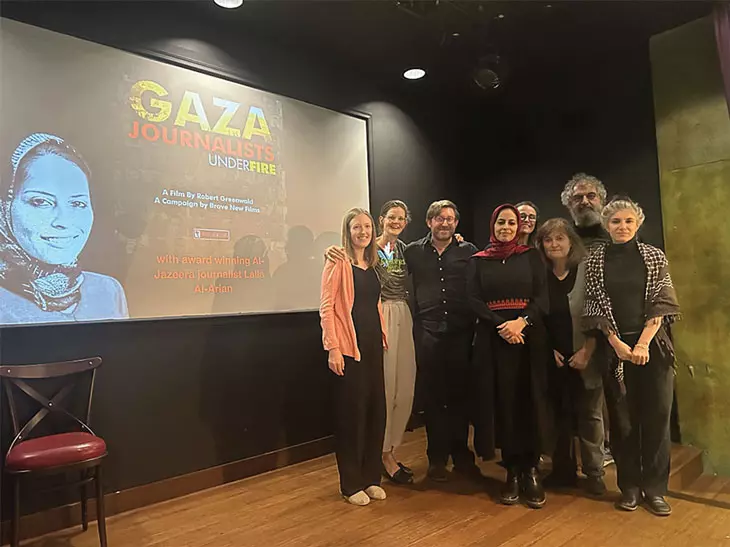
ON SEPT. 20, Maryland Neighbors Against Genocide (MDNAG) hosted a special screening of the documentary “Gaza: Journalists Under Fire,” an acclaimed new film by Robert Greenwald and Brave New Films that sheds light on the experiences of Palestinian journalists working under siege and bombardment. The event, held at Busboys and Poets in Washington, DC, was followed by a discussion with Al Jazeera’s Emmy Award-winning journalist and documentary producer Laila Al-Arian.
The screening comes at a time when global attention is focused on the unprecedented dangers faced by journalists in Gaza, many of whom have lost their lives while documenting the realities on the ground. According to Jodi Ginsberg with the Committee to Protect Journalists, more journalists have been killed in Gaza than in the U.S. civil war, both world wars, and the wars in Korea, Vietnam and Afghanistan combined. Reporters Without Borders has also noted that Gaza has become “the most dangerous place in the world for journalists.”
“Gaza: Journalists Under Fire” goes beyond statistics to humanize the journalists themselves. It focuses on three Palestinian reporters who were assassinated by Israel:
Bilal Jadallah, who founded Press House, a safe haven and training ground for Palestinian journalists.
Heba al-Abadla, who founded the Social Media Club, an initiative educating and empowering upcoming journalists, particularly women and youth. Israel killed Heba alongside her five-year-old daughter, Judy, and her mother.
Ismail al-Ghoul, a correspondent for Al Jazeera, who covered major stories including the Al-Shifa Hospital siege. While reporting there, he was captured and beaten by the Israeli military. A few months later, Israeli forces tracked and fired on his car, killing him. After his assassination, Israel attempted to discredit him by labeling him a militant.
“These journalists are truth-tellers in a place no other journalists can go,” said Laila Al-Arian. “They are part of the communities they cover, and their courage ensures that Gaza’s story is not erased.”
“We need to remember that many of these journalists have been smeared and maligned to delegitimize them,” Al-Arian explained. “They’ve lost their equipment, their offices, they’ve spent time away from their loved ones—and in many cases, they’ve seen their loved ones killed. Yet, they continue despite the grief because of their dedication to their craft and their people.”
She also highlighted the failures of Western media, which often repeats Israeli government claims without scrutiny. “Western media has been complicit, using euphemisms and failing to do any real investigation,” Al-Arian said. She pointed to the case of Anas al-Sharif, a Gaza-based video journalist for Reuters who was assassinated by Israel in August 2025. After his killing, Reuters cited Israel’s claim that he was a militant—even though al-Sharif had worked for Reuters itself and helped them win the 2024 Pulitzer Prize for Breaking News Photography.
“Western media portrays them as unreliable narrators of our genocide,” Al-Arian stressed. “But these journalists have integrity. One of them was investigating two mass assassinations of men and boys. In one case, they had a source who heard gunshots, but did not see the shooting. He chose not to use that source. I wish Western media had that much scrutiny and interrogation of the information they get.”
The screening was more than just a film showing; it was a community gathering designed to connect global issues of press freedom and human rights to local activism. MDNAG, a grassroots coalition of Maryland residents, has been actively engaged in raising awareness about U.S. complicity in Israel’s war on Gaza and mobilizing against policies that perpetuate violence.
Dr. Marie Najjar, a member of MDNAG, expressed gratitude to all who attended: “We deeply appreciate everyone who joined us tonight—by showing up in solidarity and bearing witness, we reaffirm that truth and compassion still have power. But it’s not enough to know—we must act.”
For MDNAG, framing the issue in terms of U.S. responsibility is central. “Our tax dollars are funding this genocide,” said one member. “We can’t be silent while journalists and civilians are being killed. We have a moral duty to demand change.”
Najjar encouraged residents to contact elected officials and support legislation that conditions military aid to Israel on accountability, ends U.S. complicity in genocide and supports free speech.
—Susan Kerin