















Washington Report on Middle East Affairs, March/April 2026, pp. 74-76
Music and Arts
THREE FILMS that center Palestine’s history and agony have been shortlisted for an Academy Award in the International Feature Film category of the 2026 Oscars. Two of them will be reviewed here; the third is Annemarie Jacir’s “Palestine 36.” One of the two focuses on an afternoon in Gaza during the current ongoing genocide; the second is a family saga that spans three generations of political turmoil and trauma.
“THE VOICE OF HIND RAJAB”
Tunisian director Kaouther Ben Hania (who also wrote the screenplay) has described the genesis of her film in terms of a single voice: once she heard a snippet from the audio clip of a little girl pleading for rescue, she couldn’t unhear it; she shelved the project she was working on to focus on telling Hind Rajab’s story.
The 89-minute-long film recreates the response to a call that came into the Palestine Red Crescent Society in Ramallah on the afternoon of Jan. 29, 2024. When operator Omar asks the caller for her name, her response, Hanood (the pet name used by everyone who loves Hind Rajab), gives him his first clue that she might be a child. To distract her as efforts are made by his supervisor to locate a rescue team in her area, he asks her what grade she’s in. Her response (“the butterfly class”) tells him that he is talking to a preschooler. We see that detail register on his face. From then on, he becomes more and more frantic, even hysterical, as do the coworkers who attempt to relieve him and distract the child (represented in the film by the audio waveform of her voice, the digital file name stamped in the corner). Hind’s thin, frightened voice continues to urge whoever is on the phone to find her; all her relatives in the car are dead, the tanks are close by and the sun is setting.
Tensions arise between the phone operators and the coordinator, who initially seems unmoved by her plight but then is shown to be haunted by the dozen or so rescue workers who have been killed on such missions, many of whom he knew; he recounts the orphans they left behind.
Relief is in fact available; there is an ambulance not far away. But its movement must be coordinated with several actors, with authority ultimately resting with the Israelis, who are not inclined to grant safe passage to the rescue team. In what has become standard Israeli practice, they finally grant permission but then fire at the child and her rescuers anyway. The operators in Ramallah hear the shooting on the phone line and realize the little girl is dead.
The film, shot in Tunisia over the course of three weeks in November 2024, received several awards at the 2025 Venice International Film Festival (where it received a 23-minute and 50-seconds standing ovation), the San Sebastian International Film Festival and the Chicago International Film Festival. The Vogue reviewer described it as, “A humanist marvel...This isn’t just a film you’ll keep thinking about, it’s one you’ll live with...an astounding cinematic achievement.” The long list of Hollywood names associated with it include Brad Pitt and Joaquin Phoenix as executive producers. Its U.S. distributor is Indie Willa.
“ALL THAT’S LEFT OF YOU”
This feature-length film, Jordan’s submission to the Oscars, tells the story of three generations of a Palestinian family from Jaffa that is displaced to Nablus when Israel is created in 1948. It is a complex story of intergenerational trauma, at the center of which is a moral dilemma. The performances are uniformly superb. The dialog was especially fine; every line spoken and every scene looked and sounded authentic.
In an interview with The Hollywood Reporter, director Cherien Dabis explains that she had hoped to find a mainstream U.S. distributor (“which was maybe naïve”); realizing her error, she partnered with Watermelon Pictures (self-described as “rooted in creative resistance”). This is the final film starring legendary Palestinian actor and director Mohammad Bakri, one of the three founders of Palestinian cinema whose career spanned five decades; he died at age 72 just before it was released.
The theme of intergenerational trauma is exemplified in the very making of the film: the crew was just starting to shoot the film in the West Bank when the genocide in Gaza began; movement soon became restricted, and the decision was made to move production to Cyprus, Jordan and Greece. The fact that a genocide shifted the production location of a film about ethnic cleansing and personal disaster explains why Palestinians say that the Nakba began in 1948 and never really ended.
Watching the movie (which lists Mark Ruffalo and Javier Bardem as executive producers), viewers get an education on the question of Palestine in just under 2.5 hours: the attacks on families that prompted them to leave their towns (temporarily, they thought) for safety in 1948; life in a constrained refugee camp; living under Israeli occupation after 1967 and the many petty ways the colonizer has of humiliating people (and especially fathers in the presence of their children); and shooting to kill children in protests. One understands the truth of the statement voiced by Hanan, mother of the teenager Nour, that to understand his behavior, you really do have to consider the events of 1948.
This film is about the battering to which people are subjected and the tremendous will it takes to retain their humanity, which itself is a form of powerful resistance that no one, not even the Israeli occupation, can take away.
The parents of Nour, a teenager shot in the head during a demonstration and rendered brain dead, find themselves asked to make an impossible decision: will they donate his organs to save others? It’s a triggering question for Palestinians: Nour was shot during the First Intifada, and already there were reports that Israeli doctors were helping themselves to Palestinian organs. (This accusation has been voiced repeatedly since the Gaza genocide.) The request was made in a Haifa hospital, and the hospital could not guarantee who would get the six organs they asked to harvest. Could they donate the organs of their son killed by an Israeli to other Israelis who might very well go on to kill other Palestinians?
In the last scene, the parents, now much older, visit Haifa and Jaffa as tourists, after having emigrated to Canada and secured Canadian passports. They are reminded by a Palestinian waiter in a Jaffa restaurant that the Palestinian presence, even within Israel, endures. That self-assurance, too, is a form of resistance that offers hope.
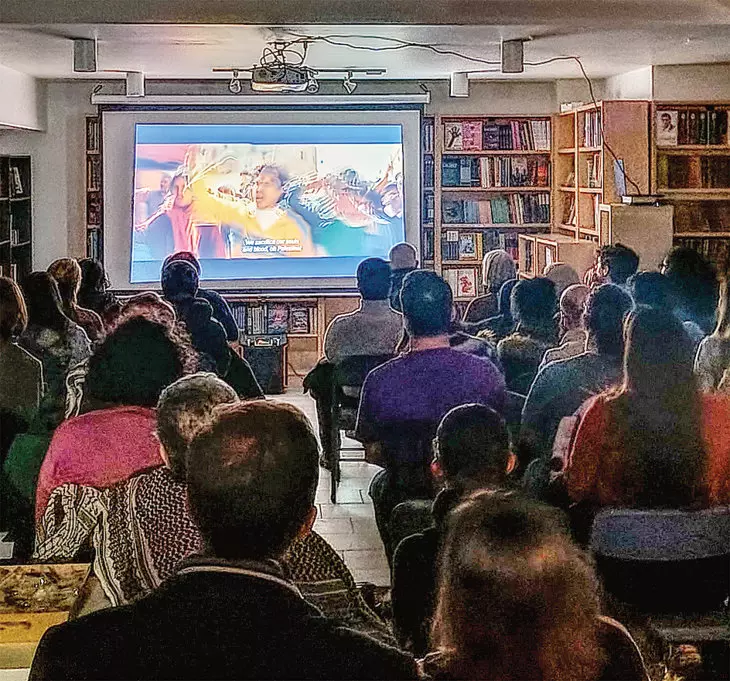
A sold-out film screening of “All That’s Left of You,” cohosted with the Museum of the Palestinian People, took place in the renovated Middle East Books and More bookstore on Jan. 16. To request a screening in your area visit, <screening.watermelonpictures.com/request>.
—Ida Audeh















