















Washington Report on Middle East Affairs, August/September 2024, p. 65
Book Talks
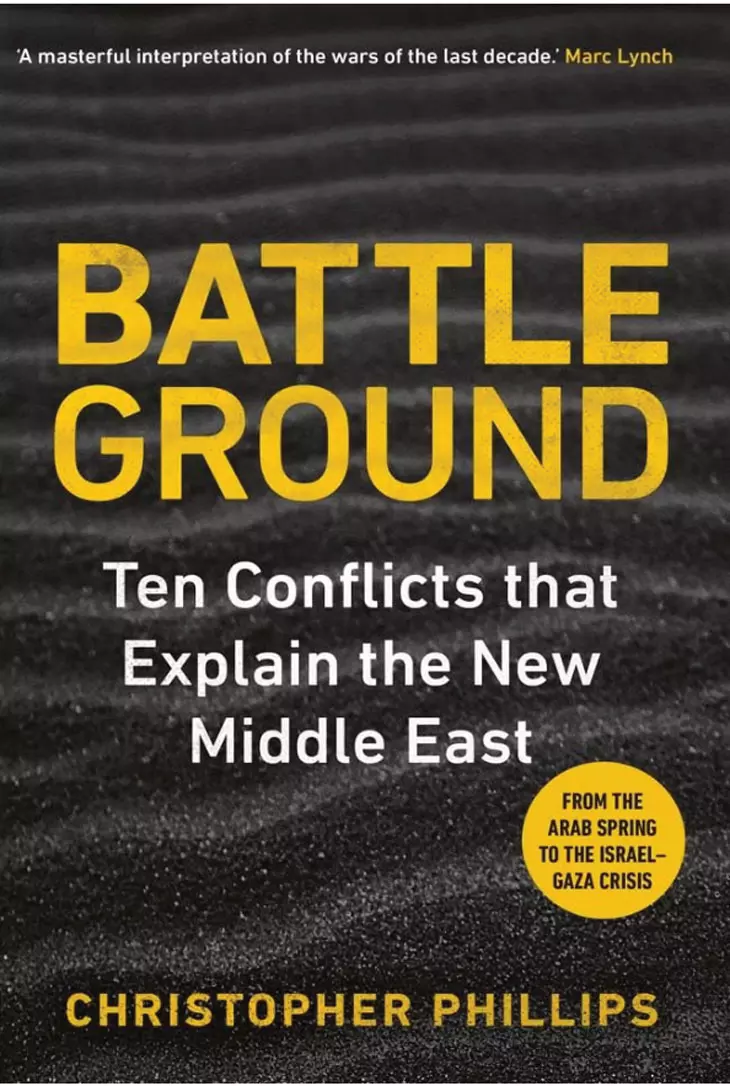
In his recently released book, Battle Ground: Ten Conflicts that Explain the New Middle East, author Christopher Phillips offers a unique view into the international relations of the Middle East. The region is frequently characterized in a rather simplified way, Phillips, a professor of international relations at Queen Mary University of London, told Gönül Tol of the Middle East Institute at a May 15 event in Washington, DC.
To provide a more complex understanding of the area, Phillips organized his book into separate chapters on Syria, Libya, Yemen, Palestine, Iraq, Egypt, Lebanon, Kurdistan, the Gulf and, a little farther afield, the Horn of Africa. “The logic of the book is that you can look at any one of the individual chapters and read them on their own and understand them,” he said, or “you could also read all 10 in turn, or even a few of them, and get a broader holistic picture of what’s going on in the region.”
One aspect of the international relations of the region that has changed over the past 15 years, Phillips claimed, is the role of the United States. While the U.S. was once perceived as the dominant power in the Middle East, it is now viewed as reluctant to become overextended in the region.
Nonetheless, Phillips noted that the U.S. has not by any means fully withdrawn from the region, citing its military bases in the Gulf, its lingering troop presence in Syria and in Iraq, and the large amount of military support it sends to Israel. Also, while recent presidents have tried to “pivot away from the Middle East…to Asia,” he noted that each time, “something has sucked them back into the Middle East,” whether it was the Arab Spring, the rise of ISIS or now the October 7 crisis and Israel’s assault on Gaza.
Amid the talk of Washington’s decreased interest in the region, Russia, in a military sense, and China, from an economic point of view, have expanded their Middle East footprint. Traditional U.S. allies in the region have used Washington’s unease with this new reality to their advantage, leveraging their relations with the two countries to draw concessions from the U.S. It’s their way of saying to the U.S., “you’re not the only game in town anymore,” Phillips said. At the same time, “they do not want the U.S. to disarm and leave the region,” he added.
China has an economic-driven foreign policy and wants to play a diplomatic—not a military—role in the region, Phillips said, noting its recent successful effort to ease relations between Iran and Saudi Arabia. “China’s foreign policy…outside of its immediate environment…is to use economics as a tool of diplomacy,” he said. Beijing also sees it as strategically beneficial that the U.S. still exerts so much military capital in the Middle East, he added.
As for other players in the region, Phillips classified Iran as an “interventionist” power, particularly following the 2003 U.S. invasion of Iraq. Türkiye is also far more willing to become involved in the region than it previously was, he added.
Meanwhile, the UAE, Qatar and Saudi Arabia, which previously tended to be more inward looking, have all become more involved in regional affairs. “So, you now have a lot of regional powers playing major roles in the region, and, interestingly, they are competing with one another.”
Longer-term, Phillips cited climate change as the greatest risk facing the region. Being one of the most water-poor regions in the world and one of the most population-dense areas of the world “is not a good combination,” he stressed. “And you are seeing the negative impact of climate change, particularly in Iraq and Jordan,” where it is “having an effect on politics and leading to a sort of mass migration to the cities, leading to more unrest.”
—Elaine Pasquini














