Washington Report on Middle East Affairs, October 2026, pp. 77-78
Book Talks
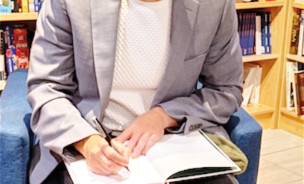
DR. RANDA TAWIL discussed her new book, Race in Transit: Tracing the Politics of Migration from Ottoman Syria Through U.S. Empire, with Amy Fallas at the 14th Street Busboys and Poets in Washington, DC on Aug. 11. Tawil is a writer and lecturer at the University of Washington in Seattle, who specializes in migration and mobility, ethnic studies and Arab/Middle Eastern American studies. Historian Amy Fallas, an associate editor at the Arab Studies Journal, is an expert on mobility between the Middle East and Latin America.
Tawil’s book follows the experiences of the early Syrian diaspora at the turn of the 20th century as they leave Ottoman Syria to migrate eventually to the United States. During Ottoman times, Greater Syria spanned modern-day Syria, Lebanon, Jordan, Israel, Palestine and parts of Türkiye and Iraq. The people Tawil features navigate multiple regimes and empires, shipping companies, ticketing agents, health inspectors, border police, plus university and kinship networks—some restricting and policing migrants while others facilitate their movement. Tawil used archives from Beirut; Marseille; Liverpool; Manila; Washington, DC; Michigan; Texas; and her own family’s stories to research these chronicles.
Tawil humanizes the people she writes about. She chose migrants with different religions, genders, marital and social status. It took her four years to put one of these stories together.
Noting Tawil’s obvious empathy with her compelling characters, Fallas asked, “How much of yourself is reflected in these stories? What inspired you to write this book?” Every book is a kind autobiography, Tawil laughed. In the Middle East we know about how to trace our ancestry and pass on family memories. “I grew up knowing about migrant journeys and the social worlds migrants created,” she said. In graduate school, during the civil war in Syria, Tawil began studying these brave migrants’ journeys.
Like other Arab Americans coming of age after the attacks on 9/11, Tawil noticed increasing racism. She also pondered how Arabs fit in Western categories—do they mark Black or white on forms? Tawil explored these issues in her book. She wrote about the intermediaries, some of them migrants themselves, who helped or hindered travelers as they tried to reach countries that sought to exclude them. Tawil learned that Syrian emigrants were always pressured to self-identify as white, since that conferred respectability and Blacks couldn’t own land or marry whom they pleased. Established emigrants were resentful of incoming Syrians, and they worried the newcomers could put their own hard-won white status in jeopardy.
She also explored gender and reproductive issues in migration. Nations always focus on women—what kind of parents will they be? Who gets to decide if they are “desirable” or “undesirable” once they reach U.S. borders? Will they be a public charge, dependent on state resources? The women she studied were “ventriloquized by male voices.” For instance, at Ellis Island, passengers faced a quick legal and medical inspection and words were inscribed by men for public records. We don’t know what the women actually said, so researchers like Tawil must use “historically grounded speculation.”
“What do you want us to take away from your book?” Fallas asked. After decades of being vilified in films and books, “I want people to read stories about Arabs who are the heroes of their story,” she replied. Today there is a cultural enforcement of ignorance, she added. Arab speakers and protesters and others are disinvited from universities. We need to uplift Arab, Asian and Black stories.
—Delinda C. Hanley