Washington Report on Middle East Affairs, January/February 2026, pp. 16-18
Daily Life and Shattered Dreams in Gaza—Writers Share Their Stories
By Sumaya Mohammed
LOSS AND PAIN are common denominators among the residents of the Gaza Strip. Some have lost their families and loved ones, while others have had their limbs amputated or their senses robbed by Israel’s bombing.
More than 1,500 Gazans have lost their eyesight during the war, and another 4,000 are at risk of blindness due to the siege and health system collapse.
DARKNESS AFTER THE BLAST
Mohammed Hijazi, 7, survived several airstrikes in Jabalia, in northern Gaza, and fled south with his family to escape the Israeli bombardment. Yet he became one of the victims of unexploded ordnance left behind by the occupation.
One Tuesday morning this summer, he innocently played with a suspicious object, believing it was just a toy, when it exploded in his face. Blood poured from his eyes. One of his eyeballs had to be removed, and the other faces imminent atrophy if he does not receive urgent medical care—care that is currently unavailable in Gaza.
Mohammed often tells his father of his desperate wish to regain his sight so he can fulfill his dream of becoming an engineer and rebuild the destroyed homes. His father is fighting tirelessly to get him out of Gaza for treatment abroad, hoping his son might see again, even if only with one eye.
THE PRICE OF CLINGING TO A LIFELINE
The last thing Osama Al-Absi saw was a sack of flour at a humanitarian aid center near the Zikim Crossing. He longed to take it home to feed his starving family. A shell struck the crowd. In an instant, darkness fell over him—both his eyes were torn out.
A young man from northern Gaza, Osama had risked everything to reach the aid center, driven by the instinct to survive despite the dangers. He and others were injured when shells hit the crowd. Today, Osama and his family beg for permission to leave Gaza so that he can receive treatment abroad, hoping he might at least receive an artificial eye. But the ongoing siege threatens to leave him permanently blind.
“We are starving, patients are dying in pain, and the Arabs are asleep,” says his brother.
“There is no treatment. Amputations in Gaza have become as common as greetings,” adds his mother.
AL-OYOUN HOSPITAL ON THE BRINK OF COLLAPSE
Al-Oyoun Hospital is the primary and only center providing eye care in the Strip, after a small ophthalmology unit at the European Hospital ceased to function when it was bombed in May 2025.
The hospital faces a catastrophic shortage of medical supplies. It has only three worn-out surgical scissors left, their continued use increasing risks for patients. Essential items like the fine sutures needed for stitching eye injuries caused by explosions have run out.
Dr. Abdullah Al-Kashef describes the patients’ suffering: most injuries result from bombings and shrapnel, while others—children included—were wounded in aid distribution zones, known among locals as “death traps.” Many of these children lost one or both eyes.
He adds: “We have a large number of patients suffering from glaucoma and most urgently need eye drops and medicines, but Gaza has lacked these medications for nearly 20 months. This puts them at imminent risk of losing their vision. We also have many children born with congenital cataracts, worsened by the lack of resources and delays caused by the blockade, leaving them with severely impaired vision. Even when we perform surgeries, we lack the necessary post-operative drugs, which leads to infections—and these infections can cost patients their sight.”
The hospital director warns: “Al-Oyoun Hospital is on the verge of declaring its total inability to provide surgical services unless immediate international intervention is made.”
Doctors also describe the emotional toll of having to tell parents their children will never see again—or telling a child he will never again see his family. Some try to give families false hope, even though deep down they know that without open crossings and treatment abroad, blindness is inevitable.
One patient shares quietly: “My simplest dream is to see myself in the mirror. I have lost sight in my left eye, and my right eye is weak. Someone has to hold me when I go out.”
TURNING ADVERSITY INTO AN EDUCATIONAL INITIATIVE
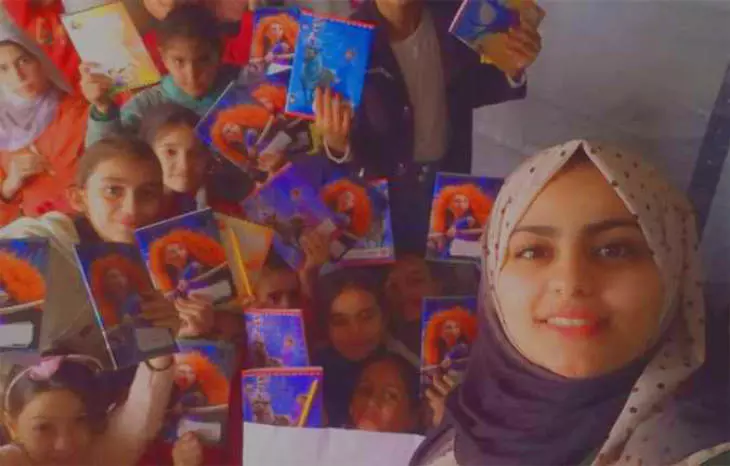
Heba Mahmoud was on the roof of her home, browsing the internet during a rare moment of quiet, awaiting the resumption of her postgraduate studies at the Islamic University. In the blink of an eye, shells rained down.
She fell, suddenly blind, as the world collapsed around her.
Fortunately, Heba began recovering after surgery at Al-Ahli Hospital, before it was bombed in April.
As she healed, she chose not to retreat into despair. Instead, she transformed her ordeal into a source of light for others. Against all odds, she launched an educational initiative to support children affected by the war’s devastation, including those who lost their sight.
Heba says, “Since I recovered, I have dedicated all my time to teaching students, standing beside them, listening to them and supporting them. It feels as if I have been reborn.”
Her initiative has become a beacon of hope, not only for students who wish to complete their studies, but for anyone striving to challenge Gaza’s grim reality and live with resilience.
A STRUGGLE UNSEEN
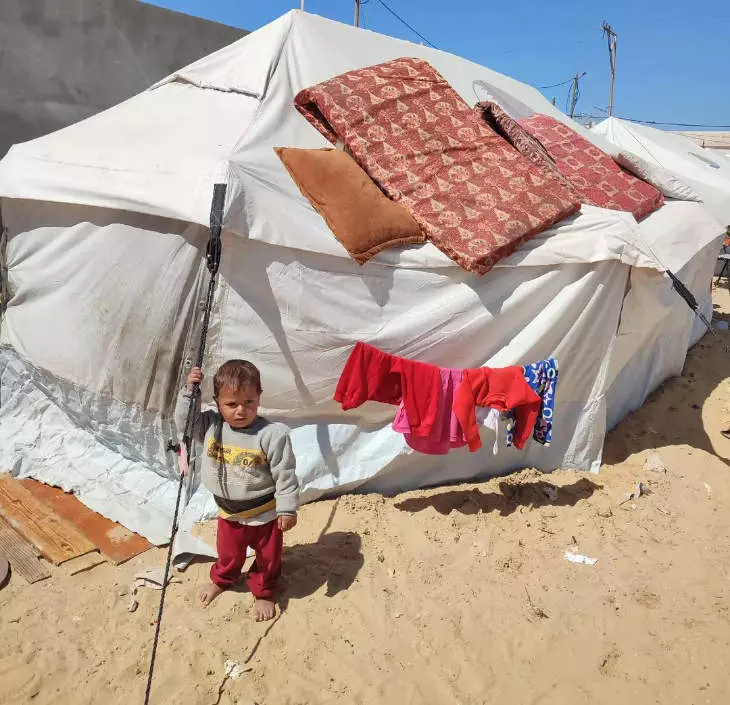
Israel’s occupation seeks not only to kill us but also to leave the survivors disabled—condemned to endure war without even being able to see it. Blindness is not a temporary injury that heals with time. It is a lifelong sentence to darkness, a theft of both present and future. It is a pain that deepens with every new wave of forced displacement. How can those who cannot see find their way through rubble and ruins? How can they locate their tent, prepare food, or perform the simplest acts of daily life?
Mohammed still dreams of becoming an engineer. Osama still waits for the chance to receive even an artificial eye. Heba is still teaching, turning her pain into strength.
The most urgent question remains: how many more atrocities must we endure before the world finally wakes from its slumber?
Sumaya Mohammed is a writer and teacher who lives in Gaza. Her work has been published by the Washington Report, The Electronic Intifada and Al Jazeera. She is training with We Are Not Numbers (WANN), a project to amplify the voices of young Palestinian writers. Her mentor was Carlo Kureishi.