















Washington Report on Middle East Affairs, March/April 2026, pp. 34-35
Special Report
By Nima Shokri
IRAN’S CURRENT WAVE of protests is often interpreted as having been sparked by inflation, currency collapse, corruption and repression. These explanations are not wrong, but they are incomplete.
Beneath the country’s political and economic crisis lies a more destabilizing force that is still largely missing from international analysis: environmental breakdown.
Iran is experiencing not one environmental crisis but the convergence of several: water shortages, land subsidence, air pollution and energy failure. All added together, life is a struggle for survival.
So when citizens protest today, they are not only resisting authoritarian governance. They are responding to a state that can no longer reliably provide the most basic forms of security: water to drink, air to breathe, land to stand on and electricity to carry on their daily lives.
From 2003 to 2019, Iran lost an estimated 211 cubic kilometers of groundwater, or twice its annual water consumption, leaving the country facing water bankruptcy. Excessive pumping—driven by agricultural expansion, energy subsidies and weak regulation—has caused land subsidence rates of up to 30cm per year, affecting areas where around 14 million people, more than one-fifth of the population, live.
Provinces such as Kerman, Alborz, Khorasan Razavi, Isfahan and the capital Tehran now have more than a quarter of their population living with the risk of subsidence. In all, large sections of the country—particularly around the capital Tehran, the agricultural center Rafsanjan and the city of Mashhad—are subsiding at alarming rates of close to 10cm per year.
Subsidence has cracked homes, damaged railways, destabilized highways, and threatened airports as well as UNESCO-listed heritage sites.
Iran’s lack of water has become politically explosive. When reservoirs fall to extremely low levels, when taps run dry at night in major cities, or when farmers watch rivers and lakes disappear, grievances turn into protest.
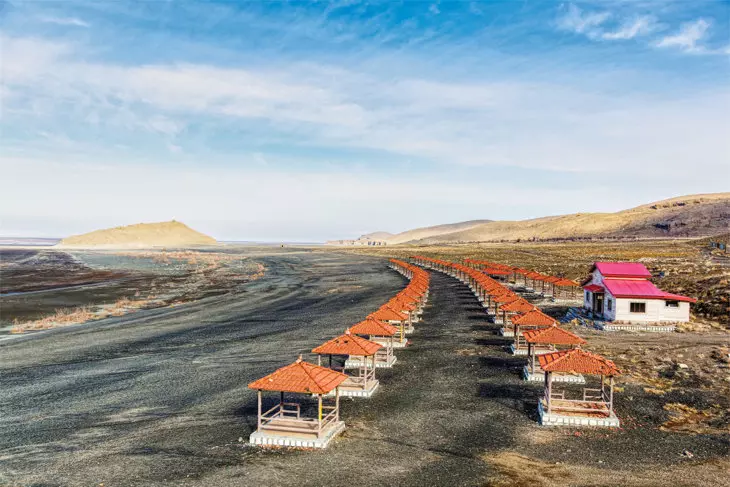
As wetlands, lakes and riverbeds dry up, their exposed surfaces generate dust and salt storms that can blanket cities hundreds of kilometers away.
At the same time, chronic electricity shortages—caused by underinvestment, inefficiency and poor infrastructure—have forced power plants and industries to burn heavy fuels. The result is extreme concentrations of sulfur dioxide, nitrogen oxides and fine particulate matter.
IGNORING ENVIRONMENTAL PROBLEMS
The World Health Organization notes that Iran is facing severe problems in terms of its air quality. Around 11 percent of deaths and 52 percent of the burden of diseases across the country are attributable to environmental risk factors.
In recent months, major cities have repeatedly closed schools and offices due to hazardous air quality, while hospitals report surges in respiratory and cardiovascular emergencies.
These environmental failures do not exist in isolation. They are the predictable outcome of decades of distorted national priorities.
Since the 1980s, Iran has channeled vast financial, institutional and political resources into ideological expansion and regional disputes—supporting groups in Lebanon, Syria, Iraq and Yemen—while systematically underinvesting in domestic environmental governance, infrastructure renewal and job creation.
Meanwhile, Iran’s political economy has been structured around energy subsidies and megaprojects that reward short-term extraction over long-term sustainability. Cheap fuel has encouraged water-intensive agriculture and inefficient industry.
Environmental agencies have remained fragmented and politically weak, unable to restrain more powerful ministries or governmentally linked economic actors. International isolation has compounded these failures.
Sanctions deepened the environmental crisis by restricting access to modern monitoring technologies, clean-energy systems, efficient irrigation and external finance.
While much of the world invested in technology and regulation to curb pollution and stabilize water systems, Iran doubled down on emergency fixes that deepened ecological damage rather than containing it. Sanctions and climate stress amplified the problems, but the root cause lay in state priorities that have consistently ignored environmental security.
The political consequences are now unmistakable. Environmental stress reshapes not only why people protest, but where and how. Maps of unrest in 92 Iranian cities reveal a clear pattern. Protests increasingly erupt in areas where there is groundwater collapse, land subsidence and water rationing.
WATER SHORTAGES AND PROTEST
In provinces such as Tehran, Khuzestan in the southwest and Isfahan in central Iran—all areas with high levels of protest—there are acute water shortages, subsidence causing damage to roads and pipelines, and disputes over access to water.
In other cities such as Kermanshah and Ilam, intensifying unrest reflects the interaction of major environmental problems of drought, rainfall decline and groundwater depletion with severe economic problems and poverty.
But Iran is not unique in this regard. Similar conflicts over water and economic issues have played a destabilizing role in neighboring Syria. Prolonged drought, conflicts over water and access to it, and limited rainfall have affected crop yields and animals there. Hundreds of thousands of people living in agricultural communities have been driven to cities and camps nearby in a desperate attempt to survive.
Water mismanagement and access to decent drinking water have also fueled unrest in Basra in the south of Iraq.
Iran is not facing a cyclical protest problem that can be stabilized through repression, subsidies or tactical concessions. It is confronting a structural collapse of the systems that make governance possible and are at the heart of human survival.
When there’s no water and the air becomes unbreathable, the social contract fractures. Citizens no longer debate ideology or reform timelines, they question the state’s right to rule at all.
What Iran sees today is not simply environmental stress but irreversible simultaneous failures across water, land, air and energy. These are not shocks that fade with rainfall or budget injections. They permanently shrink the state’s capacity to deliver security and economic opportunity.
Coercion can disperse crowds, but it cannot reverse subsidence, restore collapsed aquifers or neutralize airborne toxins. A state cannot govern indefinitely where the ecological foundations of life, agriculture and public health are failing all at once.
Nima Shokri is a professor of Applied Engineering at the United Nations University, the academic arm of the U.N., headquartered in Shibuya, Tokyo, Japan. This article is republished from The Conversation under a Creative Commons license.















